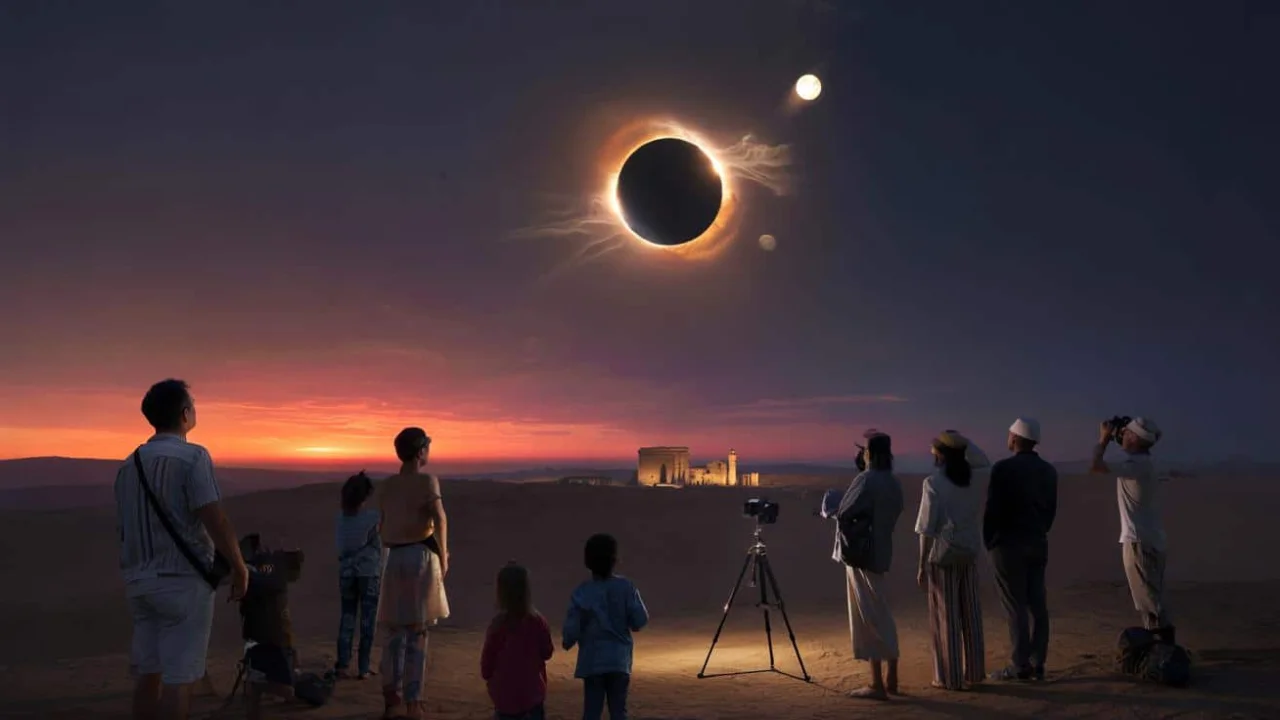
Maria’s grandmother had told her stories about the day the sun disappeared. Not metaphorically—literally. August 11, 1999, somewhere in rural Romania, when her entire village stopped what they were doing and watched the sky eat itself. “The chickens came home to roost at noon,” her grandmother would say, eyes distant with memory. “The flowers closed up tight, like they do at night. And for two minutes, we all became children again, scared and amazed at the same time.”
Maria never believed those stories could happen to her generation. Until now.
In just over a year, she’ll witness something her grandmother never did: a total solar eclipse that lasts six full minutes. Six minutes of midday darkness that will make August 11, 1999, look like a brief flicker.

The longest show Earth will see in our lifetime
On August 2, 2027, the Moon will perform the ultimate magic trick. It will slide between Earth and the Sun with such perfect timing and positioning that parts of our planet will experience the longest total solar eclipse in decades.
“We’re talking about a once-in-a-generation event,” says Dr. Sarah Chen, eclipse researcher at the International Astronomical Union. “Most total solar eclipses last 2 to 3 minutes. This one? In some places, you’ll have over 6 minutes to experience something that changes you forever.”

The path of totality—that narrow band where the eclipse reaches its full glory—will stretch across North Africa, southern Europe, and parts of the Middle East. But unlike typical eclipses that race across the Earth’s surface, this one will linger. The Moon’s shadow will move more slowly, giving lucky observers an extended front-row seat to one of nature’s most spectacular displays.
Ancient Egyptians called eclipses the “eating of the Sun.” On August 2, 2027, that cosmic meal will last long enough to brew a pot of coffee.

Your eclipse travel guide: where to witness six minutes of cosmic theater
Not all eclipse viewing spots are created equal. The difference between a 30-second glimpse and a 6-minute spectacle often comes down to being in exactly the right place at exactly the right time.
| Location | Duration of Totality | Local Time | Best Features |
|---|---|---|---|
| Luxor, Egypt | 6 minutes 23 seconds | 2:48 PM | Clear desert skies, ancient monuments |
| Mecca, Saudi Arabia | 6 minutes 18 seconds | 3:52 PM | Spiritual significance, excellent visibility |
| Gibraltar, Spain | 4 minutes 2 seconds | 1:34 PM | Easy European access, coastal viewing |
| Alexandria, Egypt | 5 minutes 11 seconds | 2:45 PM | Mediterranean coastline, historic setting |
| Sana’a, Yemen | 5 minutes 54 seconds | 4:01 PM | Mountain elevation, thin atmosphere |
The sweet spot sits right in the heart of Egypt’s desert region. Here, the Moon’s shadow will move most slowly across Earth’s surface, creating those magical six-plus minutes of totality.

“Egypt is going to be eclipse central,” explains Professor Mark Rodriguez, who has chased eclipses for over 30 years. “The weather patterns in August are remarkably stable, cloud cover is minimal, and you’re literally standing where ancient astronomers tracked these same celestial events thousands of years ago.”
Key viewing considerations include:
- Weather patterns and cloud probability in each region
- Accessibility and travel infrastructure
- Local timezone and eclipse timing
- Elevation and atmospheric clarity
- Cultural and historical significance of the location
European observers have it easier logistically. Southern Spain offers a respectable 4 minutes of totality with excellent transportation links and tourist infrastructure already in place. The trade-off? You’ll experience about 2 minutes less of total eclipse compared to Egypt.
What six minutes of darkness actually means
Six minutes sounds short until you’re standing in it. During those extended moments of totality, you’ll witness phenomena that most humans never see.
The Sun’s corona—its outer atmosphere—becomes visible as a shimmering, ethereal crown around the Moon’s silhouette. Stars appear in the darkened sky, even though your watch says it’s mid-afternoon. The temperature can drop 10-15 degrees Fahrenheit in minutes.
“Animals go completely haywire,” notes Dr. Chen. “Birds return to roost, crickets start chirping, and domestic animals often show signs of confusion or anxiety. It’s like nature itself is holding its breath.”
The extended duration of this particular eclipse means you’ll have time to:
- Observe the corona’s intricate structure and solar flares
- Watch shadow bands ripple across the landscape
- Experience the full temperature drop cycle
- See planets and bright stars appear in the eclipse-darkened sky
- Capture photographs without rushing
- Simply absorb the experience without feeling pressured by time
“Most eclipse chasers spend the entire event frantically trying to photograph everything,” says Rodriguez. “With six minutes, you can actually put the camera down for a few moments and just be present for something extraordinary.”
The economic impact is already building. Egypt’s tourism ministry estimates that eclipse tourism could bring over 100,000 international visitors in August 2027. Hotels along the path of totality are already accepting reservations, some at premium prices.
But the real impact goes beyond economics. For six minutes, millions of people will share an experience that connects them to every human who has ever looked up at the sky in wonder. They’ll understand why ancient civilizations built monuments to track these events, why sailors used eclipses to navigate, and why even today’s sophisticated astronomers still get goosebumps when day turns to night in the middle of the afternoon.
“There’s something primal about standing in the Moon’s shadow,” reflects Dr. Chen. “It reminds you that you’re on a planet, spinning through space, part of something much larger than your daily routine. That feeling stays with you long after the Sun comes back.”
FAQs
When exactly will the eclipse happen?
The total solar eclipse will occur on August 2, 2027, with totality beginning in the Atlantic and moving across North Africa, southern Europe, and the Middle East throughout the afternoon.
Is it safe to look directly at the eclipse?
You can only look directly at the eclipse during the brief moments of totality when the Sun is completely covered. At all other times, you must use proper eclipse glasses or solar filters.
How often do eclipses this long occur?
Total solar eclipses lasting over 6 minutes are extremely rare. The last one of similar duration was in 1973, and the next won’t occur until 2114.
Will I be able to see it from North America?
This eclipse will not be visible as a total solar eclipse from North America. However, parts of the eastern United States may see a partial eclipse.
Do I need special equipment to view the eclipse?
While you can observe totality with the naked eye, eclipse glasses are essential for all partial phases. A simple pair of binoculars or a small telescope can enhance the corona viewing experience during totality.
How much will it cost to travel to see the eclipse?
Costs vary widely depending on your departure location and chosen viewing spot. Budget travelers might spend $2,000-4,000 for a basic trip, while luxury eclipse tours can cost $10,000 or more per person.
About the Author