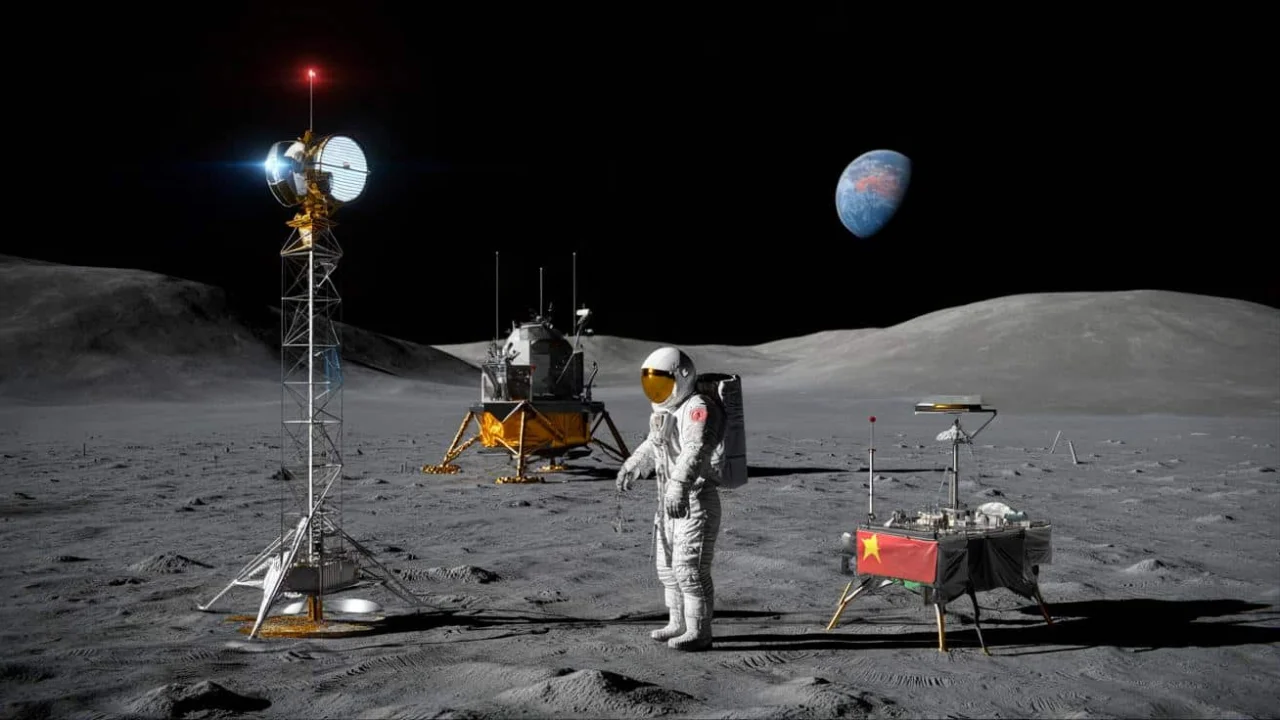
Imagine you’re an astronaut on a future lunar base, checking your wristwatch before a critical supply mission arrives from Earth. The digital display shows 14:30:00 exactly. But down on Earth, mission control is looking at their synchronized clocks showing 14:29:59. That single second difference could mean the difference between a successful docking and a catastrophic collision.

This isn’t science fiction anymore. As humanity prepares to establish permanent settlements on the moon, we’re discovering that time itself becomes a problem. Einstein’s century-old predictions about how gravity affects time are now forcing engineers to completely rethink how we’ll keep track of seconds and minutes beyond Earth.
China just announced they’ve built the world’s first lunar clock system to solve this mind-bending challenge. Their new timekeeping technology promises to keep perfect time on the moon for over a thousand years, accounting for the strange ways that time flows differently in space.

Why Your Moon Watch Would Drive You Crazy
Here’s where things get weird. If you took your perfectly accurate Earth watch to the moon, it would immediately start falling behind lunar time. Every single day that passes, your watch would lose about 56 microseconds compared to what time “should be” on the moon.
That sounds impossibly small, right? But those microseconds add up fast. After just one month on the moon, your Earth watch would be off by nearly two milliseconds. After a year? Your timepiece would be running almost 20 milliseconds slow.

“For most people, 20 milliseconds might not seem like much,” explains Dr. Sarah Chen, a relativistic physics researcher. “But for spacecraft navigation systems, that’s the difference between landing safely and crashing into a crater wall.”
This time dilation happens because of Einstein’s theory of general relativity. Gravity literally slows down time. Earth’s stronger gravity makes time pass slightly slower here compared to the moon’s weaker gravitational field. Your biological clock wouldn’t notice, but precision instruments absolutely would.

The Technical Nightmare Keeping Space Engineers Awake
China’s new lunar clock system, called LTE440, tackles several massive technical challenges that most people never think about:
- GPS satellites would be useless – Earth’s GPS constellation can’t reach the moon’s far side
- Communication delays – Radio signals between Earth and moon take 1.3 seconds each way
- Navigation precision – Rovers and landers need split-second timing to avoid obstacles
- International coordination – Multiple countries need shared time standards for joint missions

The Chinese research team, led by scientists at Purple Mountain Observatory, designed their lunar clock to handle all these problems simultaneously. Their system doesn’t just tell time – it creates a completely independent time reference for lunar operations.
| Time System | Daily Drift vs Earth | Annual Error | Navigation Impact |
|---|---|---|---|
| Earth GPS Time | 0 microseconds | 0 milliseconds | Baseline |
| Uncompensated Moon Time | +56 microseconds | +20 milliseconds | Dangerous |
| China’s LTE440 | ±0.1 microseconds | ±0.04 milliseconds | Safe for 1000 years |
“We’ve essentially built a master clock for the entire moon,” says Dr. Wei Zhang, project coordinator. “Every future lunar mission can sync to this standard, whether they’re Chinese, American, European, or from any other nation.”
What This Means for Moon Colonies and Mars Dreams
The implications go way beyond just keeping accurate time. China’s lunar clock breakthrough could reshape how humanity expands into the solar system.
First, it solves the coordination nightmare. When NASA’s Artemis missions start working alongside China’s lunar research station and other international projects, they’ll all need to operate on the same timeline. No more radio delays asking “What time is it there?” when split-second decisions matter.
Second, it enables true lunar autonomy. Future moon bases won’t have to constantly check with Earth for time updates. They can operate independently, making the moon feel less like a remote outpost and more like humanity’s second home.
“This technology is like building the first railroad across a continent,” explains Dr. Maria Rodriguez, a space systems engineer. “It’s infrastructure that makes everything else possible.”
The system also creates a template for Mars missions. The Red Planet experiences even more complex time dilation effects, plus it’s much farther from Earth. The techniques China developed for their lunar clock could adapt to Martian timekeeping challenges.
But there’s a competitive angle too. By establishing the first comprehensive lunar time standard, China positions itself as a leader in space infrastructure. Other countries will likely need to either adopt China’s system or develop competing standards – potentially fragmenting lunar operations.
The LTE440 system is already being tested with China’s Chang’e lunar missions. If successful, it could become operational by 2027, just as multiple nations ramp up their permanent lunar presence plans.
For ordinary people, this feels abstract. But imagine your grandchildren growing up in a world where checking the “moon time” is as normal as checking different time zones on Earth. China’s lunar clock isn’t just solving a technical problem – it’s laying the groundwork for humanity’s multi-planetary future.
FAQs
Why does time pass differently on the moon?
Einstein’s relativity shows that gravity affects time flow, and since the moon has weaker gravity than Earth, time passes slightly faster there.
How much faster does time move on the moon?
Moon time gains about 56 microseconds per Earth day – tiny but enough to cause serious navigation problems over time.
Will other countries use China’s lunar clock system?
It’s unclear yet, but international lunar missions will need some shared time standard, and China’s system may become the default.
Does this affect astronauts’ biological clocks?
No, the time differences are far too small for humans to notice naturally – only precision instruments detect the change.
Could this technology work for Mars missions?
Yes, the same principles could adapt to Mars, though the Red Planet would need its own customized time system.
When will the lunar clock system be operational?
China aims to have LTE440 fully operational by 2027, coinciding with expanded lunar mission schedules.
About the Author