Picture this: you’re having your morning coffee, scrolling through the news, when you stumble across a story about something called “Jetty McJetface.” Your first thought? Someone’s clearly having way too much fun naming cosmic phenomena. But here’s the thing that’ll make you nearly spit out that coffee—this playfully named object is actually one of the most powerful forces in the known universe.

We live in a world where scientists can detect explosions happening billions of miles away, yet somehow the most mind-bending discoveries often get the silliest names. It’s like finding out that the key to understanding the universe’s most violent processes comes with a name that sounds like it belongs in a children’s cartoon.
But don’t let the humorous moniker fool you. What’s happening out there in the depths of space is absolutely extraordinary, and it’s changing how we understand the raw power that black holes can unleash when they get really, really hungry.

When a Star Meets Its Cosmic Doom
The story of Jetty McJetface began in 2018, not with fanfare, but with a subtle flicker of light detected by telescopes monitoring distant galaxies. What astronomers initially thought might be just another routine cosmic event turned into something that would rewrite the textbooks on black hole behavior.
At the center of this drama sits a supermassive black hole, officially catalogued as AT2018hyz, located in a galaxy far beyond our own. Like a cosmic Venus flytrap, this black hole waited patiently until an unlucky star wandered too close to its gravitational embrace. What happened next was both beautiful and terrifying.

The star didn’t simply vanish into the black hole. Instead, it was stretched and torn apart in a process scientists call “spaghettification”—imagine pulling a piece of mozzarella cheese until it forms long, thin strands, except this cheese was once a burning ball of gas larger than our sun.
“When we first detected this event, we expected it to follow the typical pattern—flare up, then fade away over a few months,” explains Dr. Sarah Chen, a radio astronomer who has been tracking the phenomenon. “Instead, this thing just kept getting brighter and more energetic. It was like watching a campfire suddenly turn into a blast furnace.”

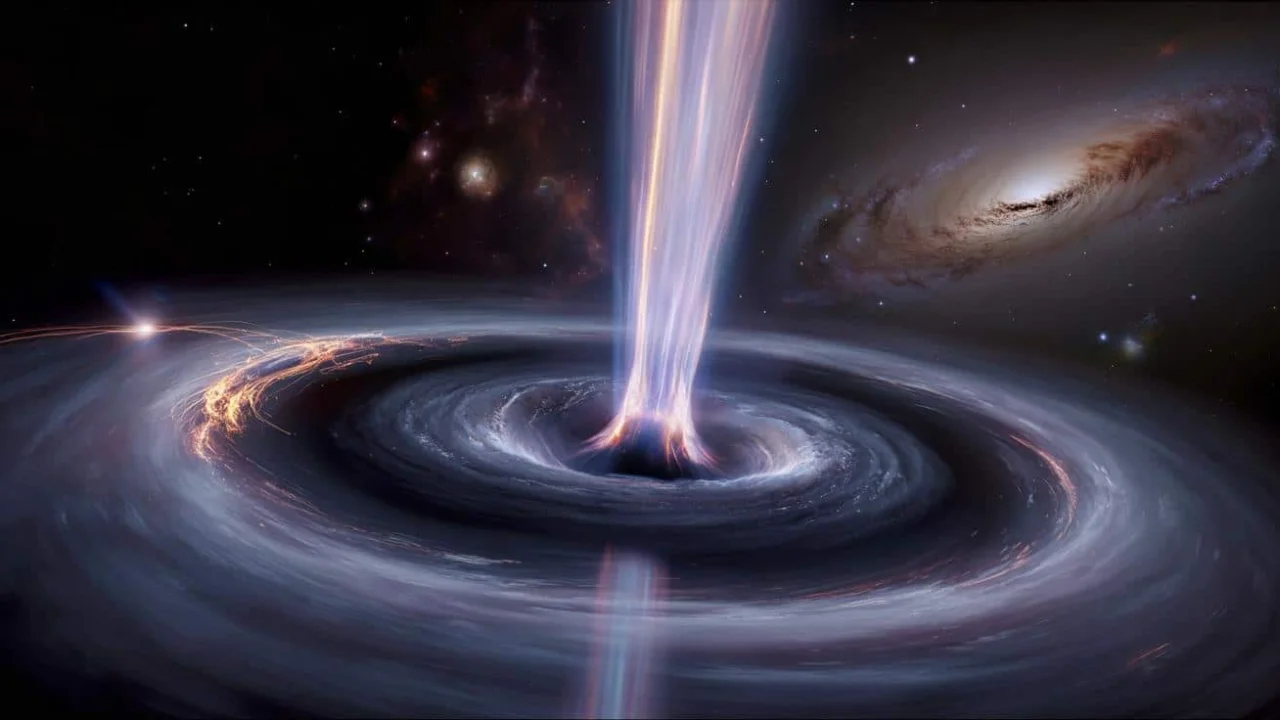
Part of the shredded star material spiraled inward toward the black hole, heating up to millions of degrees and glowing brilliantly. But here’s where things get really interesting: another portion of that stellar material got launched outward at speeds approaching that of light itself, creating what astronomers call a relativistic jet.
By 2022, researchers realized they were witnessing something unprecedented. The jet was so powerful and persistent that they couldn’t resist giving it a memorable nickname. Taking inspiration from the British public’s playful naming of “Boaty McBoatface,” the research team dubbed their discovery “Jetty McJetface.”

The Numbers That Will Blow Your Mind
Recent observations published in the Astrophysical Journal reveal just how extraordinary Jetty McJetface has become. Far from fading away as expected, this cosmic powerhouse has been growing stronger year after year. The radio signals it emits have increased by roughly 50 times since 2019.
To help you grasp the sheer scale of energy we’re talking about, here are the mind-boggling facts:
| Aspect | Measurement | Comparison |
|---|---|---|
| Energy Output | 1 trillion times more powerful | Than the Death Star from Star Wars |
| Jet Speed | Near light speed | 186,000 miles per second |
| Radio Brightness Increase | 50x brighter since 2019 | Still growing exponentially |
| Duration | 6+ years and counting | Most last only months |
| Predicted Peak | Around 2027 | Could become even more powerful |
“We’re essentially watching a black hole turn the remains of a single star into one of the most energetic phenomena in the universe,” notes Dr. Michael Rodriguez, lead author of the recent study. “It’s like seeing a small campfire somehow power an entire city’s electrical grid.”
The energy calculations are staggering. The research team estimates that this event has already released more energy than our sun will produce in its entire 10-billion-year lifetime. And it shows no signs of slowing down.
What makes Jetty McJetface particularly special isn’t just its raw power, but its longevity. Most tidal disruption events—when black holes tear apart stars—typically flare up and fade within a few months. This one has been going strong for over six years and is predicted to continue ramping up until at least 2027.
What This Cosmic Monster Means for Science
Beyond the impressive statistics and playful names, Jetty McJetface is providing scientists with something incredibly valuable: a front-row seat to watch how black holes can transform matter into energy on cosmic scales.
“This is giving us an unprecedented opportunity to study relativistic jets in real time,” explains Dr. Lisa Park, an astrophysicist not involved in the research. “Most of these events happen so quickly that we miss the details. With Jetty McJetface, we can actually track how the jet evolves over years.”
The discovery is forcing astronomers to reconsider their models of how black holes behave when they feast on stellar material. Traditional theories suggested that such feeding frenzies should be relatively brief affairs. Jetty McJetface proves that some black holes can sustain incredibly powerful outbursts for much longer periods.
For the broader scientific community, this means:
- Better understanding of how black holes convert matter into energy
- New insights into the formation and evolution of relativistic jets
- Improved models for predicting similar cosmic events
- Enhanced knowledge about the role black holes play in shaping galaxies
The implications extend beyond pure science. Understanding these extreme cosmic processes helps us better comprehend the fundamental physics that govern our universe. It’s like having a natural laboratory where we can study conditions that are impossible to recreate on Earth.
“Every time we think we understand black holes, the universe shows us something new,” adds Dr. Rodriguez. “Jetty McJetface is reminding us that there’s still so much we don’t know about these cosmic monsters.”
As astronomers continue monitoring this extraordinary event, they’re preparing for what could be an even more spectacular show. If current predictions hold true, Jetty McJetface will reach its peak brightness around 2027, potentially becoming one of the most luminous objects detectable from Earth.
The fact that something so incredibly powerful can emerge from the destruction of a single star serves as a humbling reminder of the immense forces at play in our universe. While we go about our daily lives on Earth, cosmic dramas of unimaginable scale are unfolding in the depths of space—and thanks to modern astronomy, we get to witness them firsthand.
FAQs
What exactly is Jetty McJetface?
It’s a powerful jet of material launched by a black hole after it tore apart a star in 2018. The jet travels at nearly the speed of light and has become one of the most energetic objects in the known universe.
Why did scientists give it such a silly name?
The researchers playfully nicknamed it “Jetty McJetface” as a reference to the British public’s famous naming of “Boaty McBoatface.” Despite the humorous name, the science behind it is completely serious.
How powerful is this cosmic jet?
The energy output is estimated to be at least a trillion times more powerful than the fictional Death Star from Star Wars. It has released more energy than our sun will produce in its entire 10-billion-year lifetime.
Is Jetty McJetface dangerous to Earth?
No, it poses no threat to our planet. The event is occurring in a distant galaxy, billions of miles away from Earth. We can safely observe it without any risk.
How long will this cosmic show continue?
Current models predict that Jetty McJetface will continue growing brighter and could reach its peak around 2027. It has already been active for over six years, which is unusually long for this type of event.
What can we learn from studying this phenomenon?
Jetty McJetface provides scientists with a rare opportunity to study how black holes convert matter into energy and how relativistic jets evolve over time. This helps improve our understanding of fundamental cosmic processes.
About the Author