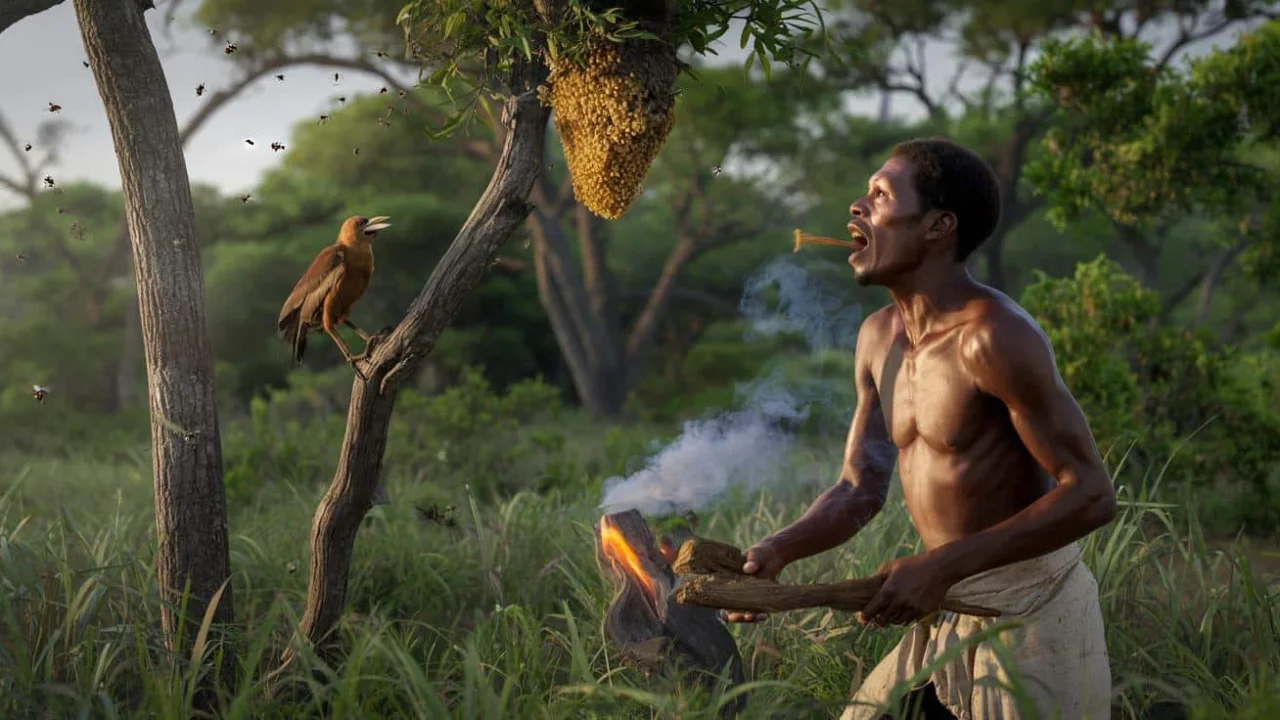
Imagine walking through dense African woodland at sunrise, making sounds that seem almost magical to outsiders. You’re not calling your hunting partner or scaring away dangerous animals. Instead, you’re having a conversation with a small brown bird that will lead you to liquid gold hidden high in the trees.

This isn’t folklore or fantasy. It’s the daily reality for honey hunters in Mozambique, who have developed one of nature’s most remarkable partnerships with wild birds called greater honeyguides.
What makes this story even more fascinating is that researchers have discovered something extraordinary about this human-bird communication. Just like people from different regions speak with distinct accents, the “language” between honey hunters Mozambique communities and their feathered guides changes from village to village.

The Ancient Partnership That Defies Belief
In northern Mozambique’s Niassa Special Reserve, the Yao people have perfected a hunting technique that sounds too incredible to be real. They don’t spend hours searching blindly for bee hives. Instead, they step into the miombo woodland and call out to greater honeyguides using specific trills, grunts, and whistles.
These aren’t trained birds or pets. They’re completely wild creatures that have learned to work with humans in a partnership that benefits both species perfectly.

“Humans call to the birds; the birds answer and lead them, tree by tree, to hidden honeybee nests,” explains one researcher who studied this phenomenon.
Here’s how this remarkable dance unfolds: A honey hunter spots a honeyguide and makes his distinctive call. If the bird is interested in cooperating, it responds with its own chatter and flies ahead to the next tree. It waits there, calling back until the human catches up, then repeats the process until they reach a bee’s nest.

The partnership works because each species brings unique skills. Humans can use fire and smoke to calm aggressive bees, crack open tree trunks, and safely extract honey and comb. The birds get their reward afterward, swooping in to feast on wax and bee larvae without facing thousands of angry stinging insects.
Scientists Discover Something Nobody Expected
Behavioral ecologist Jessica van der Wal from the University of Cape Town led a team of researchers who wanted to understand if this human-bird language stayed the same across different communities. What they found challenged everything scientists thought they knew about animal communication.

The research team worked with 131 experienced honey hunters across 13 Yao villages within the same reserve. They carefully recorded the calls used to summon honeyguides and compared them across different distances and habitats.
The results were stunning. While all the villages used the same basic “language” with the birds, each community had developed its own distinct dialect.
| Research Finding | Details |
|---|---|
| Number of hunters studied | 131 experienced honey hunters |
| Villages examined | 13 Yao communities |
| Basic language pattern | Consistent across all villages |
| Local variations | Distinct dialects matching human communities |
| Bird response | Greater honeyguides recognize local variations |
“The study found one shared language used with honeyguides, split into distinct local dialects that map onto human communities,” the researchers reported.
Think about what this means. Not only do wild birds understand human calls, but they’ve also learned to recognize subtle regional differences in those calls. It’s as if the birds have learned to understand different human accents.
Why This Discovery Changes Everything We Know
This finding has implications that reach far beyond honey hunting in Mozambique. It challenges our understanding of how animals and humans can develop complex communication systems together.
For the Yao people, honey isn’t just food. It’s currency, medicine, and a crucial element in traditional ceremonies. Without their partnership with honeyguides, finding enough wild honey would be nearly impossible in the vast woodland.
The dialect discovery suggests that both humans and birds are actively shaping this communication system over time. As different villages develop slightly different calling techniques, the local bird populations adapt and learn to respond to those specific variations.
- Each village’s honey hunters develop unique calling patterns over generations
- Local honeyguide populations learn and respond to their area’s specific dialect
- The partnership becomes more efficient as both species fine-tune their communication
- Cultural knowledge passes down through human families and bird communities alike
“This represents one of the most sophisticated examples of interspecies communication we’ve ever documented,” notes one wildlife communication expert.
The research also reveals how quickly both species can adapt. Villages that are relatively close to each other geographically have developed noticeably different calling patterns, suggesting that these dialects can emerge and spread within just a few generations.
For conservation efforts, this discovery highlights how deeply connected traditional human communities are with their local wildlife. Protecting honey hunters Mozambique traditions isn’t just about preserving culture – it’s about maintaining a sophisticated ecological partnership that has evolved over centuries.
The birds benefit enormously from this relationship. Honeyguides that work with humans are significantly more successful at accessing bee colonies than those that try to raid nests alone. The human partnership gives them a competitive advantage that has shaped their behavior across generations.
What’s particularly remarkable is how this challenges our assumptions about wild animal intelligence. These birds aren’t just following simple behavioral patterns – they’re actively learning, adapting, and even developing regional “accents” in their responses to human partners.
As researchers continue studying this phenomenon, they’re discovering that the honey hunters Mozambique partnership with greater honeyguides represents something much more sophisticated than anyone initially realized. It’s a true interspecies language that continues evolving, complete with local dialects that would make any linguist proud.
FAQs
How long have honey hunters in Mozambique been working with birds?
This partnership has likely existed for hundreds or even thousands of years, passed down through generations of Yao communities.
Can the birds understand human calls from other villages?
Research suggests that honeyguides respond best to their local dialect, though they can still work with hunters from neighboring areas.
Do the birds teach their young to work with humans?
Young honeyguides appear to learn both hunting techniques and human communication patterns from observing adult birds in their area.
Is this partnership threatened by modern changes?
Yes, habitat loss and changing lifestyles could disrupt this ancient relationship between honey hunters and their bird partners.
How successful are these hunting partnerships?
Honey hunters working with honeyguides are dramatically more successful than those searching for hives alone, with significantly higher success rates.
Could this communication system work in other regions?
Similar human-honeyguide partnerships exist in other parts of Africa, suggesting this remarkable relationship could develop wherever both species coexist.
About the Author