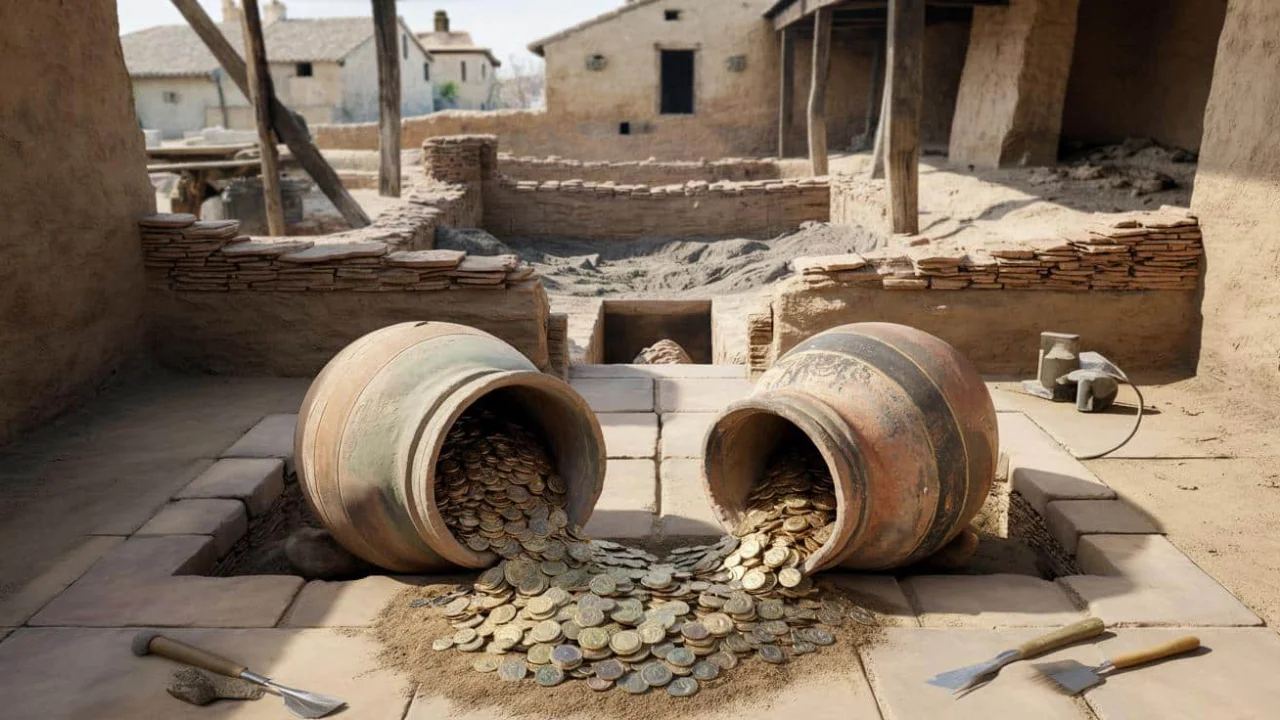
Picture this: you’re renovating your house and decide to pull up the old wooden floors in your living room. Instead of finding creaky floorboards and maybe a few lost coins, you discover three massive ceramic jars stuffed with tens of thousands of ancient Roman coins. That’s essentially what happened to archaeologists in a small French village, except their “renovation” has revealed one of the most remarkable treasure finds in recent memory.

This isn’t just about finding old money. It’s a window into how ordinary Romans lived, saved, and prepared for uncertain times nearly two thousand years ago.
The discovery has archaeologists buzzing because these Roman money jars weren’t just randomly buried treasure – they were sophisticated home banking systems built right into someone’s living room floor.

When Your Living Room Floor Hides a Fortune
In Senon, a quiet village in northeastern France, archaeologists from France’s National Institute for Preventive Archaeological Research (INRAP) uncovered something extraordinary. Three massive ceramic vessels, called amphorae, were deliberately sunk into pits cut into the floor of a late Roman house.
These weren’t hidden in some secret cave or buried in a backyard. The Roman money jars were installed like built-in safes, with their necks flush with the living room floor. Imagine walking across your floor, knowing that beneath your feet lay the equivalent of hundreds of thousands of dollars in today’s money.

“Each amphora functioned like a fixed, in-house safe: buried for security, yet accessible enough to top up with coins over time,” explains one researcher familiar with the find.
The numbers are staggering. The first jar alone weighed 38 kilograms (83 pounds) and contained an estimated 23,000 to 24,000 individual coins. The second jar was even heavier at 50 kilograms (110 pounds), holding roughly 18,000 to 19,000 coins.

The third jar tells a different story. Archaeologists found it empty except for three stray coins, suggesting someone managed to retrieve their savings before disaster struck the settlement.
The Incredible Details Behind This Ancient Banking System
What makes this discovery so special isn’t just the money – it’s the complete picture of how Romans managed their wealth at home. The site reveals a sophisticated residential district with stone houses, underfloor heating, basements, and workshops.

Here are the key facts about this remarkable find:
- Location: Senon village in northeastern France, once part of Roman Gaul
- Age: Approximately 1,800 years old
- Total coins discovered: Over 41,000 individual pieces
- Weight: Nearly 90 kilograms (200 pounds) of coins combined
- Installation method: Jars sunk into floor with necks at surface level
- Context: Found in a residential area with luxury amenities
| Jar Number | Weight | Estimated Coins | Status |
|---|---|---|---|
| Jar 1 | 38 kg (83 lbs) | 23,000-24,000 | Full |
| Jar 2 | 50 kg (110 lbs) | 18,000-19,000 | Full |
| Jar 3 | Empty | 3 remaining coins | Retrieved in antiquity |
“The real breakthrough here is context: three large hoards, still in their original locations, embedded in a domestic interior,” notes another expert involved in the research.
The Roman money jars weren’t randomly placed. They were strategically positioned in what appears to have been a main living area, suggesting the homeowners wanted easy access to their wealth while keeping it secure from thieves.
This wasn’t unusual behavior for the region. Around 30 similar coin hoards have been documented from the wider area, pointing to intense money use and frequent stockpiling during the later Roman period.
What This Discovery Means for Our Understanding of Ancient Life
This find changes how we think about Roman domestic life and personal finance. These weren’t emergency stashes hidden in panic – they were permanent household fixtures designed for long-term savings and regular use.
The Roman money jars reveal that wealthy Romans had developed sophisticated home banking systems centuries before modern safes. The amphorae were large enough to hold massive amounts of wealth yet accessible enough for regular deposits and withdrawals.
The discovery also highlights the economic prosperity of Roman Gaul. This was a frontier region packed with military garrisons, trade routes, and prosperous rural estates. The sheer volume of coins suggests a thriving cash economy where people regularly handled large sums of money.
“This gives us unprecedented insight into how Romans actually lived with their money on a daily basis,” explains a numismatic specialist. “We’re not just looking at coins anymore – we’re seeing a complete financial system integrated into home design.”
The fact that one jar was emptied in antiquity tells its own story. Someone had time to retrieve their savings before the final disaster struck, suggesting the end didn’t come suddenly. Historical records show the settlement suffered multiple devastating fires, and residents may have had warning to salvage what they could.
For modern archaeologists, findings like these Roman money jars provide rare opportunities to study ancient economics in context. Instead of analyzing random coin finds from fields or rivers, researchers can examine how money actually functioned within homes and communities.
The discovery also raises intriguing questions about Roman household management. Who controlled access to these built-in banks? How often were deposits made? Did different family members have access to different jars?
The technical aspects are equally fascinating. Installing heavy ceramic vessels flush with floor level required careful planning and skilled craftwork. The Romans had to ensure proper drainage, structural support, and easy access while maintaining the security that made these jars attractive alternatives to other storage methods.
This type of domestic archaeology helps bridge the gap between grand historical narratives and everyday human experience. While history books focus on emperors and battles, discoveries like the Senon Roman money jars reveal how ordinary people navigated their daily financial lives under Roman rule.
FAQs
How much would these Roman coins be worth today?
While the exact value depends on the specific coins and their condition, similar hoards have been valued at hundreds of thousands to millions of dollars by collectors and historians.
Why did Romans bury money jars in their floors instead of using banks?
Roman banking was limited and mainly available in large cities. For rural residents, home storage was often the safest option, and built-in floor jars provided security while allowing regular access.
What happened to the people who owned these Roman money jars?
The evidence suggests they fled during devastating fires that destroyed the settlement. One jar was emptied, indicating at least some residents had time to collect their savings before leaving.
Are discoveries like this common in Roman archaeological sites?
While coin hoards are found regularly, discovering them still in their original domestic context is extremely rare and provides invaluable insights into daily Roman life.
What will happen to the coins now that they’ve been discovered?
The coins will be carefully cleaned, cataloged, and studied by experts. They’ll likely end up in museums where they can be displayed for public education about Roman history and culture.
How did archaeologists know these jars were used for money storage?
The positioning, the massive weight of coins, and the deliberate installation method all pointed to intentional long-term storage rather than accidental loss or ritual burial.
About the Author