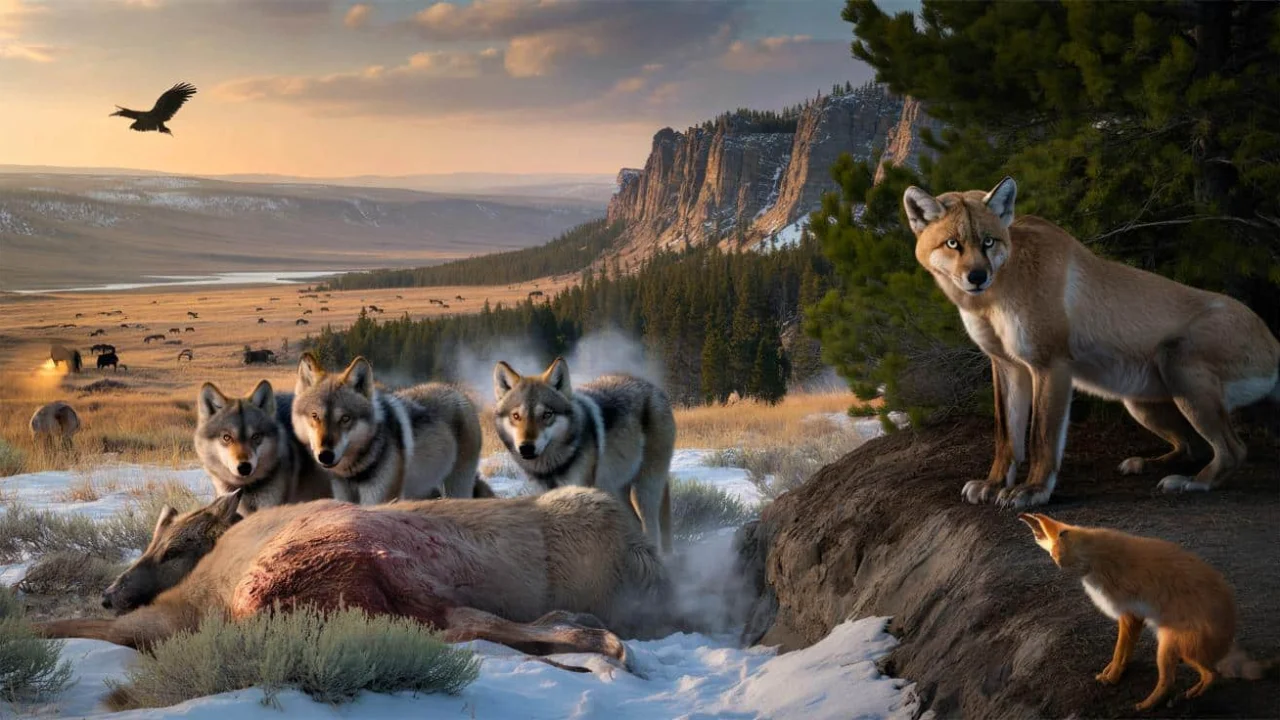
Sarah Martinez had been watching the same elk herd for three weeks when she noticed something remarkable. Through her binoculars, she could see fresh wolf tracks in the mud near the river, but just 200 yards away, cougar scat marked a different hunting trail. Both apex predators were using the same valley in Yellowstone, yet somehow avoiding deadly conflict.

As a wildlife researcher, Sarah knew this shouldn’t work. Two top predators competing for the same prey in the same territory usually means one gets pushed out or killed. But Yellowstone’s ecosystem was proving that nature has more tricks up its sleeve than anyone expected.
What Sarah was witnessing represents one of the most fascinating wildlife comebacks in North American history, where Yellowstone predators are rewriting the rules of survival in ways that scientists are only beginning to understand.

The Great Predator Experiment That Changed Everything
Yellowstone National Park has become something unprecedented: a real-world laboratory where wolves and cougars are learning to coexist after decades of absence. For most of the 20th century, both species were nearly extinct across the American West, victims of aggressive hunting campaigns and government extermination programs.
Cougars began their quiet return in the 1960s, slipping back into mountain territories under new protective laws. But the wolf reintroduction in 1995 created something entirely new. Park officials released 31 wolves from Canada into Yellowstone’s ecosystem, sparking both celebration among conservationists and fierce opposition from ranchers.

“We essentially created a natural experiment on a massive scale,” explains Dr. Lisa Thompson, a carnivore ecologist who has studied Yellowstone predators for over a decade. “Nobody knew what would happen when these two apex predators started sharing the same hunting grounds again.”
The results have been surprising. Today, both species thrive in overlapping territories across Yellowstone’s 2.2 million acres, fundamentally changing how scientists think about predator competition and ecosystem balance.

Inside the Numbers: How Wolves and Cougars Share Yellowstone
New research combining nine years of GPS collar data with investigations of nearly 4,000 kill sites reveals exactly how these Yellowstone predators have carved up their shared territory. The findings, published in the prestigious journal PNAS, show a system still finding its balance.
Here’s what scientists discovered about the daily lives of these competing carnivores:

- Wolves dominate through teamwork: Pack hunting gives wolves decisive advantages over solitary cougars
- Cougars adapt by changing diet: Mountain lions shifted to smaller prey and different hunting times
- Territory overlap is extensive: Both species use 60-70% of the same areas within the park
- Conflict is one-sided: Wolves kill cougars and steal their kills, but cougars never attack wolves
- Feeding behavior differs dramatically: Wolves feed quickly in groups while cougars cache kills for days
| Species | Pack Size | Primary Prey | Kill Frequency | Territory Size |
|---|---|---|---|---|
| Wolves | 4-8 individuals | Elk, deer, bison | Every 3-4 days | 200-400 sq miles |
| Cougars | Solitary | Deer, elk calves, small mammals | Every 7-10 days | 100-200 sq miles |
“The data shows this isn’t really a fair fight,” notes wildlife biologist Dr. Mark Rodriguez. “An individual wolf might weigh the same as a cougar, but six wolves working together completely change the power dynamic.”
The research reveals that wolves don’t just compete with cougars—they actively dominate them. Wolf packs routinely chase cougars away from fresh kills, forcing the big cats to abandon meals they spent hours hunting. In some cases, wolves have been observed killing cougars outright, though this remains relatively rare.
What This Means for Wildlife Conservation Everywhere
The Yellowstone predator experiment carries implications far beyond the park’s boundaries. As climate change and human development continue fragmenting wildlife habitats worldwide, understanding how multiple predator species can coexist becomes crucial for conservation efforts.
The research shows that cougars have developed remarkable adaptations to survive alongside wolves. They’ve shifted their hunting schedules to avoid peak wolf activity periods, changed their preferred prey species, and even altered their feeding behaviors to reduce the risk of confrontation.
“Cougars are incredibly adaptable,” explains Dr. Jennifer Walsh, who tracks predator movements using satellite collars. “They’re hunting more at dawn and dusk when wolves are less active, and they’ve gotten much better at quickly consuming kills before wolves can find them.”
This flexibility suggests that large predators might be more capable of coexistence than previously believed, offering hope for rewilding efforts in other ecosystems. European programs reintroducing wolves to areas where lynx already exist are watching Yellowstone’s results closely.
The broader ecological impacts extend throughout the ecosystem. Both predator species have altered elk behavior, creating what scientists call a “landscape of fear” that has allowed vegetation to recover in previously overgrazed areas. This demonstrates how apex predators can reshape entire ecosystems through their presence alone.
However, challenges remain. The uneasy balance between Yellowstone predators depends heavily on abundant prey populations and vast wilderness areas. Similar coexistence might not work in smaller, more fragmented habitats where competition for resources intensifies.
Park managers continue monitoring these populations carefully, knowing that the delicate equilibrium could shift if environmental conditions change. Climate change, disease outbreaks, or significant prey population declines could tip the balance and force one species to give ground to the other.
The Yellowstone predator story reminds us that nature rarely follows the simple rules we expect. Instead of one species dominating and driving out the other, both wolves and cougars have found ways to thrive in the same landscape, creating a more complex and resilient ecosystem than existed before their return.
FAQs
How many wolves and cougars currently live in Yellowstone?
Yellowstone hosts approximately 95-100 wolves in 8-10 packs and an estimated 42-48 adult cougars across the park’s territory.
Do wolves and cougars ever hunt together?
No, these species never cooperate in hunting and actively avoid each other whenever possible to prevent dangerous confrontations.
What happened to elk populations after predators returned?
Elk numbers dropped initially but have stabilized around 7,000-8,000 individuals, with herds now more mobile and alert due to predation pressure.
Can visitors safely view these predators in Yellowstone?
Yes, but always maintain at least 100 yards distance from wolves and cougars, and never approach predators near kill sites where they may be defensive.
Are wolves and cougars expanding beyond Yellowstone?
Wolves have established packs in surrounding states, while cougars have naturally recolonized much of their historic western range over recent decades.
How do researchers track these animals without disturbing them?
Scientists use GPS collars, remote cameras, and non-invasive genetic sampling from scat to monitor predator movements and behaviors with minimal human interference.
About the Author