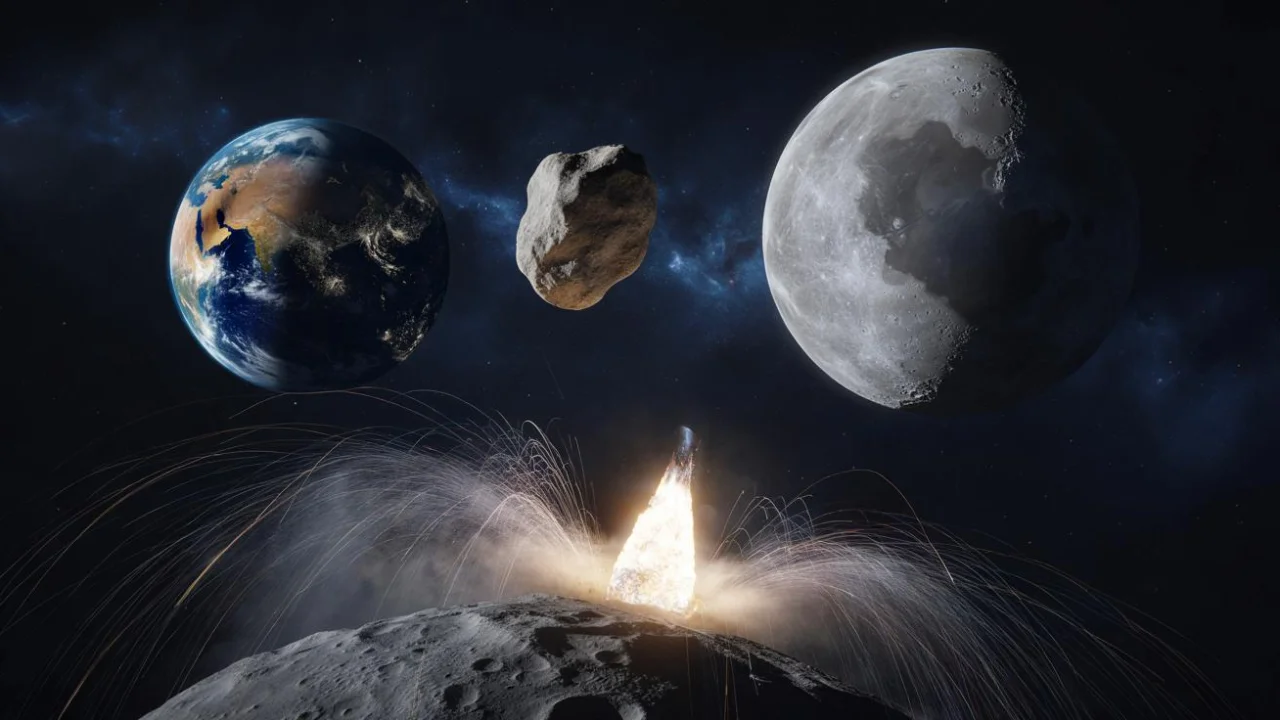
Picture this: you’re standing in your backyard on a clear December night in 2032, looking up at the full moon. Suddenly, a brilliant flash erupts across its surface—brighter than Venus, visible even in city light pollution. Within weeks, streaks of meteors begin painting trails across Earth’s atmosphere, remnants of an impact that happened 384,000 kilometers away.

This isn’t science fiction. It’s one of thousands of scenarios that scientists have mapped out for asteroid 2024 YR4, a city-sized space rock that’s currently hurtling through our solar system on what could be a collision course with the moon.
The discovery of this 60-meter-wide asteroid on December 27, 2024, sent ripples through the astronomical community. For a brief, nail-biting moment, it held the record for the highest probability of hitting Earth—a sobering 3.1% chance. Thankfully, follow-up observations quickly ruled out an Earth impact, but the moon remains squarely in the crosshairs.

A Space Rock the Size of a Skyscraper
Asteroid 2024 YR4 stands roughly as tall as a 15-story building, making it substantial enough to create a spectacular show if it does hit the lunar surface. NASA currently puts the odds at 4.3% for a December 2032 impact—numbers that might seem small but represent something extraordinary in the world of astronomy.
“We rarely get to study potential impacts before they happen,” explains Dr. Sarah Chen, a planetary scientist not involved in the research. “Usually we’re picking up the pieces afterward, trying to understand what occurred. This gives us a unique chance to predict and prepare.”

The asteroid’s trajectory brings it uncomfortably close to both Earth and the moon during its December 2032 approach. While our planet dodged the bullet, the moon’s smaller gravitational field and lack of atmosphere make it a sitting duck for incoming space debris.
What makes this situation particularly fascinating is the timing. Unlike most asteroid discoveries that give us decades or centuries of lead time, 2024 YR4 was spotted just eight years before its potential impact date.

Scientists Turn Space Into a Virtual Laboratory
Researchers at Tsinghua University in China and the University of California, Santa Cruz, saw this asteroid as more than just a potential threat—they saw it as the ultimate natural experiment. Using cutting-edge computer simulations, they essentially turned our entire solar system into a massive laboratory.
The team ran an staggering 10,000 different scenarios, each one tweaking the asteroid’s path slightly within the margins of observational uncertainty. Think of it like running the same movie 10,000 times, but changing small details each time to see how the story might unfold differently.

Here’s what their comprehensive analysis revealed:
- Impact corridor: A 3,000-kilometer-long zone stretching across the lunar near side
- Primary target area: Just north of the famous Tycho crater
- Flash brightness: Visible from Earth, potentially as bright as Venus
- Debris field: Material ejected at speeds up to 2.4 kilometers per second
- Earth effects: Possible meteor showers weeks after impact
| Impact Scenario | Probability | Expected Effects |
|---|---|---|
| Direct lunar hit | 4.3% | Bright flash, crater formation, debris clouds |
| Near miss (Moon) | 15.2% | Close approach, possible tidal effects |
| Safe passage | 80.5% | No impact, continued orbit |
“The beauty of this approach is that we can essentially fast-forward through thousands of possible futures,” notes Dr. Michael Rodriguez, an impact dynamics specialist. “Each simulation tells us something different about where the asteroid might hit and what the consequences could be.”
What This Means for Life on Earth
If asteroid 2024 YR4 does slam into the moon, the effects won’t stay confined to our celestial neighbor. The impact would create a spectacular light show visible to anyone on Earth’s night side, followed by more subtle but potentially beautiful consequences in the weeks that follow.
The collision would blast millions of tons of lunar material into space. While most debris would rain back down on the moon’s surface, some chunks could escape lunar gravity entirely. These liberated fragments might eventually cross Earth’s orbit, creating meteor showers as they burn up in our atmosphere.
For astronomers and space agencies, this represents an unprecedented opportunity. Modern telescopes and instruments could capture the impact in real-time, providing invaluable data about how asteroids behave when they hit solid surfaces.
“We’d basically get a front-row seat to cosmic demolition,” explains Dr. Lisa Park, a meteor specialist. “The scientific value would be immense—we could learn things about impact physics that we’ve only theorized about until now.”
The research also highlights how quickly our understanding of potentially hazardous objects can change. When 2024 YR4 was first discovered, it briefly became the poster child for Earth-threatening asteroids. Within days, refined observations completely eliminated the Earth impact risk, redirecting attention to our moon instead.
This rapid evolution in risk assessment demonstrates both the challenges and capabilities of modern asteroid monitoring. Space agencies worldwide track thousands of near-Earth objects, but newly discovered asteroids often come with significant uncertainties that only resolve with time and additional observations.
The December 2032 encounter, whether it results in impact or a close shave, will provide crucial data for improving our ability to predict and potentially deflect future asteroid threats. Every close encounter teaches us more about how these ancient remnants of our solar system’s formation behave when they venture too close to major gravitational bodies.
As we approach the December 2032 date, telescopes worldwide will keep their eyes trained on this space rock, refining trajectory calculations and preparing for what could be one of the most closely monitored cosmic collisions in human history.
FAQs
How big is asteroid 2024 YR4?
The asteroid measures approximately 60 meters across, roughly equivalent to the height of a 15-story building.
Will the asteroid hit Earth?
No, follow-up observations have completely ruled out an Earth impact. The asteroid will safely pass by our planet.
What are the chances it will hit the moon?
NASA currently estimates a 4.3% probability that asteroid 2024 YR4 will impact the lunar surface in December 2032.
Would we be able to see the impact from Earth?
Yes, if the collision occurs, it would create a flash bright enough to be visible from Earth, potentially as bright as the planet Venus.
Could debris from a lunar impact affect Earth?
Some ejected material might eventually create meteor showers as fragments enter Earth’s atmosphere, though this would occur weeks or months after the initial impact.
When was asteroid 2024 YR4 discovered?
The asteroid was first spotted on December 27, 2024, giving scientists about eight years to study its trajectory before the potential 2032 encounter.
About the Author