Picture this: you’re sitting in your living room, staring at your smartphone. The entire device weighs less than a candy bar, yet it holds thousands of photos, streams movies instantly, and connects you to anyone on Earth. Now imagine traveling back to 1959 and trying to explain this magic to someone watching television on a box the size of a refrigerator.

That’s exactly the kind of impossible future one brilliant physicist was dreaming up on a cold December day in California. Richard Feynman had no idea his playful afternoon lecture would birth an entire scientific revolution that now powers the device in your pocket.
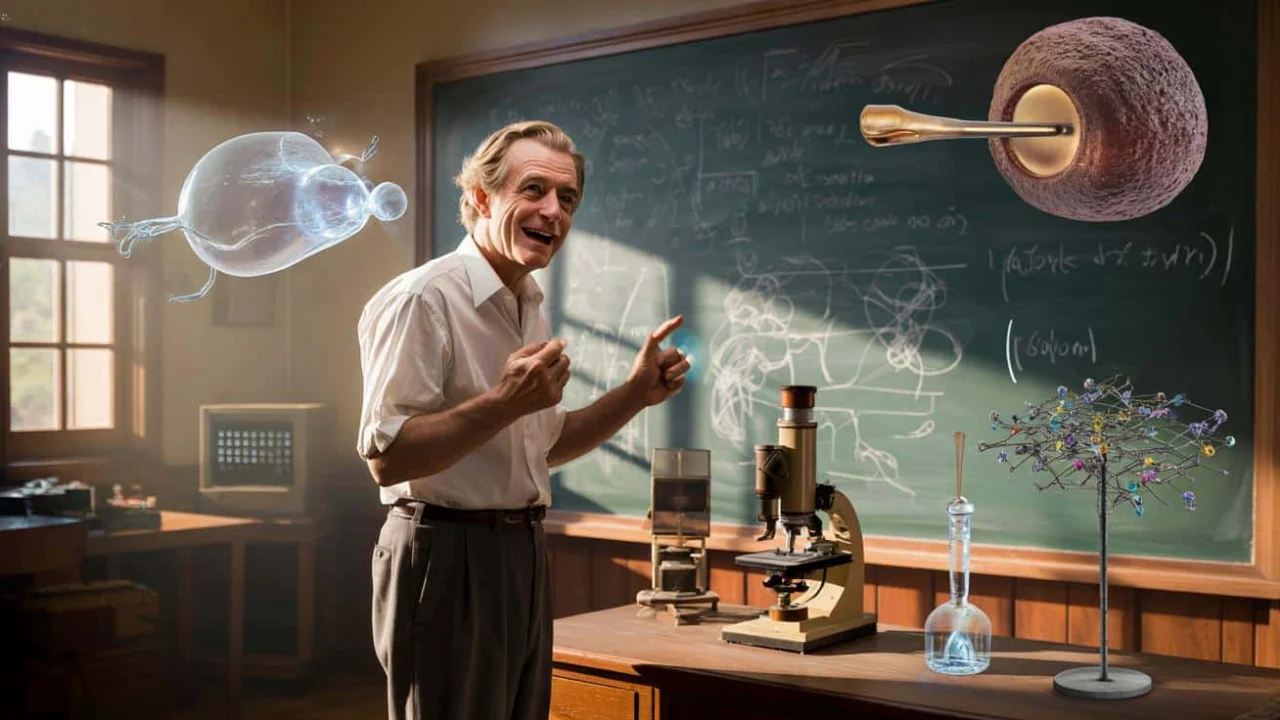
On December 29, 1959, Feynman walked into a Caltech lecture hall expecting to give what he thought would be a fun, throwaway talk about tiny things. Instead, his Feynman nanotechnology lecture became the founding moment of a field that would reshape everything from medicine to computing.

When a Mischievous Mind Met an Impossible Idea
Feynman’s talk, titled “There’s Plenty of Room at the Bottom,” started with a seemingly innocent question that would haunt scientists for decades: just how small could we make things?
The audience expected typical Feynman entertainment—clever jokes, mind-bending thought experiments, maybe some playful physics demonstrations. What they got instead was a roadmap to a future that sounded more like science fiction than science.

“Why cannot we write the entire 24 volumes of the Encyclopedia Britannica on the head of a pin?” Feynman asked his audience. At the time, engineers were already impressed with themselves for etching the Lord’s Prayer onto a pinhead. Feynman dismissed this as child’s play.
He wasn’t just talking about making things smaller. He was imagining a complete rethinking of how we build, store information, and even heal ourselves. The physicist was essentially describing what we now call nanotechnology—manipulating matter at the atomic and molecular scale.

“The principles of physics, as far as I can see, do not speak against the possibility of maneuvering things atom by atom,” Feynman declared, laying the groundwork for an entirely new field of science.
Revolutionary Predictions That Seemed Impossible in 1959
The most striking thing about Feynman’s nanotechnology lecture wasn’t just its vision—it was how specific and accurate his predictions turned out to be. Here’s what this playful physicist imagined more than six decades ago:

| Feynman’s 1959 Prediction | Today’s Reality |
|---|---|
| Electron microscopes manipulating individual atoms | Scanning tunneling microscopes routinely move atoms to create structures |
| Massive data storage in tiny spaces | MicroSD cards store terabytes in fingernail-sized chips |
| Miniaturized computers rivaling room-sized machines | Smartphones outperform 1959’s most powerful computers |
| Medical machines traveling inside the body | Nanorobots and targeted drug delivery systems in development |
But Feynman didn’t stop at predictions. He put his money where his mouth was, literally offering two cash prizes totaling $2,000 (about $20,000 today) to anyone who could achieve specific nanotechnology milestones.
The first prize went to building an electric motor smaller than 1/64th of an inch on each side. A Caltech graduate student claimed this prize just months later, stunning everyone by creating a motor barely visible to the naked eye.
The second prize proved more elusive: writing text so small that the entire page of a book could be reduced by a factor of 25,000 and still be readable. This prize wasn’t claimed until 1985, when advances in electron beam lithography finally made it possible.
“I want to build a billion tiny factories, models of each other, which are manufacturing simultaneously,” Feynman explained, describing what sounds remarkably like modern molecular manufacturing concepts.
How One Afternoon Changed Everything We Touch
The real magic of Feynman’s nanotechnology lecture wasn’t just its scientific accuracy—it was how it planted seeds in young minds who would spend the next several decades making his dreams real.
Eric Drexler, who coined the term “nanotechnology” in the 1980s, directly credited Feynman’s lecture as his inspiration. Drexler’s work, in turn, influenced countless researchers who developed the techniques we use today to manipulate matter at the atomic scale.
- Modern computer processors use transistors just a few atoms wide
- Carbon nanotubes are revolutionizing materials science
- Quantum dots are creating new types of displays and solar cells
- Targeted cancer therapies use nanoparticles to deliver drugs directly to tumors
- Self-cleaning surfaces use nanostructures inspired by lotus leaves
Consider your daily life: the phone in your pocket, the medical treatments keeping your loved ones healthy, the computers processing your work, the advanced materials in your car—all of these exist because a curious physicist asked a simple question about how small we could make things.
“What would the properties of materials be if we could really arrange the atoms the way we want them?” Feynman wondered. Today, materials scientists answer that question every day, creating substances with properties that didn’t exist in nature.
The lecture’s influence extends beyond technology into biology, chemistry, and physics. Researchers now routinely work with individual molecules, building structures one atom at a time, exactly as Feynman envisioned.
Perhaps most remarkably, Feynman delivered his nanotechnology lecture without any of the sophisticated tools we take for granted today. He had no computer models, no electron microscopes capable of atomic manipulation, no advanced materials science. Just pure imagination and an unshakeable belief that the laws of physics permitted far more than anyone was attempting.
“There is nothing that I can see in the physical laws that says the computer elements cannot be made enormously smaller than they are now,” he predicted, at a time when computers filled entire rooms and processed information slower than a modern calculator.
FAQs
What exactly did Richard Feynman predict in his 1959 nanotechnology lecture?
Feynman predicted atomic-scale manufacturing, ultra-miniaturized computers, massive data storage in tiny spaces, and medical devices that could travel inside the human body to perform repairs.
How accurate were Feynman’s predictions about nanotechnology?
Remarkably accurate—modern computer chips, data storage, medical nanoparticles, and atomic manipulation techniques all closely match what he described over 60 years ago.
What cash prizes did Feynman offer, and were they ever claimed?
He offered $1,000 each for building a tiny electric motor (claimed in months) and for creating extremely miniaturized text (claimed in 1985).
Did Feynman actually coin the term “nanotechnology”?
No, Eric Drexler coined “nanotechnology” in the 1980s, but he directly credited Feynman’s 1959 lecture as his inspiration for the field.
Why is this lecture considered so important in scientific history?
It essentially founded the field of nanotechnology by showing that manipulating matter at the atomic scale was physically possible, inspiring decades of research that powers modern electronics, medicine, and materials science.
What technologies in our daily lives trace back to Feynman’s ideas?
Smartphones, computer processors, advanced medical treatments, high-capacity data storage, and many modern materials all use principles that Feynman outlined in his groundbreaking lecture.
About the Author