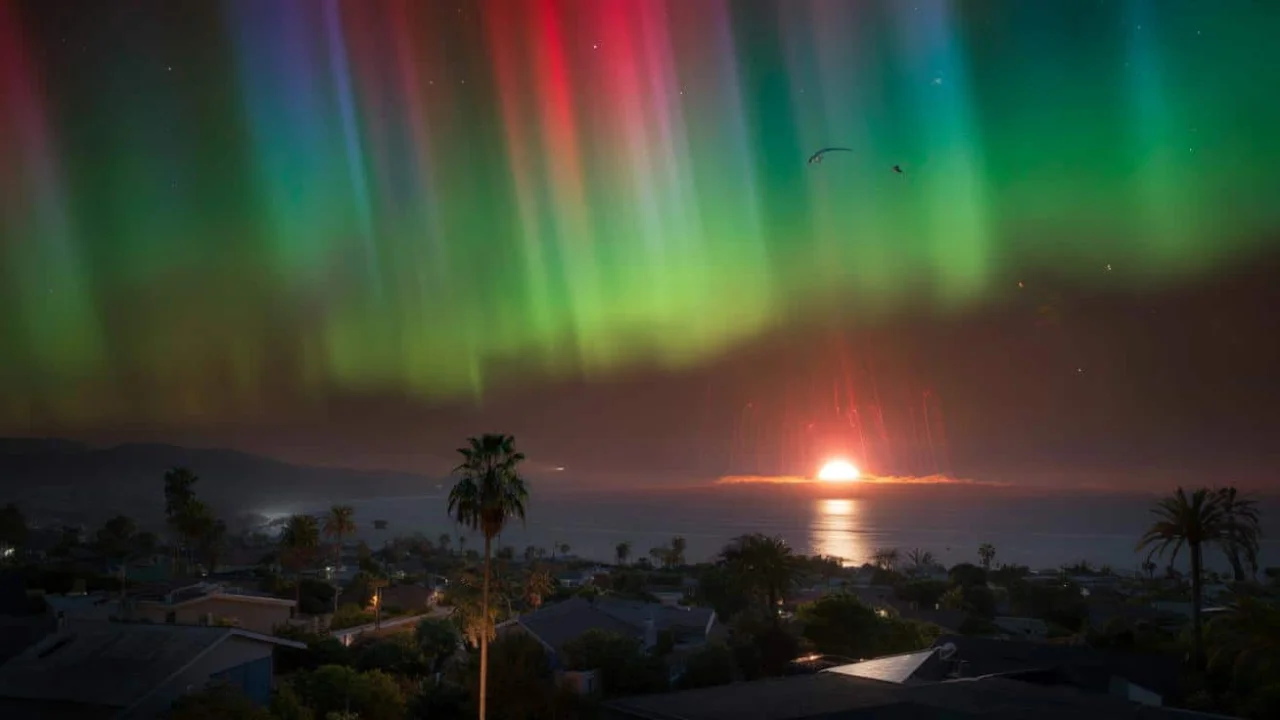
Maria stepped outside her Los Angeles home Monday night to grab her mail, expecting another ordinary evening in Southern California. Instead, she found herself staring at dancing ribbons of green and red light painting the sky above the city’s familiar glow. For a moment, she wondered if Hollywood was filming some massive special effects scene nearby.

But this wasn’t movie magic. What Maria witnessed was something that hadn’t happened in her lifetime – the Northern Lights visible as far south as Los Angeles, triggered by the most powerful solar radiation storm to hit Earth in over two decades.
Across the globe, millions of people found themselves unexpectedly treated to one of nature’s most spectacular shows, as a violent solar outburst sent charged particles cascading through our planet’s magnetic field in ways that scientists are still analyzing.

When the Sun Threw Its Biggest Punch in Decades
The solar radiation storm that captivated skywatchers worldwide began with an explosive event 93 million miles away. An X-class solar flare – the most powerful category – erupted from a massive sunspot near the sun’s equator, hurling a coronal mass ejection directly toward Earth.
This wasn’t just any space weather event. The incoming solar eruption reached S4 severity on the solar radiation storm scale, a level not recorded since the infamous Halloween storms of 2003 that knocked out power grids and disrupted satellites across multiple continents.

“We’re looking at the kind of solar activity that reminds us just how connected we are to our star,” explains Dr. Sarah Chen, a space weather researcher. “When the sun sneezes, Earth catches a cold – but this time it was more like a full-blown solar flu.”
The charged particles slammed into Earth’s magnetosphere – our planet’s invisible magnetic shield – compressing it and funneling energetic particles deep into the upper atmosphere. Space weather monitors immediately flagged a G4-level geomagnetic storm, the second-highest category on the scale.

Breaking Down the Solar Storm Impact
The effects of this historic solar radiation storm extended far beyond the beautiful aurora displays. Here’s what happened when Earth took a direct hit from solar particles:
- Satellite disruptions: Communication and navigation satellites experienced temporary interference as charged particles bombarded their systems
- Radio blackouts: High-frequency radio communications were disrupted, particularly affecting aviation and maritime operations
- Power grid stress: Electrical utilities monitored their systems for potential voltage irregularities, though no major outages occurred
- Aurora expansion: The Northern Lights appeared as far south as Southern California, Arizona, and northern Texas
- Radiation exposure: Airlines rerouted some polar flights to reduce crew and passenger exposure to elevated radiation levels

| Storm Classification | Level Reached | Last Occurrence |
|---|---|---|
| Solar Radiation Storm | S4 (Severe) | October 2003 |
| Geomagnetic Storm | G4 (Severe) | March 2024 |
| Aurora Visibility | 35°N Latitude | Extremely Rare |
“The timing was actually perfect for aurora viewing,” notes meteorologist Dr. James Rivera. “The storm peaked just as darkness fell across much of North America, giving people the best possible chance to witness this rare phenomenon.”
How This Storm Changed Life on the Ground
While the visual spectacle captured headlines, the practical impacts of this solar radiation storm touched various aspects of modern life. Air traffic controllers had to manage flight path adjustments, particularly for routes crossing polar regions where radiation exposure is highest during such events.
Emergency services reported an uptick in calls from concerned residents wondering if the unusual lights posed any danger. Social media platforms saw a surge in aurora photos and videos, with many users initially skeptical that the images were real.
Farmers and outdoor workers in northern states received advisories about slightly elevated radiation levels, though these remained well within safe limits for normal activities. The bigger concern was for astronauts aboard the International Space Station, who had to take shelter in more heavily shielded areas of the facility.
“What makes this event so significant isn’t just its intensity, but how it reminded us of our technological vulnerability,” explains space weather specialist Dr. Michael Torres. “We’re more dependent on satellites and electronic systems than ever before, making these solar storms increasingly consequential.”
The storm also provided scientists with valuable data about how Earth’s magnetic field responds to extreme solar activity. Researchers are already analyzing measurements from ground-based magnetometers and space-based instruments to better understand and predict future events.
Photography enthusiasts who managed to capture the aurora displays found themselves with once-in-a-lifetime shots. Many reported that their cameras picked up colors and details invisible to the naked eye, creating stunning images that will likely become historic records of this rare event.
For the scientific community, this solar radiation storm represents a treasure trove of data that will help improve space weather forecasting models. Better predictions could help minimize disruptions to critical infrastructure during future solar events.
The economic impact, while difficult to quantify immediately, includes costs associated with flight rerouting, satellite protection measures, and power grid monitoring. However, these expenses pale in comparison to the potential costs of being unprepared for such events.
As solar activity continues to ramp up toward the expected solar maximum in the coming years, events like this serve as important reminders of our star’s power and our planet’s position in a dynamic cosmic environment.
FAQs
How dangerous was this solar radiation storm for people on Earth?
The storm posed minimal direct risk to people on the ground, as Earth’s atmosphere provides excellent protection from solar radiation.
Will we see more aurora displays like this in the coming months?
Possibly, as we’re approaching solar maximum when such activity becomes more frequent, though storms this intense remain relatively rare.
Why did the Northern Lights appear so far south?
The intense geomagnetic storm compressed Earth’s magnetic field, allowing aurora-producing particles to penetrate much deeper into the atmosphere than usual.
Did this storm affect GPS and cell phone service?
Some GPS accuracy was temporarily reduced, and certain radio frequencies experienced interference, but most consumer devices continued working normally.
How do scientists predict when these solar storms will hit Earth?
Space weather monitors use satellite observations and computer models to track solar eruptions, typically providing 1-3 days advance warning for major events.
Could a larger solar storm cause more serious problems?
Yes, extreme solar storms could potentially damage power grids, satellites, and electronic infrastructure, which is why scientists closely monitor solar activity.
About the Author