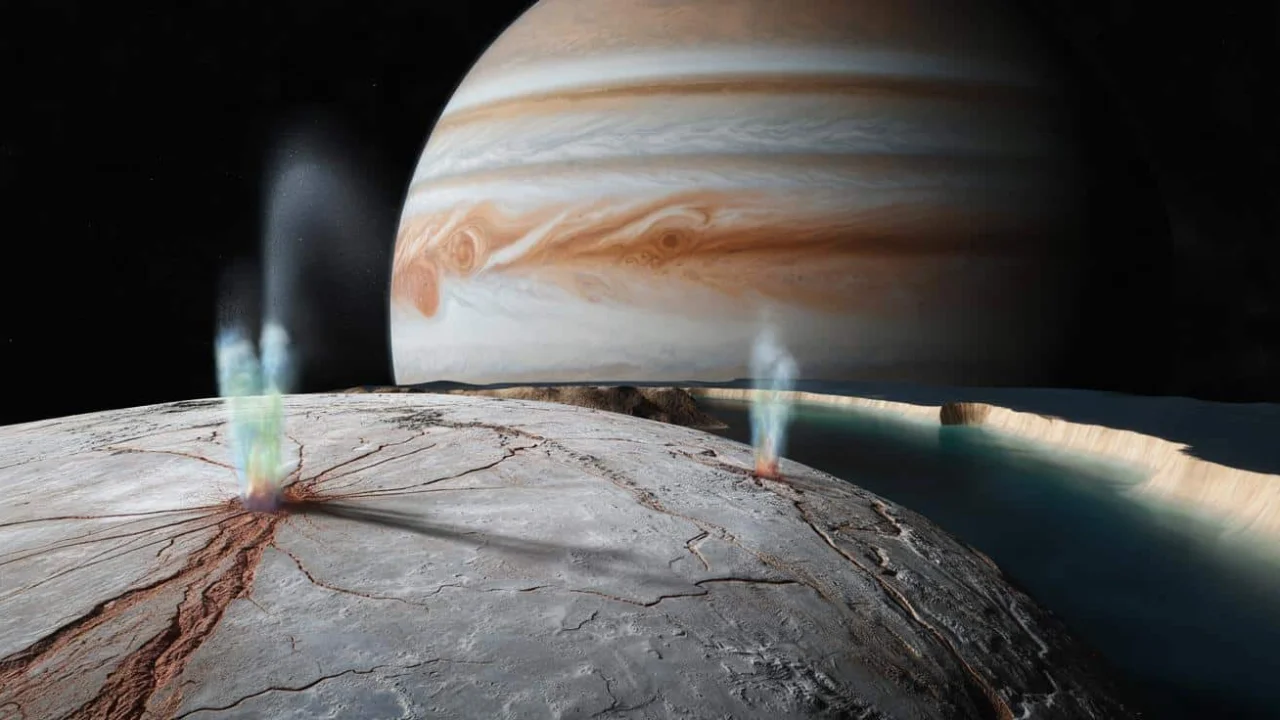
Sarah Martinez remembers the exact moment she fell in love with space exploration. She was twelve, staring at a grainy photograph of Europa in her science textbook, when her teacher mentioned something that made her heart race: “There might be an ocean under all that ice, deeper than any ocean on Earth.” Twenty-five years later, Dr. Martinez works as an astrobiologist at NASA, and that same moon still gives her goosebumps.

Last week, she got the call that every scientist dreams of. Hidden in decades-old spacecraft data, researchers had found something extraordinary—evidence that Europa might be even more suitable for life than anyone dared hope.
The discovery centers around ammonia, a simple but crucial molecule that could fundamentally change how we understand Europa habitability. What makes this finding even more remarkable is that the evidence was sitting in our archives all along, waiting for someone to look at it with fresh eyes.

A Twenty-Seven-Year Mystery Finally Solved
Back in 1997, NASA’s Galileo spacecraft was making its closest approach to Europa, Jupiter’s ice-covered moon. The craft’s near-infrared mapping spectrometer was busy collecting data, recording the unique fingerprints of chemicals on Europa’s surface. Scientists archived the measurements and moved on to other priorities.
But Al Emran at NASA’s Jet Propulsion Laboratory had a different idea. Using modern analysis techniques unavailable in the 1990s, he decided to take another look at those forgotten spectra. What he found changed everything.

“We identified the first convincing signature of ammonia on Europa’s surface, clustered around cracks in the ice,” explains Emran. The detection appears as an absorption band at 2.2 micrometers—a wavelength that screams “ammonia” to planetary scientists.
This isn’t just another interesting chemical discovery. Ammonia could be the missing piece that makes Europa habitability not just possible, but probable.

Why This Chemical Discovery Changes Everything
Think of ammonia as life’s Swiss Army knife. On Earth, nitrogen—which makes up half of every ammonia molecule—is absolutely essential for biology. It’s woven into our DNA, our proteins, and countless other molecules that keep living cells functioning.
But ammonia does something even more important for Europa habitability: it acts like cosmic antifreeze. When mixed with water, it dramatically lowers the freezing point, meaning Europa’s hidden ocean could stay liquid in conditions that would turn pure water into solid ice.

“Finding ammonia on Europa points to a nitrogen source that can both feed chemistry and help keep subsurface water liquid,” notes planetary scientist Dr. Rebecca Chen, who wasn’t involved in the study but has spent years researching icy moons.
Here’s what makes this discovery so significant for understanding Europa habitability:
- Chemical richness: The ammonia suggests Europa’s ocean contains dissolved nitrogen compounds essential for life
- Ocean stability: Ammonia helps keep the subsurface water liquid over geological timescales
- Active geology: The ammonia appears near surface cracks, indicating material exchange between the ocean and surface
- Energy availability: Nitrogen chemistry could provide energy sources for potential microorganisms
The implications extend far beyond Europa itself. If one of Jupiter’s moons can maintain such a chemically complex environment, what about other icy worlds in our solar system?
| Factor | Before Discovery | After Ammonia Detection |
|---|---|---|
| Ocean Chemistry | Mostly water and salts | Rich nitrogen environment |
| Temperature Stability | Uncertain long-term | Enhanced antifreeze effect |
| Biological Potential | Basic ingredients present | Essential nutrients confirmed |
| Ocean-Surface Exchange | Limited evidence | Active material transport |
What This Means for Future Space Missions
Dr. Martinez and her colleagues are already rethinking their approach to studying Europa habitability. NASA’s upcoming Europa Clipper mission, scheduled to launch in 2024, will now have additional targets to investigate.
“This discovery gives us specific locations to focus on,” explains mission scientist Dr. James Liu. “We know exactly where to look for these ammonia signatures and what they might tell us about the ocean below.”
The finding also affects how scientists prioritize other icy moons. Enceladus, Titan, and even distant Pluto suddenly seem more interesting as potential homes for life. If Europa can maintain such complex chemistry, these worlds might surprise us too.
For the general public, this discovery represents something profound: we’re not just looking for life in the universe anymore—we’re finding strong evidence that the conditions for life exist much closer to home than we ever imagined.
The ammonia detection also raises practical questions about future human exploration. Understanding Europa habitability isn’t just academic curiosity; it’s laying groundwork for potentially the most important discovery in human history.
“Every piece of evidence we gather brings us closer to answering whether we’re alone,” reflects Dr. Martinez. “This ammonia discovery might be the breakthrough that finally gives us that answer.”
The research, published in The Planetary Science Journal, represents more than just a scientific milestone. It’s proof that sometimes the most revolutionary discoveries are hiding in plain sight, waiting for the right person with the right tools to uncover them.
As we prepare for the next generation of space missions, Europa habitability has moved from interesting possibility to compelling probability. The frozen moon that captured a twelve-year-old’s imagination three decades ago might just be our best shot at finding life beyond Earth.
FAQs
What is Europa and why do scientists think it could support life?
Europa is Jupiter’s fourth-largest moon, covered in ice but hiding a vast ocean beneath that surface. Scientists believe this ocean contains more water than all of Earth’s oceans combined.
How was ammonia detected on Europa after all these years?
NASA scientist Al Emran reanalyzed data from the 1997 Galileo mission using modern techniques that weren’t available in the 1990s, revealing ammonia signatures that were previously hidden.
Why is ammonia so important for life as we know it?
Ammonia contains nitrogen, which is essential for building DNA, proteins, and other biological molecules. It also acts as antifreeze, helping keep Europa’s ocean liquid.
When will we know for sure if life exists on Europa?
NASA’s Europa Clipper mission, launching in 2024, will provide much more detailed information about the moon’s habitability and potential for life.
Could there be life on other icy moons too?
This discovery suggests that icy moons throughout our solar system might be more chemically complex than previously thought, making them potentially habitable as well.
What would finding life on Europa mean for humanity?
Discovering life on Europa would prove that life can exist beyond Earth, fundamentally changing our understanding of biology and our place in the universe.
About the Author