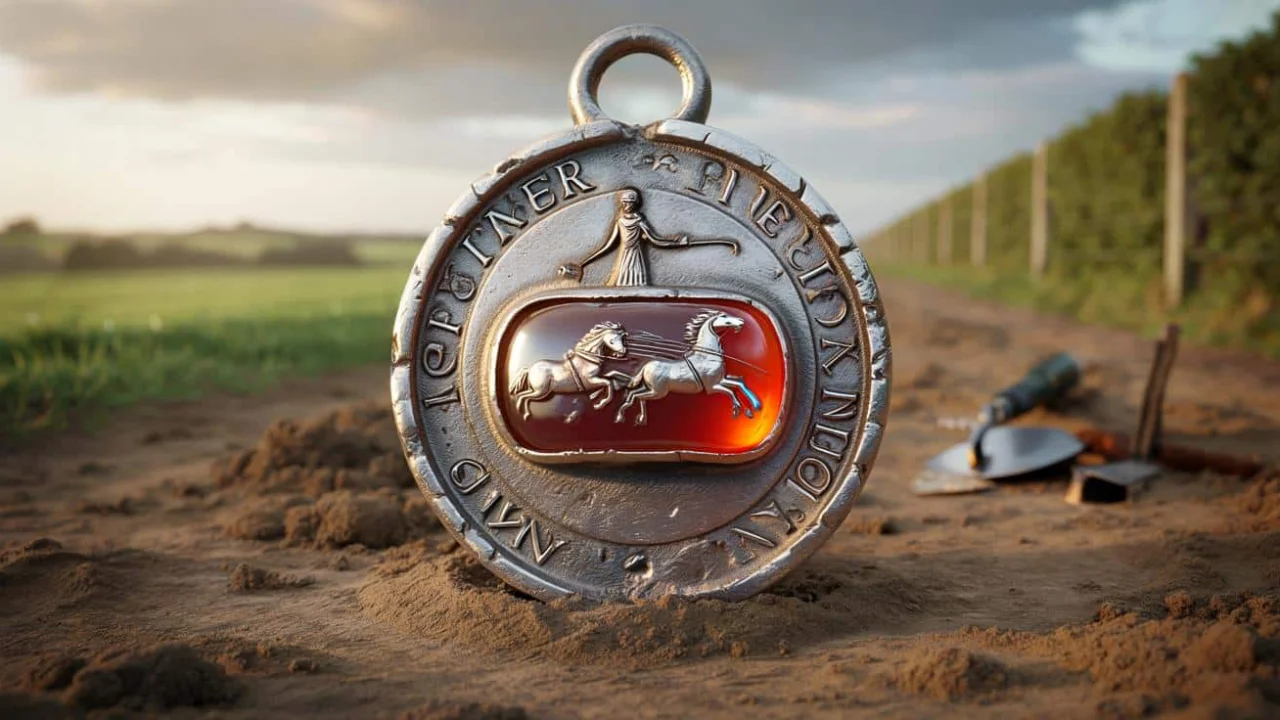
Picture this: you’re walking through a muddy field in Essex, swinging your metal detector back and forth, hoping for something more exciting than bottle caps and old coins. The machine beeps, you dig, and there it is—a tiny silver object no bigger than your thumb. You brush off the dirt, and suddenly you’re holding a piece of history that connects you to two different worlds, separated by nearly a thousand years.

That’s exactly what happened to one lucky metal detectorist in autumn 2024. What they pulled from the ground near Gosfield village wasn’t just any old trinket—it was a medieval seal that would leave archaeologists buzzing with excitement and rewrite our understanding of how medieval craftsmen honored the past.
The medieval seal, dating back roughly 800 years to the High Middle Ages, carries an inscription that reads “SECRETUM.RICARDI”—Richard’s secret. But here’s where it gets really fascinating: embedded at its center is a Roman carnelian gemstone that’s even older, carved sometime between the late first century BC and early first century AD.

When Two Ancient Worlds Collide
This isn’t your typical archaeological find. The medieval seal represents something archaeologists call “conscious reuse”—when craftsmen deliberately incorporated ancient Roman materials into their work. It’s like finding a modern jeweler who decided to set a ancient Egyptian scarab into a contemporary ring, except this happened 800 years ago.
The physical details tell a story of careful craftsmanship. The oval seal measures just 27.5 millimeters long and weighs a mere 6.44 grams. A small loop at one end suggests it hung from a chain or cord around someone’s neck, ready to be pressed into warm wax whenever Richard needed to authenticate a document or seal a private letter.

“The combination of medieval silver work with a reused Roman gemstone is extraordinary,” explains Dr. Sarah Mitchell, a specialist in medieval artifacts. “It shows us how people in the Middle Ages viewed Roman heritage—not as something to discard, but as something valuable enough to incorporate into their own precious objects.”
The inscription itself is written in mirror image, as all seals must be. When pressed into wax, “SECRETUM.RICARDI” would appear correctly, marking whatever document bore it as belonging to Richard’s private business. The word “secretum” is particularly intriguing because it suggests this wasn’t a public seal for official business, but something more personal and confidential.

Decoding Richard’s Mystery
The medieval seal reveals layers of meaning that archaeologists are still unpacking. Here’s what we know about this remarkable artifact:
- The silver seal matrix was crafted around 1224-1324 AD during the High Middle Ages
- The Roman carnelian gemstone dates to approximately 50 BC – 50 AD
- The Latin inscription translates to “Richard’s secret” or “the secret seal of Richard”
- A cross pattée (cross with widened ends) appears alongside the text
- The mirror writing indicates professional craftsmanship
- The hanging loop suggests personal rather than official use

| Feature | Details | Significance |
|---|---|---|
| Size | 27.5mm long, 6.44g | Personal scale, designed for portability |
| Material | Silver with carnelian gemstone | High-value materials suggest wealthy owner |
| Age Gap | ~1,000 years between gem and seal | Shows medieval reverence for Roman heritage |
| Inscription | SECRETUM.RICARDI | Indicates private, confidential use |
The cross pattée symbol adds another layer of mystery. While this distinctive cross appears frequently in medieval Christian art and is associated with crusading orders like the Knights Templar, experts caution against jumping to conclusions.
“Just because we see a cross pattée doesn’t mean Richard was a Templar,” notes Dr. James Harrison, a medieval historian. “This symbol was widely used in religious and secular contexts throughout the period. It’s more likely a general Christian symbol than evidence of any specific religious order.”
What This Discovery Means for History
The medieval seal is reshaping how archaeologists understand the relationship between medieval and Roman Britain. For centuries after Rome’s withdrawal from Britain in 410 AD, scholars assumed that medieval people largely ignored or destroyed Roman artifacts. This discovery suggests something far more nuanced.
The reuse of the Roman gemstone wasn’t accidental or convenient—it was deliberate. Someone, presumably Richard or the craftsman who made his seal, specifically chose to incorporate a piece of the Roman past into a medieval object. This suggests that educated medieval people had a sophisticated understanding of their heritage and saw value in connecting themselves to Rome’s legacy.
For the modern archaeological community, this find represents a treasure trove of information. The Portable Antiquities Scheme, which recorded the discovery, has logged thousands of finds across England and Wales, but few combine elements from such distant time periods.
“This seal bridges two civilizations in a way we rarely see,” says Dr. Emily Roberts, an expert in portable antiquities. “It’s not just about the object itself—it’s about the mindset of someone who lived 800 years ago and chose to honor a piece of history that was already ancient to them.”
The discovery also highlights the ongoing importance of responsible metal detecting. The finder properly reported their discovery through official channels, allowing archaeologists to study and preserve the artifact for future generations. Without this cooperation between amateur enthusiasts and professional researchers, discoveries like Richard’s seal might disappear into private collections, lost to scholarly study.
The medieval seal now serves as a bridge between past and present, connecting a Roman craftsman who carved a gemstone 2,000 years ago, a medieval man named Richard who commissioned the seal 800 years ago, a modern metal detectorist who found it in 2024, and countless future researchers who will study its secrets.
As archaeologists continue to analyze the artifact, they’re uncovering new questions about medieval attitudes toward history, the practical uses of personal seals, and the networks of craftsmen who created such sophisticated objects. Richard’s secret, it seems, was just the beginning of a much larger story about how people across the centuries have honored and preserved their past.
FAQs
What exactly is a medieval seal and how was it used?
A medieval seal was like a personal signature and security device combined, pressed into warm wax to authenticate documents and close letters.
Why is the Roman gemstone so significant?
The carnelian gemstone is over 1,000 years older than the medieval seal, showing how craftsmen deliberately incorporated ancient Roman artifacts into their work.
What does “SECRETUM.RICARDI” tell us about the owner?
The inscription suggests this was Richard’s private seal for confidential business, not an official or public emblem.
Could Richard have been connected to the Knights Templar?
While the cross pattée symbol appears on the seal, experts say this was a common Christian symbol and doesn’t necessarily indicate Templar connections.
How do we know the ages of both the seal and the gemstone?
Specialists with the Portable Antiquities Scheme dated the silver seal to around 800 years ago, while the Roman carnelian shows craftsmanship typical of the late first century BC to early first century AD.
What happens to the medieval seal now?
The artifact will be studied by archaeologists and likely preserved in a museum collection where researchers and the public can continue to learn from this remarkable discovery.
About the Author