Maria stared at her phone screen, scrolling through photos of her newborn niece. Each image showed the same beautiful baby, but some were blurry while others were crystal clear. The sharp ones revealed tiny details she’d missed in the fuzzy shots – delicate eyelashes, perfect fingernails, even the pattern of her blanket.

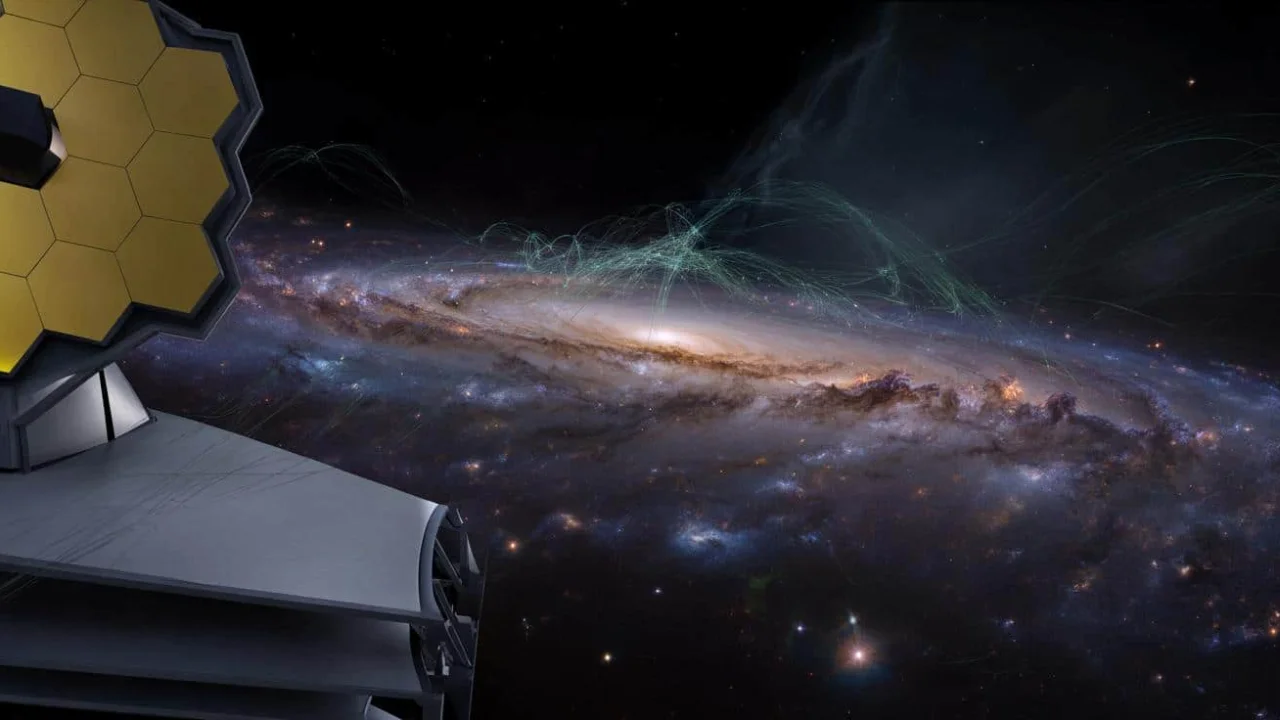
What Maria didn’t realize was that astronomers had just experienced something remarkably similar, but instead of baby photos, they were looking at the invisible backbone of our entire universe. The James Webb Space Telescope has just delivered the sharpest dark matter map ever created, transforming what once looked like cosmic blur into startling clarity.
This breakthrough isn’t just another pretty space picture. It’s revealing the hidden architecture that shapes everything we see in the night sky – and everything we can’t see.

Webb’s Marathon Reveals Universe’s Hidden Blueprint
Think of dark matter as the universe’s invisible scaffolding. You can’t see it directly, but it’s holding everything together and determining where galaxies form and grow. The James Webb Space Telescope has now created the most detailed dark matter map ever made, focusing on a small patch of sky in the constellation Sextans.
The achievement required an incredible commitment. Webb stared at the same slice of space for 255 hours straight – that’s more than 10 days of continuous observation. The result was worth every minute: astronomers identified nearly 800,000 galaxies in that single field of view.

“Webb’s view turns a once-sparse field into a crowded cityscape of distant galaxies, each subtly twisted by hidden mass,” explains lead researcher Dr. Sarah Chen from the Space Telescope Science Institute.
To put this in perspective, that’s about 10 times more galaxies than ground-based telescopes could detect in the same region, and nearly double what Hubble managed to spot. But finding the galaxies was just the beginning – the real magic happened when scientists analyzed how their shapes were distorted.

How Scientists Map the Invisible
Dark matter doesn’t emit, absorb, or reflect light. It’s completely invisible to our eyes and cameras. So how do you map something you can’t see? The answer lies in gravitational lensing – a phenomenon where massive objects bend light traveling through space.
Here’s how the process works and what makes this dark matter map so revolutionary:

- Shape Analysis: Webb measured tiny distortions in galaxy shapes caused by dark matter’s gravitational pull
- Statistical Detection: Individual galaxies might be naturally lopsided, but when hundreds of thousands align the same way, gravity is the culprit
- Pattern Recognition: Scientists converted these subtle distortions into a detailed map showing dark matter clumps and filaments
- Enhanced Resolution: Webb’s infrared vision and sharp optics captured details impossible for previous telescopes
“The team describes the new result as moving from a smudged outline to a clean blueprint of the universe’s hidden backbone,” notes Dr. Michael Rodriguez, a cosmologist at Harvard University.
Previous dark matter maps, including Hubble’s earlier attempts in the same area, were relatively coarse and fuzzy. Webb’s superior sensitivity transformed that blurry hint into crisp, detailed structure.
| Telescope | Galaxies Detected | Map Quality | Key Advantage |
|---|---|---|---|
| Ground-based | ~80,000 | Low resolution | Wide sky coverage |
| Hubble | ~400,000 | Moderate resolution | Optical precision |
| James Webb | ~800,000 | Ultra-high resolution | Infrared sensitivity |
What This Means for Our Understanding of Everything
This isn’t just an academic exercise. Understanding dark matter’s distribution helps scientists answer fundamental questions about how our universe evolved and where it’s heading.
Dark matter makes up roughly 85% of all matter in the universe, yet we barely understand what it is. This new map provides crucial clues about how galaxies form, why they cluster in certain patterns, and how the cosmic web of matter evolved over billions of years.
“Every galaxy we see today formed along these invisible highways of dark matter,” explains Dr. Lisa Park from the European Space Agency. “Webb is showing us the roads that guided cosmic construction.”
The practical implications extend beyond pure science. Understanding dark matter’s behavior could eventually lead to breakthroughs in physics, potentially revealing new particles or forces we haven’t discovered yet. Some researchers believe dark matter studies might even unlock new forms of energy or propulsion technology decades from now.
For astronomers, this ultra-detailed dark matter map serves as a cosmic GPS system. It helps predict where future galaxies might form and explains why existing galaxies appear where they do. The map also provides a testing ground for theories about how the universe works at its most fundamental level.
“This is like having a detailed street map of a city you’ve only seen from airplane windows before,” says Dr. James Thompson from the University of California. “Suddenly we can navigate the cosmic neighborhood with precision we never had.”
The research team plans to expand their mapping project to other regions of the sky. Each new dark matter map will add another piece to the puzzle of cosmic structure, gradually revealing the universe’s invisible architecture in unprecedented detail.
Future observations could map dark matter around individual galaxy clusters, trace how it evolved over cosmic time, and potentially identify different types of dark matter particles. These discoveries might fundamentally change our understanding of physics and our place in the cosmos.
FAQs
What exactly is dark matter?
Dark matter is an invisible form of matter that makes up about 85% of all matter in the universe. It doesn’t emit, absorb, or reflect light, but we can detect it through its gravitational effects on visible matter.
How does Webb create a map of something invisible?
Webb measures tiny distortions in the shapes of distant galaxies caused by dark matter’s gravity bending light. By analyzing hundreds of thousands of galaxies, scientists can reconstruct where dark matter must be located.
Why is this dark matter map better than previous ones?
Webb’s infrared sensitivity and sharp resolution detected nearly 800,000 galaxies in one small patch of sky – about 10 times more than ground telescopes and double what Hubble found. More galaxies means more precise measurements of dark matter’s location.
How long did it take to create this map?
Webb observed the same small region of sky for 255 hours straight – more than 10 days of continuous observation. The actual data analysis and map creation took additional months of computer processing.
What will scientists do with this information?
This dark matter map helps researchers understand how galaxies form, test theories about the universe’s evolution, and potentially discover new physics. It also serves as a foundation for mapping dark matter across larger areas of the sky.
Could dark matter research lead to new technology?
While dark matter remains mysterious, studying it could eventually reveal new particles or forces that might lead to breakthrough technologies in energy or propulsion, though such applications would likely be decades in the future.
About the Author