Picture this: you’re drifting down a muddy Amazon river in a rickety wooden boat, the jungle pressing in on all sides. The air is thick with humidity and the buzz of insects. Your guide suddenly goes rigid, pointing at something massive sliding through the water ahead.

For most of us, this would be the stuff of nightmares. But for a small team of scientists in Ecuador’s remote rainforest, it became the moment they’d been waiting for—and the discovery that would shake the scientific world.
What they captured on camera that day wasn’t just any snake encounter. It was the first documented footage of a newly discovered giant anaconda species, one that had been hiding in plain sight for millions of years.

When Hollywood Meets Scientific Discovery
The story begins in 2022, deep in the Baihuaeri Waorani Territory of Ecuador’s Amazon. Professor Bryan Fry, a venom specialist from the University of Queensland, was there on what seemed like routine business—collecting DNA samples from anacondas for genetic research.
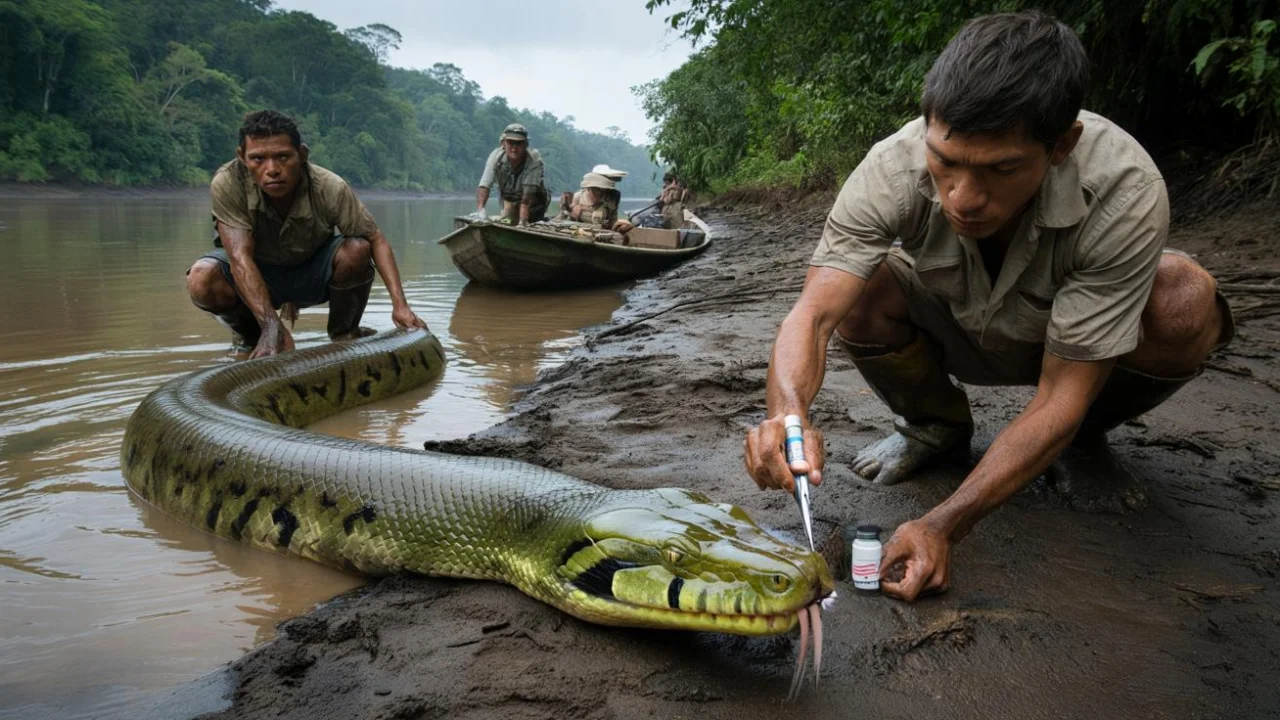
But this wasn’t your typical scientific expedition. Actor Will Smith had joined the team, along with a National Geographic crew filming the series “Pole to Pole with Will Smith.” What started as a genetics survey turned into something far more dramatic when Indigenous Waorani guides spotted movement in the riverside vegetation.

“Scientists and Waorani guides suddenly spotted a massive, olive-green body sliding through a gap in the riverside vegetation,” recalls one witness to the encounter.
There, coiled between the muddy shallows and land, lay a female anaconda that Fry estimated at 16 to 17 feet long. The footage shows the Waorani guides approaching with calm precision—one securing the head, another grabbing the thick, muscular body that could easily crush a human.

Green anacondas kill by constriction, wrapping their powerful coils around prey and squeezing until blood flow stops. For the research team, getting close enough to collect a tissue sample meant trusting completely in the expertise of their Indigenous guides.
The Laboratory Revelation That Changed Everything
After carefully collecting scale samples and releasing the snake back into the water, the real discovery happened thousands of miles away in a genetics lab. The DNA analysis revealed something extraordinary: what scientists had long considered one species was actually two distinct giant anaconda species.
The green anaconda, scientifically known as Eunectes murinus, had been split. The newly identified species, dubbed the Northern Green Anaconda (Eunectes akayima), had been evolving separately for nearly 10 million years.
“This discovery fundamentally changes our understanding of anaconda evolution and biodiversity in the Amazon basin,” explains Dr. Sarah Johnson, a herpetologist not involved in the study. “It shows how much we still don’t know about the world’s most biodiverse ecosystem.”
Here are the key differences scientists have identified between the two giant anaconda species:
- Geographic distribution: Northern species found in Venezuela, Guyana, Suriname, and northern Brazil
- Genetic divergence: 5.5% difference in mitochondrial DNA sequences
- Physical characteristics: Subtle differences in scale patterns and coloration
- Size potential: Both species can reach similar massive proportions
- Evolutionary timeline: Separated approximately 10 million years ago
| Species | Scientific Name | Primary Range | Key Identifier |
|---|---|---|---|
| Green Anaconda | Eunectes murinus | Southern Amazon Basin | Original classification |
| Northern Green Anaconda | Eunectes akayima | Northern South America | 5.5% genetic divergence |
| Maximum Length | Up to 20+ feet | Both species | Females larger than males |
| Weight Potential | 200+ pounds | Both species | Heaviest snakes on Earth |
Why This Discovery Matters for Conservation
The identification of this new giant anaconda species isn’t just academic—it has real-world implications for conservation efforts across South America. When scientists discover that what they thought was one widespread species is actually two distinct populations, it completely changes how we approach protection strategies.
“Each species may have different habitat requirements, different threats, and different population dynamics,” notes Dr. Maria Rodriguez, a conservation biologist specializing in Neotropical fauna. “This means we need separate conservation plans for each.”
The discovery also highlights the critical role Indigenous knowledge plays in modern scientific research. The Waorani guides who helped capture the footage possess generations of understanding about anaconda behavior and habitat preferences that proved invaluable to the research team.
For local communities throughout the Amazon, this finding could impact everything from eco-tourism opportunities to traditional hunting practices. Understanding that there are now two distinct species means wildlife management policies may need updating across multiple countries.
The timing couldn’t be more crucial. Amazon deforestation continues at alarming rates, and habitat destruction affects different species in different ways. The Northern Green Anaconda’s range includes some of the most threatened areas of the Amazon basin.
“We’re essentially racing against time to document biodiversity before it disappears,” explains Dr. James Mitchell, a tropical ecology researcher. “Discoveries like this remind us how much we’re still learning about the natural world, even as we’re losing it.”
The research team’s work also demonstrates how modern genetic techniques can reveal hidden diversity in species that have been studied for centuries. It raises questions about how many other “well-known” animals might actually represent multiple distinct species.
For the scientific community, this discovery opens new research avenues into anaconda evolution, behavior, and ecology. For the rest of us, it’s a reminder that our planet still holds remarkable secrets—even in its largest, most intimidating creatures.
FAQs
How big can these newly discovered giant anacondas get?
Both the original green anaconda and the newly identified Northern Green Anaconda can reach lengths of 20+ feet and weigh over 200 pounds, making them among the heaviest snakes on Earth.
Are the two anaconda species dangerous to humans?
While both species are powerful constrictors capable of killing large prey, attacks on humans are extremely rare. They typically avoid human contact and prefer aquatic environments where they hunt fish, birds, and other animals.
How did scientists miss this for so long?
The two species look nearly identical to the naked eye, with only subtle differences in scale patterns and coloration. It took advanced genetic analysis to reveal they’ve been evolving separately for about 10 million years.
Where exactly can you find the Northern Green Anaconda?
This newly identified species is found primarily in Venezuela, Guyana, Suriname, French Guiana, and northern Brazil, while the original green anaconda inhabits the southern Amazon basin.
What does this mean for Amazon conservation?
The discovery means conservation strategies need to account for two distinct species with potentially different habitat requirements and threats, rather than treating them as one widespread population.
Could there be more undiscovered anaconda species?
Scientists believe it’s possible, especially given how genetic analysis continues to reveal hidden diversity in many animal groups that were previously thought to be single species.
About the Author