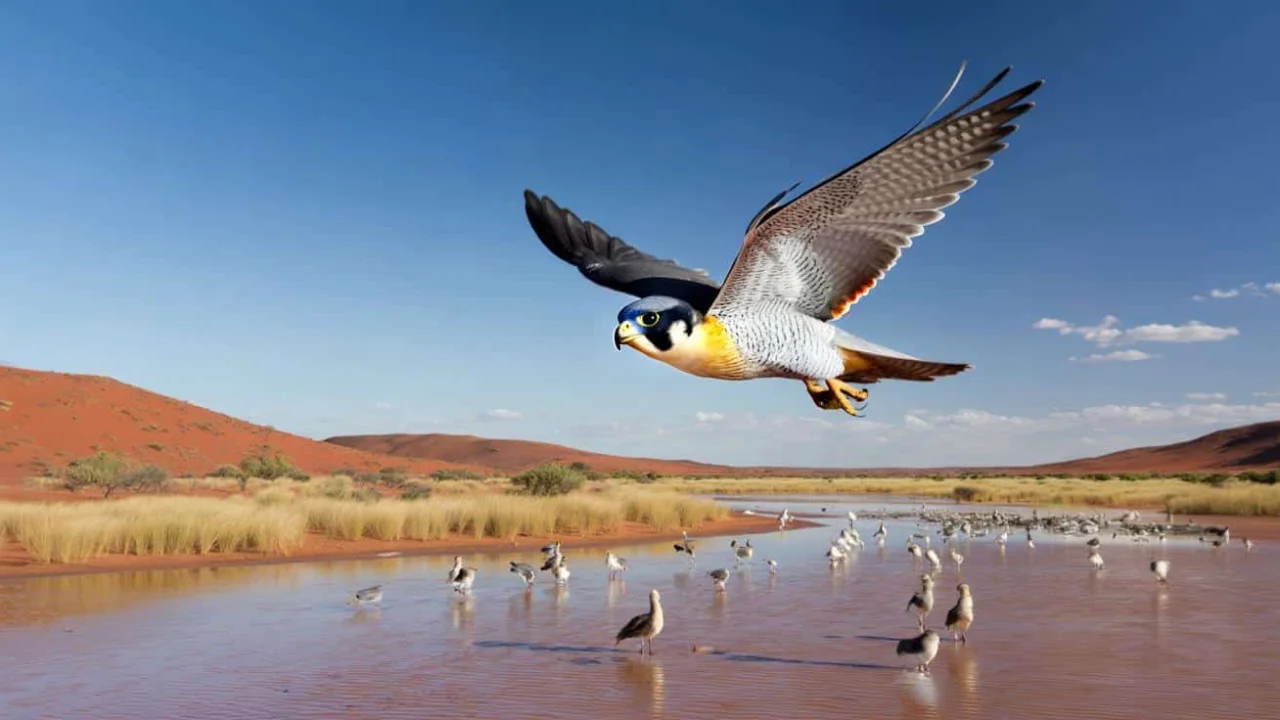
Picture this: you’re standing in the middle of Australia’s red desert, camera in hand, when something extraordinary shoots across the sky above you. That split second of perfect timing just captured something that’s never been documented before in the continent’s harsh interior.

That’s exactly what happened to wildlife ecologist Tim Henderson in February 2025, when his quick reflexes and keen eye resulted in a photograph that’s rewriting the books on bird migration patterns. His camera captured a Siberian peregrine falcon soaring over central Australia’s arid landscape—the first time this Arctic-breeding bird has ever been recorded so deep in the country’s desert heart.
For most of us, spotting any bird of prey feels like a small thrill. But Henderson’s discovery represents something much bigger: proof that even our most remote wilderness areas are connected to ecosystems thousands of miles away in ways we’re only beginning to understand.

A Desert Transformed by Rare Rain Creates Perfect Conditions
The story begins with something equally rare in central Australia: abundant rainfall. The 2024 wet season had been unusually generous to the red center, transforming the typically bone-dry claypans of Newhaven Wildlife Sanctuary into temporary shimmering wetlands.
These ephemeral water bodies, located northwest of Alice Springs, became magnets for waterbirds arriving from across the continent. Where birds gather, so do their predators. Henderson was conducting his routine raptor surveys when he noticed a falcon moving with exceptional speed across the transformed landscape.

“The bird looked different from the peregrines usually seen in inland Australia, so Henderson took a rapid series of photographs to examine later,” according to field notes from the survey.
Back at camp, those images revealed something remarkable. The falcon’s distinctive markings and proportions didn’t match Australia’s resident peregrine subspecies. Expert analysis confirmed what Henderson suspected: this was a Siberian peregrine falcon, a subspecies that breeds on Arctic tundra across northern Eurasia and typically migrates to coastal regions of Southeast Asia and northern Australia.

The Australian Wildlife Conservancy, which manages Newhaven Wildlife Sanctuary, has now officially confirmed this as the first documented record of a Siberian peregrine falcon in Australia’s arid interior.
Understanding the Siberian Peregrine Falcon’s Remarkable Journey
To appreciate how extraordinary this sighting is, you need to understand just how far this bird traveled and where it normally goes. Siberian peregrine falcons are among nature’s most impressive migrants, but their usual routes don’t include Australia’s desert interior.

Here are the key facts about these remarkable birds and this historic sighting:
- Siberian peregrines breed across the Arctic tundra of northern Russia and Siberia
- They typically migrate to coastal Southeast Asia, Indonesia, and northern Australia for winter
- Previous Australian sightings have been almost exclusively near coastlines
- The species is classified as “rare migrants or vagrants” in Australia
- Up to a dozen suspected sightings occur annually, mostly along northern and eastern coasts
- This central Australian record represents the deepest inland penetration ever documented
“Specialists describe Siberian peregrines in Australia as rare migrants or vagrants—birds that typically appear only sporadically, and usually near the sea,” explains the research team behind the discovery.
| Siberian Peregrine Falcon Facts | Details |
|---|---|
| Scientific Name | Falco peregrinus calidus |
| Breeding Range | Arctic tundra across northern Eurasia |
| Winter Range | Southeast Asia, Indonesia, northern Australia |
| Migration Distance | Up to 15,000+ miles annually |
| Previous Australian Records | Primarily coastal regions |
| Status in Australia | Rare migrant/vagrant |
The timing of Henderson’s sighting also tells us something important. February marks the end of the Australian summer, when northern hemisphere birds like this Siberian peregrine would typically be preparing for their return journey to Arctic breeding grounds.
What This Discovery Means for Desert Conservation and Science
This single photograph is changing how scientists think about Australia’s arid ecosystems and their connections to global migration networks. The discovery has implications that extend far beyond bird watching.
For conservationists, the sighting demonstrates that Australia’s desert interior isn’t the biological island it was once thought to be. These landscapes, when conditions are right, can support and attract species from the other side of the globe.
“The bird’s presence so far inland sets a new benchmark for how far this subspecies can range into the desert under the right conditions,” Henderson noted in his report published in Pacific Conservation Biology.
The unusually wet conditions that created temporary wetlands at Newhaven proved crucial. Climate scientists predict that extreme weather events, including unusually heavy rainfall in arid regions, may become more frequent. This could mean more opportunities for rare migrants to venture into Australia’s interior.
For local ecosystems, the presence of apex predators like peregrine falcons can have cascading effects on prey species populations and behavior. Even temporary visitors can influence local food webs in ways researchers are only beginning to understand.
The discovery also highlights the importance of continuous monitoring in remote areas. Without Henderson’s systematic raptor surveys, this historic first would have gone unrecorded. How many other rare visitors might be using Australia’s interior when conditions align?
Wildlife sanctuaries like Newhaven serve as crucial refuges not just for resident species, but potentially for unexpected travelers from around the globe. The 262,000-hectare sanctuary protects diverse habitats that can support both desert-adapted residents and occasional visitors taking advantage of favorable conditions.
“This sighting pushes the known distribution edge deep into the continent’s center,” researchers note, suggesting that our understanding of bird migration patterns and desert ecosystem connectivity still has major gaps to fill.
The photograph also represents the power of citizen science and field documentation. Henderson’s quick thinking and photographic skills provided the evidence needed to confirm this remarkable first. In an age of smartphone cameras, such discoveries remind us that anyone spending time in nature might capture something scientifically significant.
FAQs
What makes a Siberian peregrine falcon different from Australian peregrines?
Siberian peregrines are generally paler and more lightly built than Australia’s resident subspecies, with subtle but distinct differences in markings and proportions that experts can identify from photographs.
How did the falcon end up so far inland in Australia?
The unusual wet conditions in 2024 created temporary wetlands that attracted waterbirds, which in turn drew predators like this peregrine falcon deeper into the continent than normal.
Are Siberian peregrine falcons endangered?
No, Siberian peregrines are not considered endangered globally, but they’re rare visitors to Australia and this was the first ever recorded so far inland.
Could climate change bring more Arctic birds to Australia’s interior?
Possibly—if extreme weather events create more temporary wetlands in arid regions, they could attract more unusual migrants and predators following them.
How can people help document rare bird sightings?
Taking clear photographs and reporting unusual bird sightings to organizations like the Australian Wildlife Conservancy or eBird helps scientists track migration patterns and range changes.
What other rare birds might show up in Australia’s deserts?
When conditions create temporary wetlands, various migratory waterbirds and their predators could potentially venture inland, though most such visits likely go unrecorded due to the remote locations.
About the Author