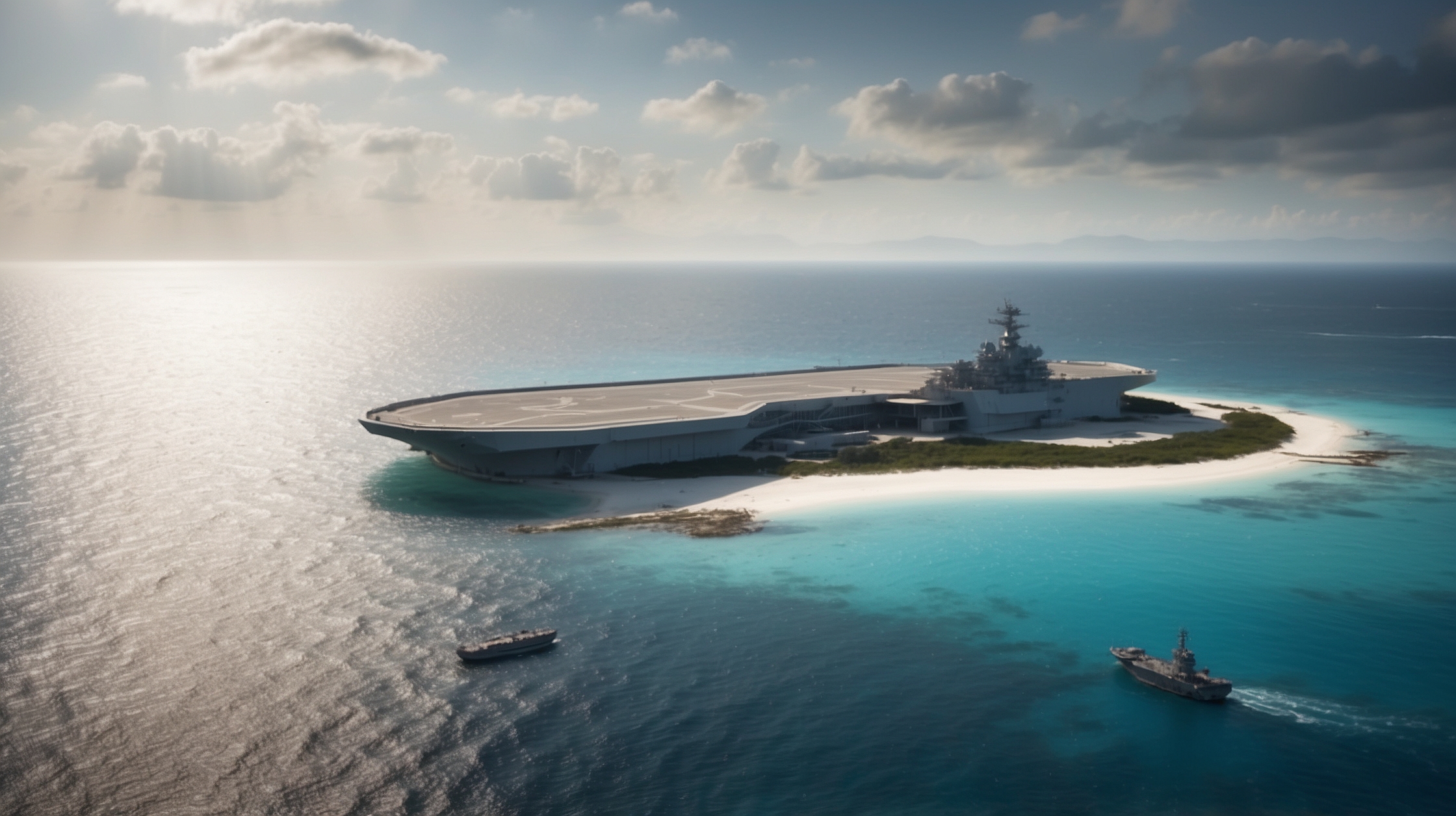

In an ambitious and controversial move that has reshaped geopolitical realities in the South China Sea, **China has transformed remote coral reefs into fortified military bases** using massive amounts of concrete and dredging technology. These artificial outposts, complete with runways, radar systems, and missile shelters, now dominate several of the disputed Spratly Islands. What began as murky reef-building under the guise of civilian infrastructure has evolved into a modern example of territorial expansion—one constructed not by negotiation, but by the pouring of cement onto the ocean floor.

This transformation has escalated tensions in one of the world’s most critical naval corridors, affecting fishing rights, civilian freedom of navigation, and the balance of power in Asia-Pacific. The project has raised alarms from neighboring Southeast Asian states and longstanding naval powers like the United States. While China insists its intentions are peaceful, **satellite imagery and global maritime practices suggest otherwise**. The reefs-turned-runways now extend Beijing’s reach far beyond its mainland, pushing artificial shorelines deep into international waters.
South China Sea militarization: key facts at a glance
| Aspect | Details |
|---|---|
| Regions Involved | Spratly Islands, Paracel Islands |
| Main Activities | Dredging, Land Reclamation, Construction of Military Infrastructure |
| Major Chinese Bases | Fiery Cross Reef, Subi Reef, Mischief Reef |
| Purpose | Strategic military outposts to support air and naval operations |
| Environmental Impact | Destruction of coral ecosystems and marine habitats |
| International Reaction | Criticism from the U.S., ASEAN nations, and global maritime bodies |
From shallow reef to fortified runway
The process behind these militarized islands begins with **dredging sand and coral from the seafloor** to create artificial land above sea level. Once these man-made foundations are stabilized with concrete, heavy machinery constructs airstrips, port facilities, and multi-story military installations. Fiery Cross Reef, for example, was once a submerged coral atoll; it is now home to a 3,000-meter runway and radar towers extending China’s surveillance capability across the South China Sea.

Satellite images have captured dramatic changes in geography over a short span—what were once specks in the sea now resemble small cities, armed and engineered for strategic dominance. The construction phase includes **installing missile shelters, anti-aircraft systems**, and communication arrays. This buildup has given China an unprecedented forward-operating presence in international waters, radically altering the confrontational calculus.
Why these reefs matter
Control of reefs in the South China Sea is not merely symbolic. The waterway accounts for roughly **30% of global shipping trade**, linking markets from Asia to Europe and Africa. It’s also rich in **undersea oil and gas reserves**, and supports fisheries that sustain millions. Whoever controls the Spratly Islands has the power to monitor, restrict, or reroute maritime movement through a vital, congested corridor.

The reefs also hold legal importance under the United Nations Convention on the Law of the Sea (UNCLOS). Natural land features afford an Exclusive Economic Zone (EEZ), granting fishing and resource rights. **Artificial islands, however, do not generate these rights**, a fact repeatedly emphasized by international courts. Yet China asserts historical entitlement to the “Nine-Dash Line,” a broad claim of territory covering up to 90% of the South China Sea—a claim broadly rejected by other regional actors.
Environmental and ecological upheaval
Environmental scientists warn that the **reef reclamation campaign has inflicted irreversible damage** to biodiversity hot spots. Coral reefs—which take centuries to develop—have been blasted, dredged, and paved over by construction materials. These ecosystems once teemed with marine life essential to the food security of countries like the Philippines, Vietnam, and Malaysia.

“What China is doing is the equivalent of paving over Yellowstone for a military runway. It’s obliterating life-sustaining marine habitat.”
— Dr. Eloisa Mercado, Marine Biodiversity Expert
Increased military traffic, ship anchoring, and chemical runoff further degrade already fragile coral systems. Environmental damage, once a secondary concern in territorial disputes, is now a rallying point among local communities and international conservationists.
What regional actors and the US are doing in response
Opposition to China’s activities has been vocal, though largely ineffectual in stopping land reclamation. The Philippines brought a landmark case to The Hague in 2016, which ruled China’s artificial islands had no legal basis for sovereignty claims. Beijing rejected the ruling outright. Neighboring countries have bolstered their own patrols and infrastructure, but none match China’s scale or pace of construction.
The United States routinely conducts **freedom of navigation operations (FONOPs)**, sailing warships near disputed areas to contest China’s claims. These missions often attract stern warnings and escalated encounters with the Chinese navy. In response, nations like Japan, Australia, and India are increasing their own naval cooperation with Southeast Asian allies.
“We must safeguard a region where international law prevails—not the law of pouring cement wherever you want.”
— Admiral Susan Hines, U.S. Pacific Fleet Commander
China’s narrative: peaceful intentions versus facts on the sea
Despite footage of fighter jets landing on newly-built runways and large radar domes swinging into position, China maintains that the projects serve **humanitarian and defensive functions**. The Ministry of Foreign Affairs often states that the islands offer typhoon shelters, lighthouse facilities, and search-and-rescue operations.
This narrative aims to soften foreign criticism but contradicts how the islands are used. Enforcement of exclusion zones, harassment of neighboring fishing fleets, and restrictions on airspace all signal a clear **militarized intent**. Far from mere territorial staking, these islands project hard power and reshape commercial and defense planning in the Indo-Pacific.
Technology powering the transformation
China employed state-of-the-art **dredgers capable of moving thousands of cubic meters of seafloor material per day**. Combined with modular construction and reinforced concrete units, landmasses were made habitable in months. This capability marks a new class of geopolitical engineering—where terrain is not discovered, but built to order.
Artificial intelligence and satellite surveillance now help coordinate movement around these bases, allowing real-time monitoring of sea traffic. This tech-backed infrastructure gives the Chinese navy more than just ports—it provides data, logistics support, and reach to challenge foreign navies far from the Chinese coast.
Winners and losers in this high-stakes transformation
| Winners | Losers |
|---|---|
| China’s military and strategic positioning | Marine biodiversity and regional ecological balance |
| Chinese commercial fisherman with extended reach | ASEAN countries with weaker naval capability |
| Chinese construction and dredging firms | Global maritime legal norms and UNCLOS authority |
Short FAQs
Why is China building on reefs in the South China Sea?
China aims to establish military and strategic control over key trade and fishing routes, extending its influence by converting submerged features into operational bases.
Are these artificial islands legal under international law?
No. According to a 2016 international tribunal ruling, artificial islands do not grant territorial claims or economic rights under UNCLOS agreements.
How does this affect the environment?
Reefs have been dredged, destroyed, and covered in concrete, drastically affecting marine life and local fishing economies dependent on healthy ecosystems.
Which reefs have been militarized by China?
Main sites include Fiery Cross Reef, Subi Reef, and Mischief Reef—all featuring airstrips, radar systems, and military installations.
Can other countries stop further land reclamation?
Diplomatic efforts and international rulings have failed to deter China. Only coordinated strategic pressure and regional defense pacts might slow new construction.
How does this impact global trade?
It empowers China to potentially control or disrupt shipping lanes vital to global commerce, creating long-term instability in trading forecasts and insurance costs.
Is there military conflict brewing over this?
Not directly, but there’s a constant undercurrent of naval brinkmanship and increasing military deployments by regional and foreign navies.
What is the global community doing about it?
Countries like the U.S., Japan, and Australia conduct joint exercises and patrols to challenge unlawful maritime claims, but united global enforcement remains lacking.
About the Author