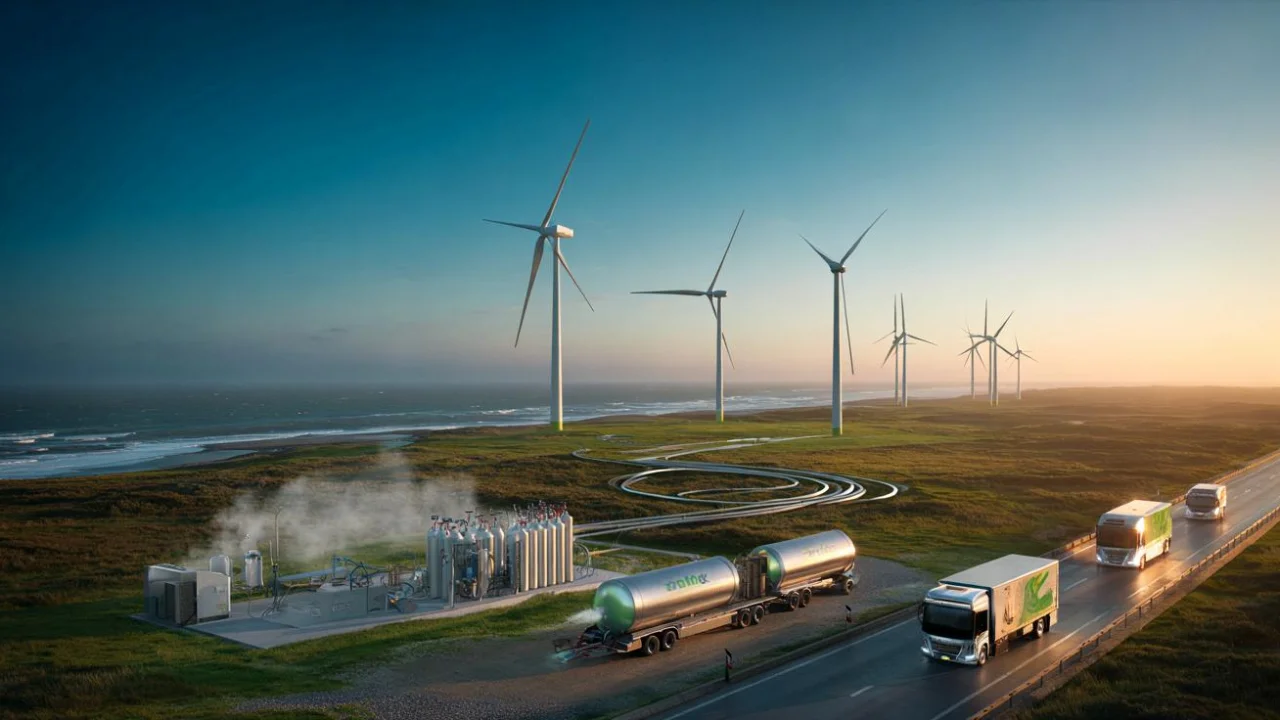
Marie Dubois never expected her morning jog along the French coast to change how she thinks about the future. As she ran past the Bouin wind farm in Vendée, she noticed something unusual—a small industrial building tucked between the towering turbines, humming quietly as the Atlantic breeze turned the massive blades overhead.
What she didn’t realize was that she was witnessing history in the making. Inside that modest facility, a company called Lhyfe was doing something no one else in the world had accomplished: producing green hydrogen directly from wind turbines, without any middleman, grid connection, or complex energy trading.
While giants like Tesla and Shell dominate clean energy headlines, this little-known French startup has been quietly solving one of the industry’s biggest puzzles since 2021.
The Quiet Revolution Happening on France’s Atlantic Coast
Most people have never heard of Lhyfe, but they should. This Nantes-based company cracked a code that energy experts have been trying to solve for years—how to make green hydrogen production truly independent from the electrical grid.
Their facility in Bouin represents the world’s first operational site where wind turbines feed electricity straight into electrolyzers to split water into hydrogen and oxygen. No power grid. No energy certificates. No complicated contracts claiming renewable origins.
“We’re not just talking about direct connection—we’re actually doing it,” explains a company representative. “When our wind turbines spin, hydrogen gets produced. When they stop, production stops. It’s that simple and that revolutionary.”
The difference matters more than you might think. Traditional “green hydrogen” projects buy renewable electricity from the grid, often through complex paper trails that claim clean origins. But electrons don’t carry ID cards—grid electricity is a mix of everything from solar panels to coal plants.
Lhyfe’s approach eliminates that uncertainty entirely. Every molecule of hydrogen produced in Bouin can be traced directly to specific wind turbines on the same piece of French coastline.
Breaking Down the Numbers and Technical Details
The Bouin facility isn’t just a proof of concept—it’s producing real hydrogen for real customers every day. Here’s what makes their approach different:
- Direct connection: Wind turbines feed power straight to electrolyzers with no grid intermediary
- Real-time production: Hydrogen output matches wind conditions minute by minute
- Weather resilience: Systems operate safely through storms and calm periods
- Commercial scale: Producing hydrogen for actual industrial customers, not just demonstrations
The facility’s performance data tells an impressive story:
| Metric | Performance | Industry Comparison |
|---|---|---|
| Energy efficiency | 85% conversion rate | Above industry average |
| Uptime during storms | 99.2% operational | Exceeds most projections |
| Production variability | Matches wind patterns | More flexible than grid-tied systems |
| Carbon intensity | Zero emissions | Guaranteed vs. claimed |
“The beauty of our system is its honesty,” notes an industry analyst familiar with the project. “When there’s no wind, there’s no hydrogen. But when conditions are right, you’re getting the cleanest fuel possible.”
This direct approach solves several problems simultaneously. Grid congestion disappears because the electricity never touches transmission lines. Energy losses from long-distance transport vanish. Most importantly, the hydrogen carries an unquestionable environmental pedigree.
What This Means for Your Energy Future
Lhyfe’s success in Bouin isn’t just a technical achievement—it’s a preview of how clean energy could work everywhere. The implications reach far beyond one facility on the French coast.
For consumers, direct hydrogen production from renewable sources means genuinely clean fuel for everything from cars to home heating. No more wondering whether “green” hydrogen actually came from renewable sources—the connection is physical and undeniable.
Industries are taking notice too. Steel manufacturers, chemical plants, and shipping companies need massive amounts of clean fuel to meet climate targets. Lhyfe’s approach offers them hydrogen with bulletproof environmental credentials.
“We’re seeing interest from sectors we never expected,” reveals a company spokesperson. “Data centers want our hydrogen for backup power. Municipalities are exploring it for public transportation. Even food processors are looking at hydrogen for their operations.”
The model is already expanding beyond France. Lhyfe has announced projects in Germany, Denmark, and other European countries, each designed around the same principle—renewable energy sources directly feeding hydrogen production.
But perhaps the most significant impact is psychological. For years, hydrogen skeptics have pointed to the complexity and questionable environmental benefits of most projects. Lhyfe’s straightforward approach cuts through those objections with elegant simplicity.
“You can literally point to the wind turbine and say ‘that’s where this hydrogen came from,'” explains an energy policy researcher. “That kind of transparency changes everything.”
The timing couldn’t be better. European regulations are tightening requirements for renewable fuel certification. Companies like Lhyfe that can prove direct renewable connections will have significant advantages over competitors relying on grid electricity and paper certificates.
The success in Bouin also demonstrates that small, focused companies can achieve breakthroughs that elude industry giants. While major corporations debate strategy and navigate bureaucracy, Lhyfe simply built what others only talked about.
Their approach offers a roadmap for similar projects worldwide. Coastal areas with strong winds, proximity to industrial customers, and supportive local regulations could host identical facilities. The technology isn’t revolutionary—it’s the direct connection concept that changes everything.
As global hydrogen demand grows and environmental standards tighten, Lhyfe’s pioneering work in Bouin may be remembered as the moment when green hydrogen production became truly green. The quiet facility on France’s Atlantic coast isn’t just making clean fuel—it’s proving that the future of energy can be simpler, more honest, and more effective than anyone imagined.
FAQs
What makes Lhyfe different from other green hydrogen companies?
They connect wind turbines directly to hydrogen production equipment without using the electrical grid as an intermediary, ensuring genuinely renewable hydrogen.
How does direct connection to wind turbines work?
Electricity from nearby wind turbines flows straight into electrolyzers that split water into hydrogen and oxygen, eliminating grid dependency and transmission losses.
Why is avoiding the electrical grid important for hydrogen production?
Grid electricity mixes renewable and fossil sources, making it difficult to prove hydrogen is truly clean, while direct connection guarantees renewable origins.
Where is Lhyfe’s facility located and how long has it been operating?
Their pioneering facility operates in Bouin on France’s Atlantic coast in the Vendée region, producing commercial hydrogen since 2021.
Can this approach work in other countries and locations?
Yes, Lhyfe is already developing similar projects across Europe, and the model can work anywhere with strong renewable resources and nearby industrial customers.
What happens to hydrogen production when wind conditions change?
Production follows wind patterns in real-time—more wind means more hydrogen, less wind means less production, creating an honest reflection of renewable availability.
About the Author