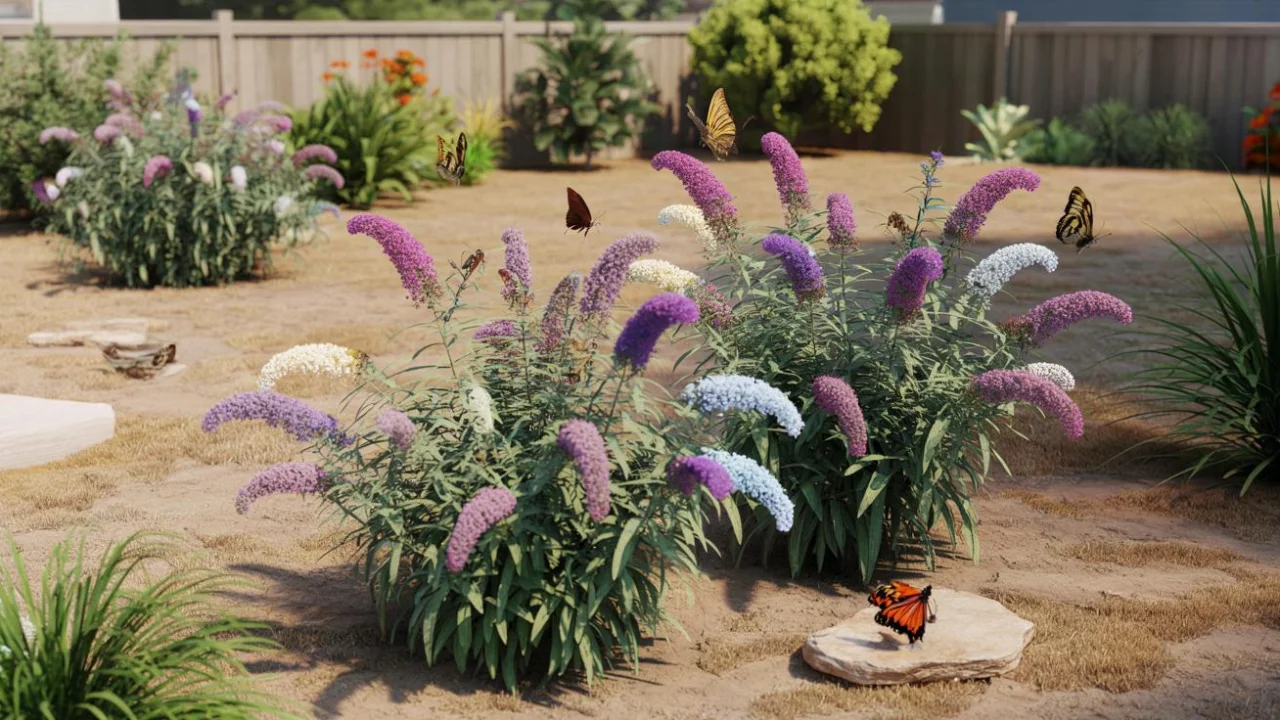
The first time I saw a front yard packed with butterflies, it wasn’t in some lush, misty garden. It was on a dry, sunburned street in late July, where the grass was crispy and the air felt like a hairdryer on high.

Right in the middle of that heatwave, one small corner lot was buzzing and fluttering like its own little universe. No sprinkler lines. No perfect lawn. Just swaying spikes of purple flowers and clouds of orange, yellow, and black wings.
Cars slowed down when they passed. A kid on a scooter stopped, staring, his mouth open. Behind the fence, an older woman in a straw hat smiled and said, almost proudly: “It’s just my butterfly bush.” Then she added, with a shrug: “I barely water it at all.” That’s when I realized how one tough plant can flip an entire yard’s story.

The drought-champion that creates butterfly magic
Walk through any hot, dry neighborhood in midsummer and you’ll notice two kinds of yards. The ones that look tired. And the ones that look alive.
Very often, the living, moving ones have the same star player: butterfly bush, also known as Buddleja. Long, honey-scented flower spikes, sometimes purple, sometimes white or deep magenta, waving over a mess of narrow gray-green leaves.

It looks a bit wild, a little rebellious. Yet for butterflies, it’s basically a neon “Open” sign.
“I’ve never seen anything draw butterflies like a butterfly bush in full bloom,” says Maria Rodriguez, a master gardener in Austin. “On a good day, I’ll count fifteen different species just on one plant.”

The secret lies in the flowers themselves. Each bloom spike contains hundreds of tiny, nectar-rich flowers that open in sequence, creating a buffet that lasts for months. While most flowers fade after a week or two, butterfly bush keeps pumping out fresh blooms from early summer through the first frost.
But here’s what makes this butterfly haven plant truly special: it thrives on neglect. The more you baby it, the less impressive it becomes. Skip the fertilizer. Forget the daily watering. This Mediterranean native actually prefers lean, well-draining soil and can handle weeks without rain.

Everything you need to know about growing your butterfly haven plant
Creating your own butterfly paradise doesn’t require a green thumb or a gardening degree. Here’s what makes butterfly bush so beginner-friendly:
| Growing Requirement | Butterfly Bush Needs |
|---|---|
| Water | Minimal after first year – drought tolerant |
| Sunlight | Full sun (6+ hours daily) |
| Soil | Well-draining, average to poor soil |
| Temperature | Thrives in heat, hardy to zones 5-10 |
| Maintenance | Annual pruning, deadheading for more blooms |
The planting process couldn’t be simpler. Dig a hole twice as wide as the root ball but just as deep. Backfill with native soil – no need for fancy amendments. Water deeply once or twice a week for the first month, then step back and let nature take over.
“Most people kill butterfly bush with kindness,” explains Tom Chen, a nursery owner in Denver. “They water it every day, fertilize it monthly, and wonder why it looks leggy and produces fewer flowers. This plant wants to struggle a little.”
Key varieties to consider for your butterfly haven plant collection:
- Black Knight: Deep purple spikes, compact growth, extremely hardy
- White Profusion: Pure white flowers, attracts different butterfly species
- Pink Delight: Soft pink blooms, lighter fragrance, longer flowering period
- Nanho Blue: Dwarf variety, perfect for smaller spaces or containers
Timing matters when planting. Spring installation gives the roots time to establish before summer heat hits. Fall planting works in milder climates but requires some winter protection in colder zones.
The ripple effect of butterfly gardens
Once you’ve got butterflies visiting your yard, something magical happens. Other pollinators notice. Bees arrive for the nectar. Hummingbirds investigate the activity. Birds come hunting for insects. What started as one drought-tolerant shrub becomes the foundation of a thriving ecosystem.
Dr. Sarah Williams, an entomologist at the University of California, has studied butterfly populations in urban areas for over a decade. “A single mature butterfly bush can support the entire lifecycle of multiple butterfly species,” she notes. “We’re not just talking about adult butterflies stopping by for a snack. Some species actually lay their eggs on nearby plants because they know food will be available.”
The environmental benefits extend beyond your property line. Butterfly populations have declined by nearly 80% in some regions over the past two decades, largely due to habitat loss and climate change. Every butterfly haven plant you establish creates a stepping stone that helps these fragile creatures move through increasingly developed landscapes.
Neighborhoods with multiple butterfly gardens report higher property values and increased community engagement. There’s something about watching butterflies that brings people together. Kids become curious about nature. Adults start conversations over fence lines about which varieties work best.
“My butterfly bush started a whole movement on our street,” says Jennifer Park, a homeowner in suburban Atlanta. “Now we have seven houses with butterfly gardens, and the kids do butterfly counts every weekend during summer.”
The maintenance payoff is real too. While your neighbors struggle with brown patches, irrigation repairs, and weekly mowing, your butterfly haven plant just keeps blooming. One woman in Phoenix calculated that switching to drought-tolerant butterfly gardens saved her $1,200 annually in water bills.
Beyond butterflies, these plants support an incredible diversity of beneficial insects. Native bees, hover flies, and predatory wasps all visit butterfly bush flowers. This natural pest control reduces the need for chemical interventions in your garden.
Climate change makes heat-tolerant, water-wise gardening more relevant every year. As summers get longer and droughts become more common, plants like butterfly bush offer a glimpse of what successful landscaping looks like in our changing world.
FAQs
How long does it take for butterfly bush to attract butterflies?
Most gardeners see their first butterfly visitors within the first blooming season, usually by midsummer of the planting year.
Do I need to plant multiple butterfly bushes to create a butterfly haven?
One mature plant can attract dozens of butterflies, but having 2-3 different colored varieties extends the blooming season and appeals to more species.
Is butterfly bush invasive?
Traditional varieties can self-seed aggressively, but newer sterile cultivars like ‘Miss Molly’ and ‘Miss Ruby’ provide the same butterfly benefits without spreading.
Can butterfly bush survive winter in cold climates?
Most varieties are hardy to zone 5 and can handle temperatures down to -10°F with minimal winter protection like mulching around the base.
How big do butterfly bushes get?
Standard varieties reach 6-8 feet tall and wide, while dwarf cultivars stay around 3-4 feet, making them perfect for smaller yards or container growing.
Do butterfly bushes need special soil?
They’re remarkably adaptable and actually prefer average to poor soil with good drainage over rich, heavily amended garden soil.
About the Author