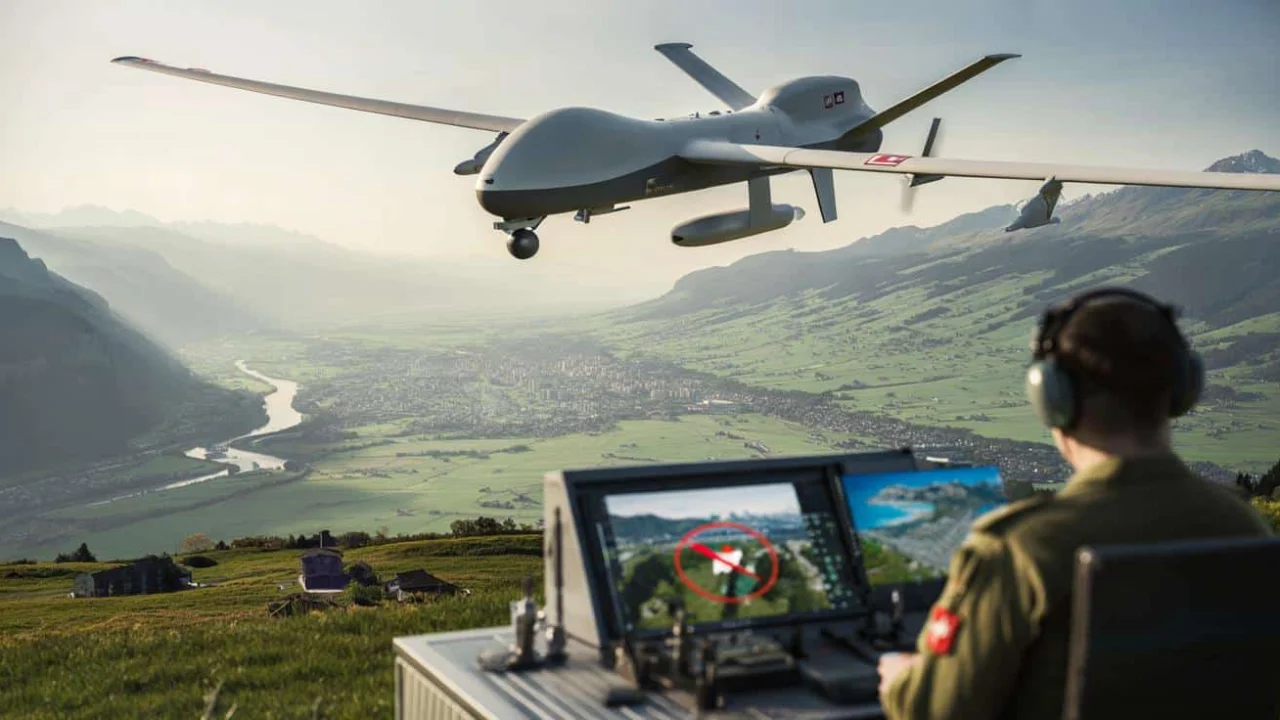
Maria Zimmermann was walking her dog through the quiet streets of Emmen when she heard the distinct hum overhead. Looking up, she spotted the unmistakable silhouette of a large military drone cutting through the Swiss sky. “I thought we were done with those things,” she muttered to her neighbor, remembering the heated town hall meetings about drone safety just months earlier.

What Maria witnessed was history repeating itself – but this time with a twist. The controversial Hermes military drone is back in Swiss airspace, though under dramatically different rules than before.
After months of being grounded due to safety concerns and public outcry, Switzerland’s most expensive military drone program is cautiously returning to active testing. But don’t expect to see these Israeli-made aircraft buzzing over Zurich or Geneva anytime soon.

Why Switzerland’s Most Expensive Drone Got a Second Chance
The Hermes 900 represents more than just another military aircraft – it’s a 300 million Swiss franc bet on Switzerland’s defense future. When you’re talking about that kind of money, you don’t just walk away without a fight.
Swiss defense officials found themselves caught between mounting public pressure and the reality of signed contracts with Israeli manufacturer Elbit Systems. The drone program had already faced significant delays and technical problems that made headlines across the country.

“We couldn’t simply abandon a program of this scale without exploring every possible solution,” explains defense analyst Thomas Hurter. “The financial implications alone demanded a more measured approach.”
The compromise? Bring back the Hermes military drone, but strip away its most controversial capability – flying over populated areas where millions of Swiss citizens live and work.

The New Rules That Change Everything
The restrictions now governing the Hermes 900 operations represent a complete overhaul of how Switzerland approaches military drone testing. These aren’t minor adjustments – they’re fundamental changes that will shape every flight.
| Previous Operations | New Restrictions |
|---|---|
| Flights over all Swiss territory | Banned over densely populated areas |
| Standard military protocols | Enhanced safety monitoring required |
| Routine test schedules | Limited flight windows with advance notice |
| Military airspace priority | Civilian air traffic takes precedence |
The most significant change involves geographic restrictions. The drone can no longer operate over Switzerland’s major population centers, effectively creating invisible boundaries in the sky.

Here’s what the new operating framework includes:
- Mandatory flight path approval 48 hours in advance
- Real-time monitoring by both military and civilian aviation authorities
- Automatic flight termination if the drone approaches restricted zones
- Enhanced communication protocols with local communities
- Monthly safety reviews with public reporting requirements
“These restrictions fundamentally change how we can use this system,” admits Colonel Andreas Weber from the Swiss Air Force. “But they represent a necessary compromise between operational needs and public concerns.”
The Hermes military drone must also carry upgraded tracking technology that allows ground controllers to monitor its position with unprecedented precision. If the aircraft deviates from its approved flight path by even a few hundred meters, automatic systems will force it to return to base.
What This Means for Swiss Defense and Your Daily Life
For most Swiss residents, these changes translate into something surprisingly simple: you’re far less likely to see or hear military drones during your daily routine. The aircraft will primarily operate over remote mountain regions and designated military training areas.
But the implications run much deeper than noise reduction. Switzerland’s defense strategy has traditionally relied on the ability to monitor its entire territory, including border regions that pass through or near populated areas.
“We’re essentially operating with one hand tied behind our back,” explains security expert Dr. Sarah Meier from the Graduate Institute in Geneva. “The question becomes whether a drone that can’t fly over population centers can actually fulfill its intended mission.”
The economic impact extends beyond the military sphere. Switzerland’s reputation as a reliable partner for international defense contracts could suffer if the Hermes program ultimately fails. Other nations watching this situation might reconsider their own Swiss military partnerships.
Local communities near remaining flight zones face a different reality. Towns like Alpnach and surrounding areas will continue experiencing regular drone operations, though with enhanced advance notification systems.
The restricted Hermes military drone operations also affect emergency response capabilities. During natural disasters or security threats, Swiss authorities may find their surveillance options limited precisely when they need them most.
Swiss taxpayers, meanwhile, are watching their 300 million franc investment operate under conditions that significantly reduce its effectiveness. Parliament members have already begun questioning whether the program delivers sufficient value under these new constraints.
“Citizens deserve to know whether we’re getting our money’s worth from this system,” states parliamentarian Lisa Mazzone. “These restrictions may have solved the safety concerns, but they’ve created new questions about operational value.”
The international defense community is also paying close attention. Switzerland’s handling of the Hermes military drone situation could influence how other nations approach similar programs, particularly regarding public acceptance and safety protocols.
Looking ahead, the success or failure of these modified operations will likely determine whether Switzerland continues investing in large military drones or shifts toward alternative surveillance technologies. The next six months of testing will be crucial for the program’s long-term survival.
FAQs
Why was the Hermes military drone grounded in the first place?
Safety concerns arose after technical issues during test flights, combined with public opposition to military drones flying over populated areas.
How much did Switzerland spend on these drones?
The total program cost is approximately 300 million Swiss francs for six Hermes 900 drones and associated equipment.
Can the drones still be used for border security?
Yes, but only along border sections that don’t pass over densely populated areas, which limits their effectiveness in certain regions.
Will these restrictions be permanent?
The current restrictions are part of a testing phase, but they could become permanent depending on public acceptance and operational results.
What happens if a drone accidentally flies over a restricted area?
Automatic systems will force the drone to return to base immediately, and the incident will trigger a mandatory safety review.
Are other countries watching Switzerland’s approach?
Yes, several nations with similar drone programs are closely monitoring how Switzerland balances public concerns with military needs.
About the Author