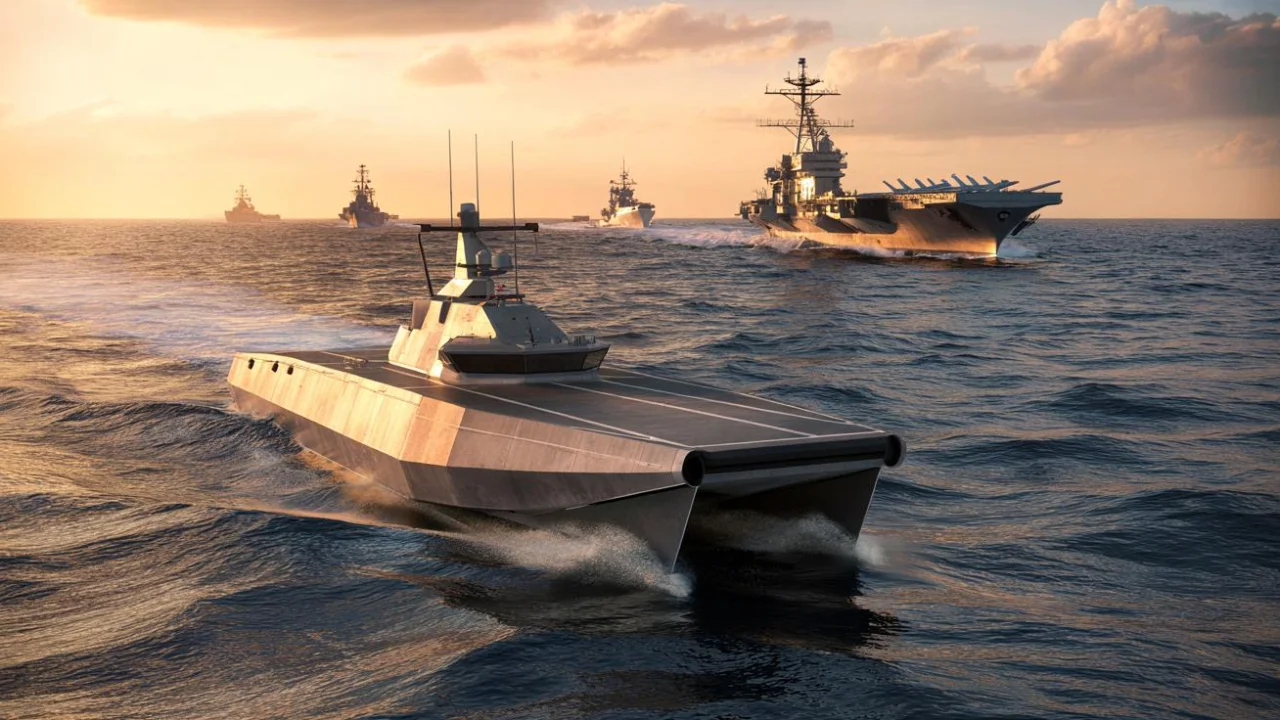
Captain Sarah Chen still remembers the skeptical looks from her fellow officers when she first heard about unmanned boats patrolling the seas. “Robot ships? Come on,” she thought, imagining clunky prototypes bumping into everything. That was five years ago at the Naval War College.
Today, Chen commands a destroyer in the Pacific, and those same “robot ships” are about to become her new wingmen. The Navy’s experimental drone boats are finally ready for prime time, shifting from curiosity to crucial naval asset in what officials are calling a pivotal moment for maritime warfare.
After years of testing, tweaking, and proving themselves in controlled environments, navy drone boats are stepping into operational reality. This isn’t just another military gadget story—it’s about fundamentally changing how America projects power across the world’s oceans.

From Science Project to Naval Reality
The U.S. Navy will deploy two medium-sized unmanned surface vessels this year, marking the first time these experimental platforms move from research labs to actual fleet operations. Officials confirmed that one drone boat will operate alongside a carrier strike group in 2026, representing a major shift in naval strategy.
Captain Garrett Miller, who leads Surface Development Group One, made the announcement at the Surface Navy Association symposium in Washington. His words carried weight that years of speculation couldn’t match: “They will no longer be experimental vessels. They will actually be under fleet control.”

The two vessels—Sea Hunter and Seahawk—are classified as medium displacement unmanned surface vessels (MDUSVs). While they might look like modest trimaran patrol ships to casual observers, their real power lies beneath the surface in sophisticated autonomy software, extended operational range, and adaptable mission capabilities.
“We’ve moved beyond the proof-of-concept phase,” explains naval technology analyst Dr. Rebecca Torres. “These aren’t remote-control boats anymore. They’re autonomous naval platforms that can make decisions, adapt to threats, and operate for weeks without human intervention.”

What These Navy Drone Boats Actually Do
The capabilities of these unmanned vessels extend far beyond what their compact size might suggest. Here’s what makes them game-changers for naval operations:
- Extended patrol missions: Operate continuously for up to 90 days without refueling
- Intelligence gathering: Monitor enemy movements and communications in contested waters
- Anti-submarine warfare: Track and identify underwater threats using advanced sonar systems
- Force protection: Screen larger vessels from small boat attacks and underwater threats
- Mine detection: Clear shipping lanes and harbor approaches of explosive devices
- Electronic warfare: Jam enemy communications and radar systems

The versatility comes from modular payload systems that allow commanders to configure each vessel for specific missions. Today’s sub-hunting platform becomes tomorrow’s electronic warfare node with relatively simple equipment swaps.
| Specification | Sea Hunter | Traditional Patrol Boat |
|---|---|---|
| Crew Required | 0 | 12-20 |
| Operating Range | 10,000+ nautical miles | 2,500 nautical miles |
| Mission Duration | 70-90 days | 7-14 days |
| Annual Operating Cost | $3.2 million | $15.8 million |
“The economics are compelling, but the strategic implications are what really matter,” notes former Navy commander James Walsh. “You can position these assets in areas too dangerous or politically sensitive for crewed vessels.”
Why This Changes Everything for Naval Warfare
The deployment of operational navy drone boats represents more than technological advancement—it signals a fundamental shift in how naval forces project power and gather intelligence. The implications ripple across multiple domains of maritime security.
For allied nations, these platforms offer enhanced cooperation opportunities. Drone boats can patrol shared territorial waters, conduct joint intelligence missions, and provide early warning capabilities without the diplomatic complications of stationing foreign sailors in sensitive areas.
Commercial shipping companies are watching closely too. These unmanned platforms could provide escort services through piracy-prone regions, clear shipping lanes of mines, and respond to maritime emergencies faster than traditional naval assets.
The technology also addresses a critical personnel challenge. Navy recruitment has struggled in recent years, and these platforms multiply the effectiveness of available crews. One destroyer can now coordinate with multiple drone boats, expanding its operational reach without additional human resources.
“We’re seeing the early stages of distributed maritime operations,” explains defense analyst Maria Rodriguez. “Instead of concentrating firepower in a few large vessels, the Navy can spread capabilities across multiple platforms, making the entire force more resilient and flexible.”
The timing isn’t coincidental. Rising tensions in the South China Sea, increased submarine activity from potential adversaries, and the need to monitor vast ocean areas all create perfect conditions for unmanned naval platforms to prove their worth.
Potential adversaries are taking notice too. The successful deployment of these systems could accelerate similar developments by other nations, creating a new dynamic in naval competition where autonomous systems play increasingly prominent roles.
For naval officers like Captain Chen, the transition represents both opportunity and adaptation. “You have to think differently about command and control when your wingman doesn’t have a crew to radio,” she explains. “But the tactical advantages are undeniable—these platforms go places and do things that would be too risky for crewed vessels.”
The broader implications extend to naval budgeting and shipbuilding priorities. If drone boats prove as effective as early testing suggests, future fleet compositions might favor larger numbers of smaller, unmanned platforms over traditional approaches emphasizing fewer, larger crewed vessels.
This shift also influences naval training and career development. Officers must now learn to integrate autonomous systems into traditional naval operations, while engineers and technicians need specialized skills to maintain and upgrade these sophisticated platforms.
FAQs
How are navy drone boats controlled during missions?
They operate autonomously using artificial intelligence for routine tasks, but human operators can take control remotely when needed for critical decisions or complex situations.
What happens if a drone boat loses communication with its controllers?
The vessels are programmed with pre-set mission parameters and safety protocols that allow them to continue operating or return to base safely even without constant communication.
Can these unmanned boats defend themselves if attacked?
Current models focus primarily on detection and evasion rather than offensive capabilities, though they can be equipped with defensive countermeasures depending on mission requirements.
How much do these navy drone boats cost compared to traditional ships?
Each drone boat costs approximately $20-30 million to build and $3.2 million annually to operate, significantly less than comparable crewed vessels which can cost $15-20 million per year just in personnel expenses.
Will drone boats replace human sailors entirely?
No, these platforms are designed to augment human capabilities rather than replace them. Complex decision-making, maintenance, and strategic planning still require human expertise and judgment.
When will other countries deploy similar unmanned naval vessels?
Several nations including China, Russia, and the UK are already testing similar technologies, with operational deployments likely within the next 2-3 years as the technology matures and costs decrease.
About the Author