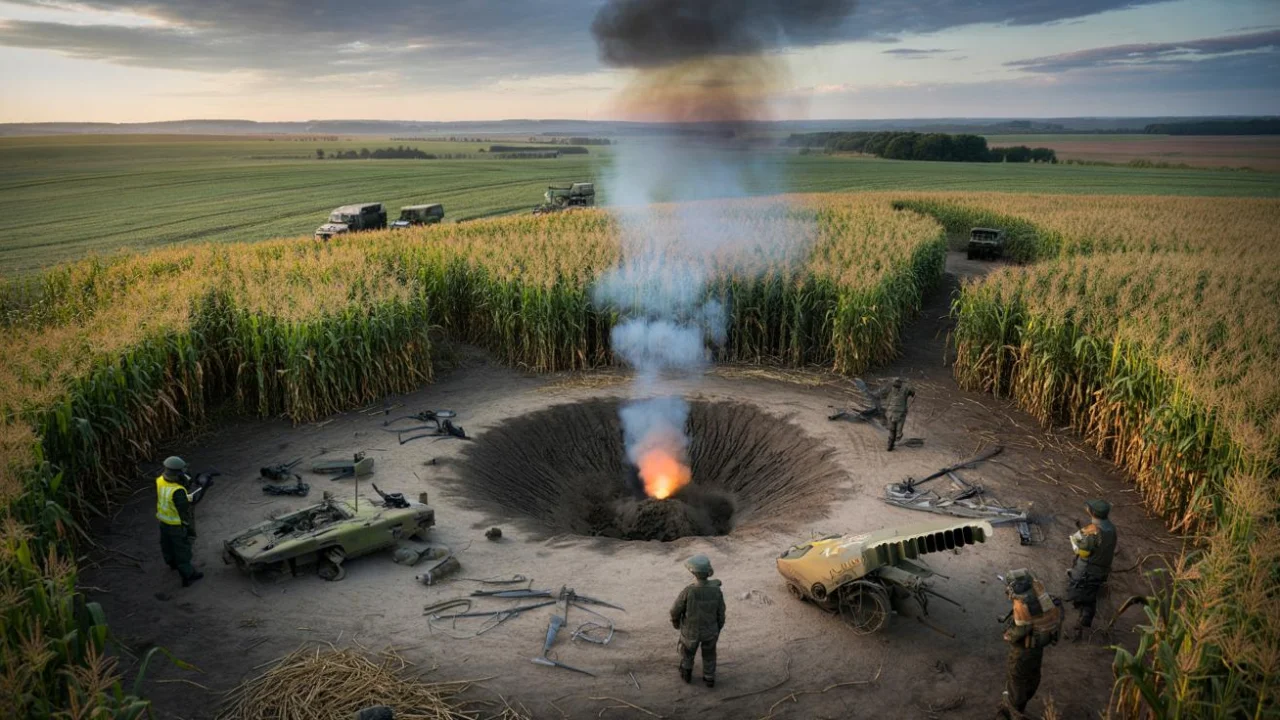
Maria Kowalski was feeding her chickens when the ground beneath her feet trembled. The 67-year-old farmer from Osiny village had lived near Poland’s eastern border her entire life, but she’d never heard anything like the thunderous boom that echoed across her cornfield at 3:47 AM. “I thought lightning struck, but there were no clouds,” she later told local police. “Then I saw this orange glow in my neighbor’s field.”

What Maria witnessed wasn’t a storm. Polish authorities now believe a Russian military drone may have crashed into NATO territory, marking another dangerous escalation in how the Ukraine war continues to spill beyond Ukrainian borders.
This incident highlights a growing concern for millions living near conflict zones: when does a distant war become your immediate reality? For residents along Poland’s 530-kilometer border with Ukraine, that question becomes more pressing with each passing month as the conflict enters its second year with no clear resolution in sight.

When War Crosses Borders: What Happened in the Cornfield
The explosion occurred in a rural area near Osiny village, roughly 60 kilometers from the Ukrainian border. Polish emergency services responded within hours after multiple residents reported the blast and mysterious flash of light that illuminated the pre-dawn darkness across several neighboring farms.
Investigators discovered a crater approximately two meters wide in the middle of a cornfield owned by local farmer Stanisław Górski. The blast pattern suggested a relatively small explosive device rather than a large missile strike, with corn stalks flattened in a circular pattern extending roughly 30 meters from the impact point. Most significantly, military experts found engine components that appeared consistent with a Gerbera drone system.

“The debris pattern and engine parts we recovered point to a drone-type aircraft rather than traditional ordnance,” explained Colonel Jan Nowak, a Polish military spokesman. “We’re analyzing the components to determine their exact origin and whether this represents an intentional border crossing or technical malfunction.”
Gerbera drones represent a specific type of Russian military technology designed for reconnaissance and light attack missions. These unmanned aircraft typically carry small payloads ranging from surveillance equipment to modest explosive charges, and operate within a 150-kilometer range of their launch point. Russian forces have increasingly relied on drone swarms to overwhelm Ukrainian air defenses while conserving more expensive missile systems.

The timing raises additional concerns for NATO security analysts. This incident occurred during a period of intensified Russian drone attacks against Ukrainian infrastructure, particularly targeting power grids and transportation networks in western Ukraine. Intelligence reports suggest Russia has been launching up to 50 drones per night in coordinated waves designed to saturate Ukrainian air defense systems.
Weather conditions at the time may have contributed to the navigation error. Meteorological data shows dense fog and low cloud cover across the border region, conditions that commonly interfere with GPS navigation systems used by unmanned aircraft. Several aviation experts noted that such weather patterns have historically led to navigation errors during military operations.

Breaking Down the Technical Evidence
Polish military analysts are examining several key pieces of evidence from the crash site. Their findings could determine whether this represents an intentional border violation or an accidental overflight that might trigger Article 5 consultations within NATO.
| Evidence Type | Description | Significance |
|---|---|---|
| Engine Components | Piston-powered motor fragments with Cyrillic markings | Consistent with Gerbera drone propulsion systems |
| Blast Pattern | 2-meter crater, limited structural damage | Small explosive payload typical of reconnaissance drones |
| Debris Field | Scattered over 50-meter radius in directional pattern | Suggests controlled crash rather than mid-air explosion |
| Electronic Components | Circuit boards and navigation equipment fragments | Under analysis for origin determination and GPS data recovery |
| Fuel Residue | Traces of aviation fuel in soil samples | Confirms aircraft-type propulsion rather than missile fuel |
Several factors support the drone theory according to forensic analysis conducted by Polish military engineers:
- The explosion’s limited scope matches typical drone payloads of 5-10 kilograms
- Engine fragments appear consistent with small aircraft propulsion systems manufactured in Russia
- No missile-type warhead debris or rocket fuel residue was discovered at the site
- The crash pattern suggests a mechanical failure rather than intentional detonation
- Timing coincides with increased Russian drone operations in western Ukraine near Lviv
- Recovered GPS components show coordinates suggesting a target 40 kilometers inside Ukraine
“We’re treating this as a potential navigation error or technical malfunction rather than a deliberate attack,” noted Defense Minister Antoni Macierewicz during a press briefing. “However, we’re taking the investigation very seriously given the implications for NATO security and the precedent this might set for future incidents.”
The investigation has revealed additional concerning details about the drone’s capabilities. Preliminary analysis suggests the aircraft was equipped with advanced navigation systems and carried surveillance equipment alongside its small explosive payload. This dual capability raises questions about whether Russian forces are using reconnaissance drones to map NATO defensive positions along the border.
Real Consequences for Border Communities
For the 2.1 million Polish citizens living within 100 kilometers of the Ukrainian border, incidents like this represent a daily reality check. The Ukraine war isn’t something they read about in newspapers – it’s reshaping their everyday lives in ways that Western Europeans and Americans rarely consider.
Local authorities have implemented new emergency protocols following this incident. Residents now receive regular updates through a dedicated mobile app about potential airspace violations and know exactly what steps to take if they discover suspicious objects on their property. The system includes automated alerts sent directly to mobile phones when military aircraft are detected approaching the border.
“We’ve had three similar alerts in the past six months,” explained Tomasz Wielicki, mayor of nearby Chełm. “Each time, we activate our emergency response system and coordinate with military units stationed in the region. Our residents understand the risks of living this close to an active conflict zone, but they’re remarkably resilient.”
The economic impact extends far beyond immediate security concerns. Agricultural communities near the border face increased insurance costs that have risen by an average of 40% since the war began. Stricter airspace regulations now affect crop-dusting operations and agricultural flights, forcing farmers to rely on ground-based pest control methods that are often less effective and more expensive.
Polish farmers have also reported significant changes in their daily routines that reflect the new reality of living near an active conflict. Many now avoid working their fields during early morning and evening hours when drone activity typically peaks according to military advisories. Some have invested in radio equipment to maintain constant contact with local emergency services, while others have installed security cameras to monitor their property for unusual activity.
“My grandfather farmed this same land during World War II,” said Pavel Kowalczyk, whose property borders the crash site. “He always said wars have a way of finding ordinary people, even when they try to stay out of the way. I never thought I’d understand what he meant until now.”
The psychological impact on border communities cannot be understated. Local mental health services report a 60% increase in anxiety-related visits since February 2022, with many residents struggling to cope with the constant uncertainty. Children in border schools now participate in regular air raid drills, and many families have prepared emergency evacuation plans.
NATO officials are closely monitoring the investigation’s progress with particular attention to its implications for collective defense. Any confirmation that Russian military equipment crossed into Polish airspace would trigger formal diplomatic protests and potentially more serious military responses under Article 5 provisions. The alliance has already deployed additional Patriot missile batteries along the Polish border as a precautionary measure.
The incident also highlights broader challenges facing NATO’s eastern flank as the organization struggles to maintain unity while supporting Ukraine. Alliance members must balance providing robust military aid to Ukrainian forces while preventing the conflict from escalating into a direct confrontation with Russia that could trigger World War III.
“Every border incident requires careful analysis and measured response,” explained former NATO analyst Dr. Rebecca Martinez, who now teaches security studies at the Warsaw Institute. “We need to distinguish between accidental violations and intentional provocations while maintaining our collective defense commitments. The risk of miscalculation grows with each incident.”
Intelligence sources suggest this may not be an isolated incident. Classified reports indicate similar drone incursions have occurred along NATO borders with Romania and Slovakia, though details remain restricted. The pattern suggests either systematic navigation failures in Russian drone systems or potential testing of NATO response capabilities.
Looking Ahead: Implications for Regional Security
Polish officials expect to complete their technical analysis within two weeks, with findings shared immediately with NATO partners and the European Union. The results will likely influence future air defense deployments along NATO’s eastern borders and could affect how alliance members respond to similar incidents in the coming months.
Military planners are already discussing enhanced coordination mechanisms to prevent accidental escalation. Proposed measures include establishing a direct communication channel with Russian military commanders to clarify incidents quickly, though Moscow has shown little interest in such arrangements.
The European Union is also considering additional sanctions targeting Russian drone manufacturing capabilities. Current restrictions focus primarily on advanced semiconductors and guidance systems, but officials are exploring ways to limit access to basic components used in simpler reconnaissance drones.
For now, life continues in Osiny village with a new sense of wartime normalcy. Maria Kowalski still feeds her chickens each morning, though she admits to checking the sky more often these days and keeping her mobile phone nearby for emergency alerts. The cornfield where the drone crashed has been cordoned off while investigators complete their work, serving as a stark reminder that the Ukraine war may feel distant to people in Western capitals, but for border communities like hers, it’s never been closer to home.
Local authorities have established a victim compensation fund for property damage from military incidents, though the psychological scars may prove harder to address. As one resident noted during a community meeting, “We wake up each morning not knowing if today will bring another explosion, another reminder that the war next door could become our war at any moment.”
FAQs
What is a Gerbera drone and how dangerous is it?
Gerbera drones are Russian reconnaissance aircraft designed for surveillance and light attack missions, typically carrying small explosive payloads of 5-10 kilograms for limited-range operations up to 150 kilometers.
Has this happened before along Poland’s border?
Polish authorities have reported several similar incidents over the past year, including missile fragments and suspected drone activity, though this marks the first confirmed aircraft crash on NATO territory.
What does this mean for NATO’s response to the Ukraine war?
Any confirmed border violation by Russian military equipment triggers diplomatic protocols and potentially influences NATO’s air defense deployments, though accidental incursions are handled differently than deliberate attacks.
Are Polish border communities at risk from these incidents?
While the overall risk remains relatively low, communities have implemented emergency protocols and residents receive regular safety updates about airspace violations and suspicious object procedures.
How long will the investigation take?
Polish officials expect to complete technical analysis within two weeks, with preliminary findings shared with NATO allies and final results determining diplomatic response measures.
Could this escalate into direct NATO-Russia conflict?
Military experts believe accidental border violations are unlikely to trigger Article 5 responses, though repeated incidents could lead to enhanced air defense measures and diplomatic tensions.
About the Author