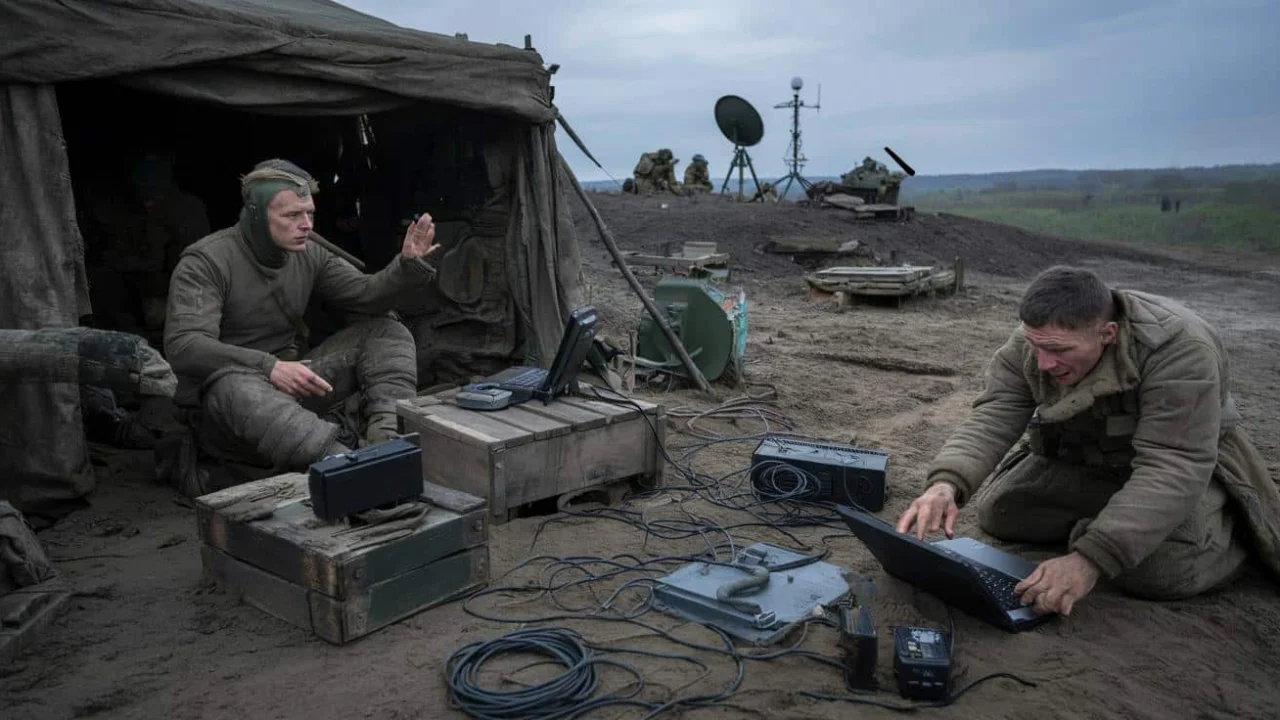
Captain Dmitry had grown used to the quiet hum of his Starlink terminal in the cramped command bunker near Donetsk. For months, the small white dish had been his lifeline—connecting him to artillery coordinates, drone feeds, and encrypted messages from Moscow. Then, on a bitter February morning, the screen went dark.
He wasn’t alone. Across Russian-held territory in Ukraine, similar scenes played out as hundreds of terminals suddenly lost connection. The silence that followed wasn’t caused by Ukrainian jamming or winter storms. It came from a decision made thousands of miles away in SpaceX headquarters, where Elon Musk’s company had quietly implemented new Starlink restrictions targeting Russian military users.
This technological cat-and-mouse game has now become one of the most dramatic examples of how civilian infrastructure shapes modern warfare—and how quickly the rules can change.

When Satellites Became Weapons of War
Few people imagined that a commercial internet service would become central to Europe’s largest conflict since World War II. Yet Starlink’s constellation of low-orbit satellites has quietly transformed how both sides fight in Ukraine.
The compact terminals, originally designed for rural internet access and maritime communications, proved perfect for battlefield conditions. Unlike traditional military radios, they offer high-speed data connections that work even when ground infrastructure is destroyed. Their portability meant they could be quickly relocated as front lines shifted, while their satellite-based nature made them nearly immune to conventional jamming techniques.

Ukraine received official Starlink access early in the conflict, with thousands of terminals donated through government and private channels. The service became so crucial that Ukrainian President Volodymyr Zelensky personally thanked Musk on multiple occasions. Russian forces took a different approach—acquiring terminals through third-party countries and gray-market dealers, then installing them across occupied territories.
The irony wasn’t lost on military observers: opposing armies were using the same civilian network to coordinate attacks against each other. Intelligence reports suggest that at peak usage, both Ukrainian and Russian forces were operating thousands of Starlink terminals simultaneously.

“Both armies became completely dependent on the same civilian satellite network,” explains Dr. Sarah Mitchell, a defense technology analyst at the Institute for Strategic Studies. “It was unprecedented—enemy forces literally sharing the same internet service provider while trying to kill each other.”
Inside Russia’s Communication Crisis
The new Starlink restrictions have created chaos for Russian military operations. Intelligence reports suggest Moscow is scrambling to implement emergency communication alternatives, but the transition hasn’t been smooth.

The restrictions work through a combination of geofencing technology and behavioral analysis. When terminals are detected operating in Russian-controlled areas or displaying usage patterns consistent with military operations, they’re automatically cut off from the network. The system can differentiate between civilian and military use by analyzing data flow patterns, connection frequencies, and geographical movements.
Here’s what Russian forces are dealing with:
- Loss of real-time drone surveillance feeds that previously provided continuous battlefield awareness
- Disrupted artillery coordination systems, forcing units to rely on slower radio communications
- Broken encrypted communication links between command posts and front-line units
- Limited access to satellite imagery and real-time mapping data crucial for tactical planning
- Reduced capability for electronic warfare operations that required high-bandwidth connections
- Delayed intelligence sharing between different military branches and command levels
- Compromised logistics coordination, affecting supply chain efficiency
The impact varies dramatically by location and unit type. Elite special forces units often had multiple backup communication systems and were less affected. However, regular army units that had grown dependent on Starlink for everything from navigation to entertainment found themselves suddenly isolated.
Some Russian positions that had relied almost entirely on Starlink connectivity now struggle with basic operational tasks. Artillery units report delays of several minutes in receiving targeting data—an eternity in modern warfare where positions can change rapidly.
| Communication Type | Pre-Restrictions Status | Current Impact Level | Recovery Timeline |
|---|---|---|---|
| Artillery Coordination | Starlink-dependent | Severely disrupted | 6-12 months |
| Drone Operations | Mixed systems | Moderately affected | 2-4 months |
| Command Networks | Multiple backups | Limited disruption | Immediate |
| Intelligence Sharing | Starlink-preferred | Major delays | 3-6 months |
| Electronic Warfare | High bandwidth required | Capability reduced | 12+ months |
“The Russians built their tactical internet around consumer-grade satellite dishes,” notes Colonel James Harrison, a military communications expert and former Pentagon advisor. “When that access disappeared overnight, entire operational networks collapsed. It’s like losing electricity in a modern city—everything stops working.”
The Scramble for Alternatives
Moscow isn’t sitting idle. Russian forces are reportedly working on several workarounds to overcome the Starlink restrictions, though each comes with significant drawbacks and implementation challenges.
Traditional military radio networks are being rapidly expanded, but they lack the bandwidth needed for modern data-heavy operations. High-frequency radio systems can carry voice communications and simple text messages, but they can’t handle the continuous streams of video, satellite imagery, and real-time tactical data that modern armies require.
Some units are attempting to use commercial cellular networks in occupied areas, though these are vulnerable to Ukrainian cyber attacks and often have limited coverage in rural battlefield locations. Russian forces have also tried establishing their own cellular towers, but these fixed installations become immediate targets for Ukrainian artillery.
Perhaps most concerning for Russian planners is the time factor. Military communication systems typically take months or years to properly implement, test, and integrate with existing doctrine. Battlefield conditions don’t allow for such methodical deployment. Systems are being rushed into service without proper testing, leading to compatibility issues and operational failures.
Russian military contractors are reportedly working on emergency solutions, including:
- Deploying additional GLONASS satellite communication systems, though with limited bandwidth
- Installing more powerful military-grade radio repeaters to extend traditional communication ranges
- Developing mobile communication nodes that can be rapidly relocated to avoid targeting
- Implementing mesh networking systems that can operate without centralized infrastructure
“You can’t just flip a switch and replace satellite broadband with field radios,” explains tech analyst Maria Volkov, who specializes in military communications systems. “The entire tactical doctrine has to change when you lose that connectivity. Units that were operating as networked, information-rich forces suddenly find themselves fighting like armies from the 1980s.”
Some Russian units have reportedly tried to circumvent the restrictions by spoofing their geographical locations or using terminals registered in neutral countries like Kazakhstan or Belarus. However, SpaceX’s detection methods appear to be catching most of these attempts through sophisticated behavioral analysis and cross-referencing with intelligence sources.
The company has also implemented what insiders call “pattern recognition algorithms” that can identify military usage patterns even when location data is masked. These systems look for telltale signs like synchronized connections from multiple terminals, specific data transmission patterns, and usage timing that correlates with known military operations.
The Broader Strategic Impact
The implications extend far beyond individual battles. Modern military operations depend heavily on what defense analysts call “battlefield digitization”—the real-time sharing of data from sensors, drones, satellites, and human observers to create a comprehensive picture of the combat environment.
When that digital backbone fails, forces often revert to slower, less efficient methods that can affect overall campaign effectiveness. Artillery becomes less accurate, air defense systems lose coordination, and logistics networks struggle to adapt to changing battlefield conditions.
The psychological impact shouldn’t be underestimated either. Russian soldiers who had grown accustomed to constant connectivity for both operational and personal communications now find themselves more isolated than their predecessors in previous conflicts.
“We’re witnessing the first major conflict where civilian technology companies can effectively influence military operations through access control,” observes Dr. Mitchell. “This sets precedents that will shape how future wars are fought and how companies navigate wartime responsibilities.”
Intelligence analysts are watching closely to see whether Russia can develop effective alternatives or whether the Starlink restrictions will force significant changes in their operational approach. Early indicators suggest that Russian forces are adapting, but at the cost of reduced operational tempo and decreased tactical flexibility.
The situation also highlights the vulnerability of modern militaries to commercial technology dependencies. What happens when armies become reliant on services controlled by private companies with their own political and ethical considerations?
For now, the silence in Russian command bunkers continues, broken only by the static of traditional radios and the urgent voices of commanders adapting to a suddenly analog world. The long-term effects of this technological disruption may not be fully understood until the conflict ends and military analysts can properly assess how communication limitations affected Russian operational capabilities.
FAQs
How does SpaceX detect Russian military use of Starlink terminals?
SpaceX uses geofencing technology, usage pattern analysis, and behavioral algorithms to identify terminals operating in restricted areas or showing military communication signatures.
Can Russian forces bypass these Starlink restrictions?
Some units attempt workarounds through location spoofing or third-party registrations, but SpaceX’s detection methods are becoming increasingly sophisticated at identifying these attempts.
What alternatives does Russia have to Starlink?
Russian forces can use traditional military radios, their own GLONASS satellite systems, cellular networks, or mesh networking, but these options are slower and less reliable than Starlink.
Are Ukrainian forces affected by these restrictions?
No, Ukrainian military and government users have official access to Starlink services and are not subject to the same geographic or usage restrictions.
How long do these Starlink restrictions last?
The duration depends on SpaceX policy decisions and geopolitical developments, but the company has shown willingness to maintain restrictions throughout ongoing conflicts.
Could this affect civilian Russian users of Starlink?
The restrictions primarily target military usage patterns, but civilian users in occupied territories may experience service limitations due to geographic restrictions.
About the Author