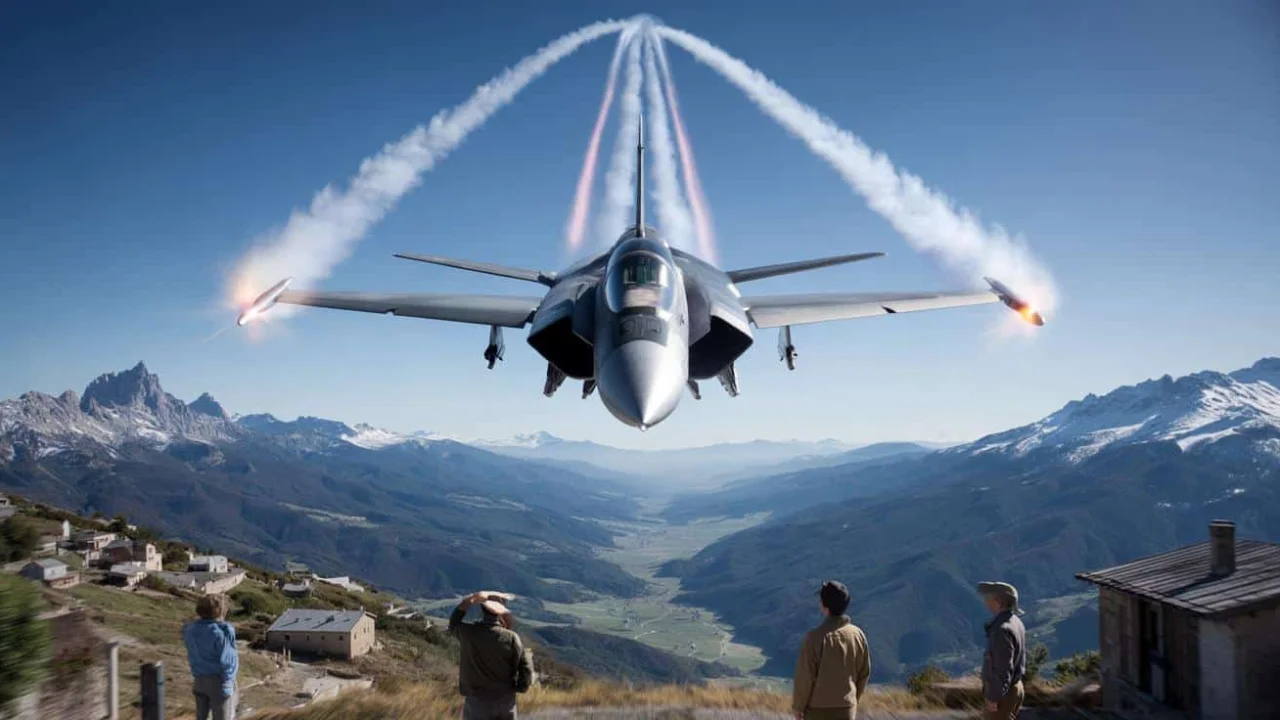
Marie Dubois was hanging laundry in her garden when the world seemed to crack in half. The elderly resident of Saint-Girons had lived in the Pyrenean foothills for seventy years, through thunderstorms that shook the mountains and factory explosions that rattled windows for miles. But this sound was different – a single, ear-splitting bang that seemed to come from the sky itself.

“I thought a plane had crashed right above my house,” she later told her neighbors. Within minutes, her phone was buzzing with calls from worried family members across the valley, all asking the same question: what on earth was that noise?
Marie wasn’t alone in her confusion. Across the entire Pyrenean region, thousands of residents experienced the same jarring moment when a mysterious blast echoed through their communities, sending people rushing outdoors and flooding emergency phone lines with concerned calls.

The mystery blast that shook an entire mountain range
The sonic boom over the Pyrenees occurred late Wednesday morning, transforming a peaceful day into one filled with speculation and worry. Residents from valley villages to remote hilltop farms reported hearing what sounded like a massive explosion or “cannon shot” in perfectly clear weather conditions.
Social media platforms quickly exploded with theories. Some suspected an industrial accident at a nearby factory. Others wondered if a commercial aircraft was in distress. A few even suggested earthquake activity, despite the absence of any ground tremors.
“The sound was so intense that it rattled our windows and made our dog hide under the table for hours,” said local farmer Jean-Pierre Moreau. “We’ve never heard anything like it in thirty years of living here.”
Emergency services across multiple communes received simultaneous calls from concerned citizens. The most telling detail emerged from these reports: nearly everyone described the sound as coming from “everywhere at once” rather than from a specific direction.

This characteristic, as aviation experts later explained, is the unmistakable signature of a sonic boom – the shock wave created when an aircraft exceeds the speed of sound.
Understanding what really happened in the skies above
By afternoon, military officials confirmed what many aviation enthusiasts had already suspected: a supersonic fighter jet had broken the sound barrier during a high-altitude flight over the region. The aircraft was conducting either a training exercise or an interception mission when it generated the sonic boom that startled residents below.

Here’s what makes a sonic boom so distinctive and powerful:
- Sound waves compress and merge when an aircraft exceeds Mach 1 (approximately 767 mph at sea level)
- The resulting shock wave creates a pressure cone that follows the aircraft
- When this cone reaches the ground, it produces the characteristic “double crack” or single boom
- The sound can be heard across an area roughly one mile wide for every 1,000 feet of altitude
- At typical military flight altitudes, this creates an impact zone spanning many miles
“Modern fighter jets routinely break the sound barrier during training and operational missions,” explained former air force pilot Captain Laurent Rousseau. “What’s unusual is having it happen over populated areas where civilians can hear and feel the effects so dramatically.”
The intensity of the sonic boom Pyrenees residents experienced suggests the aircraft was flying at a relatively low altitude compared to typical supersonic flights, which usually occur at much higher elevations to minimize ground impact.
| Altitude (feet) | Boom Impact Zone Width | Sound Intensity |
|---|---|---|
| 10,000 | 10 miles | Very Strong |
| 30,000 | 30 miles | Moderate |
| 50,000 | 50 miles | Mild |
Why this sonic boom caught everyone off guard
Supersonic flights over populated areas are relatively uncommon in European airspace, making the sonic boom Pyrenees event particularly surprising for local residents. Most military supersonic training occurs over designated areas or open ocean to avoid disturbing civilian populations.
The timing and location suggest this may have been an unplanned supersonic flight, possibly related to:
- An emergency scramble to intercept unidentified aircraft
- A training exercise that deviated from its planned route
- International military cooperation exercises in the region
- Testing of new aircraft or flight procedures
“When we hear sonic booms over populated areas, it’s usually because something urgent is happening,” noted aviation security analyst Dr. Sophie Martinez. “Routine training flights are carefully planned to avoid these kinds of civilian impacts.”
The incident highlighted how startling and disorienting sonic booms can be for people who rarely experience them. Unlike the gradual buildup of thunder or the recognizable sound of aircraft engines, a sonic boom arrives as a sudden, violent crack that seems to come from nowhere.
Local authorities praised residents for their quick response and responsible use of emergency services. While the initial flood of calls created some strain on communication systems, officials noted that the community’s reaction was entirely appropriate given the unexpected nature of the event.
The French military has not released specific details about the mission that created the sonic boom, citing operational security protocols. However, such flights are considered routine aspects of national defense and NATO cooperation exercises.
“People shouldn’t worry about occasional sonic booms,” said defense analyst Michel Blanchard. “They’re simply evidence that our military aviation remains active and prepared to respond when needed.”
For residents like Marie Dubois, the experience provided an unexpected reminder of the sophisticated aircraft operations happening in the skies above their peaceful mountain communities. While the initial shock was concerning, most locals expressed relief that the sound had such a mundane explanation.
The sonic boom Pyrenees incident serves as a fascinating example of how modern military aviation can unexpectedly intersect with civilian life, creating moments of drama and confusion that ultimately highlight the constant vigilance of national defense forces.
FAQs
What exactly causes a sonic boom?
A sonic boom occurs when an aircraft travels faster than the speed of sound, creating compressed sound waves that merge into a shock wave and produce the characteristic loud crack when reaching the ground.
How fast was the fighter jet flying to create this sonic boom?
The aircraft was traveling faster than Mach 1, which is approximately 767 mph at sea level, though the exact speed varies with altitude and atmospheric conditions.
Are sonic booms dangerous to people or buildings?
Sonic booms are generally harmless to people but can rattle windows and occasionally cause minor property damage like cracked plaster in very intense cases.
Why don’t we hear sonic booms more often?
Most supersonic flights occur at high altitudes over oceans or designated military areas specifically to avoid disturbing civilian populations with sonic booms.
Can you predict when sonic booms will happen?
Planned supersonic training flights are scheduled in advance, but emergency scrambles or intercept missions can create unexpected sonic booms over populated areas.
How wide an area was affected by this Pyrenees sonic boom?
Based on reports from multiple communes, the sonic boom likely affected an area spanning several dozen miles across the Pyrenean region.
About the Author