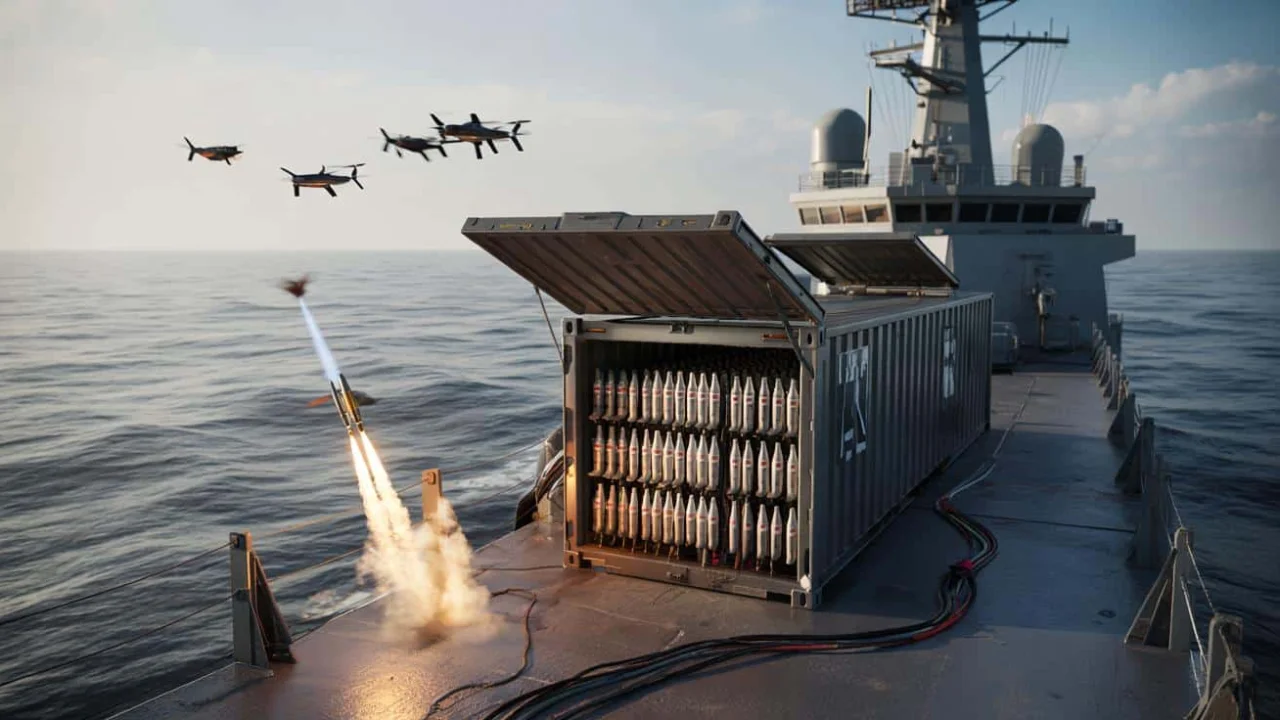
Captain Sarah Mitchell was watching her radar screen during a routine patrol in the North Sea when dozens of small blips suddenly appeared on the horizon. What looked like a swarm of birds turned out to be something far more sinister – a coordinated drone attack heading straight for her destroyer. In that moment, she realized her million-dollar interceptor missiles would be useless against such cheap, disposable threats.

This scenario isn’t science fiction anymore. It’s happening right now in conflict zones around the world, and it’s forcing military leaders to completely rethink how they protect their ships and coastlines.
That’s exactly why British defense giant Babcock and Estonian startup Frankenburg Technologies just announced a game-changing partnership that could revolutionize maritime defense forever.

The Tiny Missile That’s Making Big Waves
Babcock has signed a memorandum of understanding with Frankenburg to develop what they’re calling the world’s most compact antidrone missile system. Think of it as David’s slingshot in an age of Goliath-sized threats.
The Estonian company has created what industry insiders are buzzing about as the “smallest guided missile” ever built for maritime defense. But here’s the kicker – Babcock plans to pack these miniature interceptors into standard shipping containers that can be loaded onto virtually any naval vessel or coastal installation.

“We’re not just building a new weapon system,” explains a senior Babcock engineer familiar with the project. “We’re creating an entirely new philosophy of naval defense that puts quantity and affordability ahead of individual missile sophistication.”
The partnership represents a dramatic shift from traditional naval thinking. Instead of relying on a few expensive, high-tech interceptors, this system would deploy swarms of small, affordable missiles that can engage multiple drone threats simultaneously.

What makes this approach so revolutionary is its flexibility. The containerized launcher system means that any ship – from massive aircraft carriers to small patrol boats – could potentially carry these defensive weapons without major modifications to their existing structure.
Breaking Down the Technology Behind the Defense Revolution
The technical specifications of this antidrone missile system reveal just how different this approach really is from conventional naval defense:

| Feature | Traditional Naval Missile | Frankenburg Antidrone Missile |
|---|---|---|
| Size | Several meters long | Ultra-compact design |
| Cost per unit | $1-3 million | Under $50,000 (estimated) |
| Target capability | Large aircraft, ships | Small drones, swarm attacks |
| Deployment | Dedicated launch systems | Standard shipping containers |
| Reload time | Minutes to hours | Rapid automated reloading |
The system’s key advantages become clear when you consider modern drone warfare tactics:
- Rapid response capability against fast-moving drone swarms
- Cost-effective engagement of low-value targets
- Modular deployment across different vessel types
- Reduced dependency on complex radar and guidance systems
- Quick rearmament and maintenance cycles
But perhaps most importantly, the containerized design means naval forces won’t need to invest in completely new ships or expensive retrofitting programs. The launchers can be loaded and unloaded like standard cargo containers, giving commanders unprecedented flexibility in how they deploy their defensive capabilities.
“The beauty of this system lies in its simplicity,” notes a maritime defense analyst who has reviewed early specifications. “You’re essentially turning every cargo ship into a potential missile platform, which fundamentally changes the strategic calculus for both attackers and defenders.”
What This Means for Naval Warfare and Global Security
The implications of this antidrone missile development extend far beyond the technical specifications. We’re looking at a potential transformation in how nations protect their maritime interests and coastal infrastructure.
For smaller naval forces, this technology represents a democratization of advanced defense capabilities. Countries that could never afford sophisticated missile destroyers might now be able to protect their waters using modified civilian vessels equipped with these containerized systems.
The timing couldn’t be more critical. Recent conflicts have demonstrated how drone swarms can overwhelm traditional defenses, and maritime shipping lanes – the arteries of global commerce – have become increasingly vulnerable to these asymmetric threats.
“We’re essentially witnessing the naval equivalent of the machine gun revolution,” explains a former Royal Navy officer now working in defense consulting. “Just as rapid-fire weapons changed land warfare forever, these swarm-capable defense systems are going to reshape how we think about controlling the seas.”
The economic implications are equally significant. Traditional naval defense systems cost hundreds of millions of dollars and take years to develop and deploy. This modular approach could dramatically reduce both the financial barriers and time-to-deployment for effective maritime defense capabilities.
Commercial shipping companies are already expressing interest in the technology. Cargo vessels traveling through high-risk areas could potentially lease or purchase these containerized defense systems, transforming merchant ships into self-defending platforms without requiring extensive modifications or specialized crews.
However, this democratization of military technology also raises important questions about arms control and regional stability. If antidrone missile systems become as readily available as shipping containers, it could trigger a new kind of maritime arms race where offensive and defensive capabilities evolve rapidly in parallel.
The partnership between Babcock and Frankenburg also represents a broader trend in defense cooperation between established Western defense contractors and innovative smaller companies from NATO’s newer member states. Estonia, despite its small size, has emerged as a significant player in military technology, particularly in areas related to cyber warfare and autonomous systems.
For the UK specifically, this collaboration supports broader strategic goals of maintaining technological leadership in defense while building stronger partnerships with Baltic allies who understand firsthand the evolving nature of modern security threats.
The project is still in early development phases, but industry insiders suggest we could see initial testing within the next 18 months, with potential deployment scenarios emerging by 2027 or 2028.
FAQs
How small is the “smallest” antidrone missile being developed?
While exact dimensions haven’t been released, the missile is designed to be ultra-compact compared to traditional naval interceptors, fitting multiple units within standard shipping containers.
Can any ship use these containerized missile launchers?
The system is specifically designed to work with standard shipping container mounts, meaning most naval vessels and many civilian ships could potentially carry these defensive systems.
How much will these antidrone missiles cost compared to traditional naval weapons?
Industry estimates suggest these missiles will cost under $50,000 each, dramatically less expensive than current naval interceptors that can cost millions per unit.
When will this antidrone missile system be available for deployment?
While still in development, initial testing could begin within 18 months, with potential operational deployment by 2027-2028.
What makes this system better against drone swarms than existing naval defenses?
The system can deploy multiple small missiles simultaneously at a fraction of the cost, making it economically viable to engage large numbers of low-value drone targets.
Will civilian shipping companies be able to use these defense systems?
The modular, containerized design suggests potential civilian applications, though regulatory and legal frameworks would need to be developed for commercial use.
About the Author