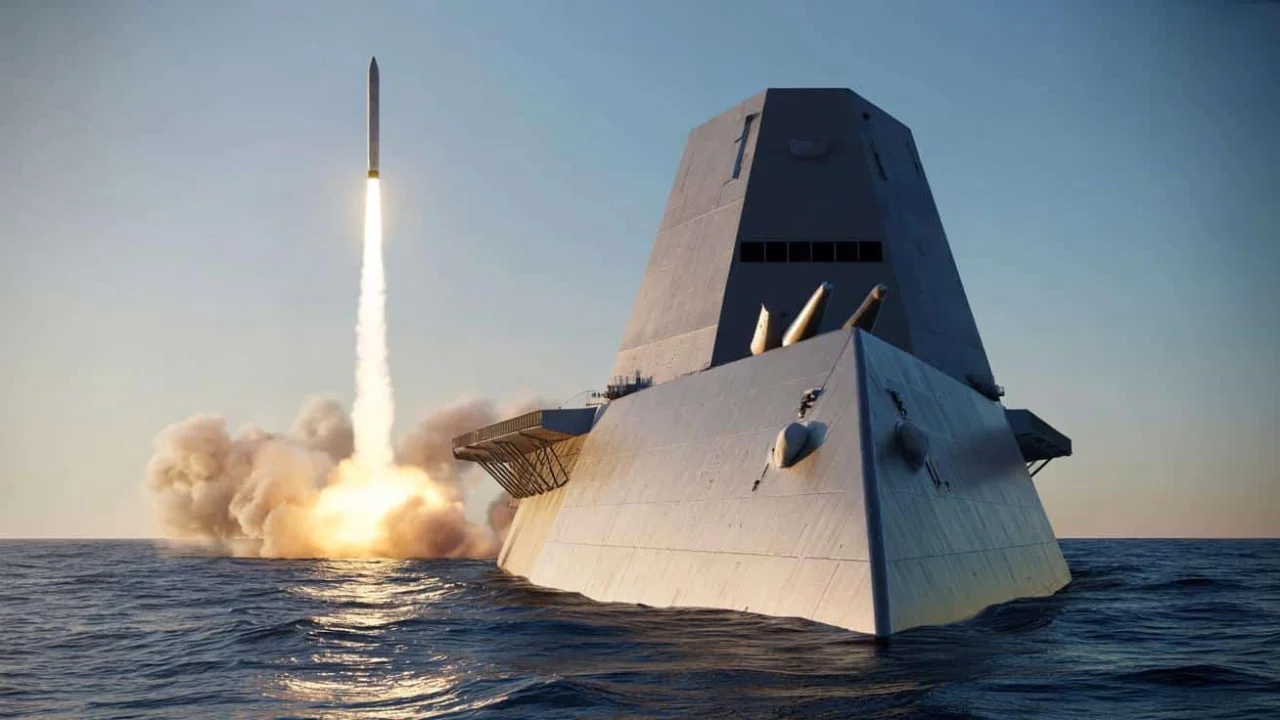
When Sarah Chen first saw the USS Zumwalt during a Navy family day in 2016, her 12-year-old son couldn’t stop talking about its massive guns. “Mom, look at those cannons!” he whispered in awe, pointing at the sleek turrets that made the destroyer look like something from a sci-fi movie. Today, that same boy is serving aboard a different Navy ship, and the Zumwalt he once admired is about to return to sea looking completely different.
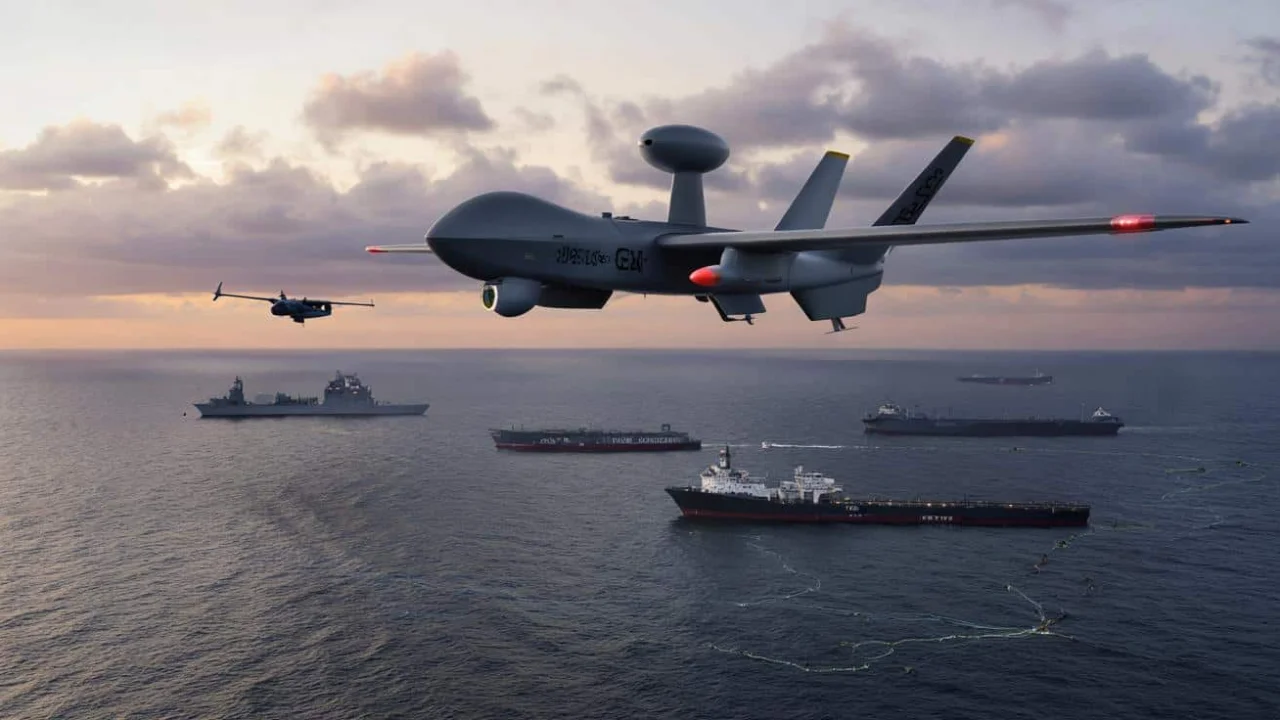
The guns that captured his imagination are gone. In their place sits something far more powerful and terrifying: America’s first shipborne hypersonic missile system. It’s a transformation that tells the story of how quickly military technology evolves, and how even the most advanced warships must adapt or become obsolete.
The USS Zumwalt is preparing to leave dry dock in 2026 after three years of radical surgery. What emerges won’t be the heavily-armed gunship the Navy originally envisioned, but rather a floating launch platform for weapons that can strike targets thousands of miles away in minutes.
From Failed Experiment to Cutting-Edge Weapon
The USS Zumwalt’s journey reads like a cautionary tale about military procurement gone wrong, followed by an impressive comeback story. Originally designed as a stealth destroyer built around two massive 155mm Advanced Gun Systems, the ship became a $4.4 billion disappointment when the ammunition for those guns proved too expensive to produce.
“We realized we had built the world’s most expensive gun platform with no affordable bullets,” explained Captain Clint Lawler, the Navy officer overseeing the Zumwalt-class program, during a recent defense symposium. “Sometimes you have to admit when something isn’t working and find a better path forward.”

That better path involves completely gutting the ship’s main armament and installing something far more valuable: 12 Conventional Prompt Strike hypersonic missiles. These weapons can travel at more than five times the speed of sound, making them nearly impossible to intercept once launched.
The transformation required removing the distinctive angular gun turrets that gave Zumwalt its sci-fi appearance. In their place, engineers installed vertical launch tubes capable of housing the Navy’s newest and most advanced missiles.
What’s Actually Changing on the Ship
The modifications to USS Zumwalt represent one of the most extensive warship overhauls in recent Navy history. Here’s exactly what’s being changed:
| System Removed | Replacement System | Capability Change |
|---|---|---|
| Two 155mm Advanced Gun Systems | 12 Conventional Prompt Strike missiles | Range increases from 83 miles to 1,725+ miles |
| 920 rounds of gun ammunition storage | Advanced missile guidance systems | Precision targeting at hypersonic speeds |
| Gun fire control systems | Hypersonic weapon control center | Ability to engage time-sensitive targets globally |
The engineering challenges have been immense. The original gun systems weighed hundreds of tons and required massive support structures throughout the ship. Removing them meant redesigning power systems, updating cooling infrastructure, and completely rewiring command and control networks.
“We essentially performed open-heart surgery on a warship,” said one Navy engineer familiar with the project, who requested anonymity because they weren’t authorized to speak publicly. “Everything had to be rebuilt from the inside out.”
Key modifications include:
- Installation of 12 vertical launch system tubes designed specifically for hypersonic weapons
- New command and control systems capable of managing hypersonic flight profiles
- Enhanced radar and communication arrays for long-range targeting
- Upgraded power generation to support the energy-intensive missile systems
- Reinforced hull sections to handle the stress of hypersonic weapon launches
The work officially completed in November 2025, with engineers now conducting extensive testing of all systems before the ship returns to active duty.
Why This Matters for America’s Defense
The USS Zumwalt’s transformation reflects a broader shift in how the Navy thinks about future conflicts. Traditional naval gunfire, while effective for coastal bombardment, has limited range and effectiveness against modern air defenses. Hypersonic weapons change that equation entirely.
These missiles can strike targets anywhere in the world within an hour, traveling too fast for current defense systems to intercept. For military strategists, this represents a game-changing capability that could deter conflicts before they start.
“When potential adversaries know that any target can be hit within minutes by a weapon they can’t shoot down, it changes their calculus significantly,” explained Dr. Michael Griffin, former Under Secretary of Defense for Research and Engineering, during a recent defense conference.
The implications extend beyond pure military capability. The USS Zumwalt will serve as a testing platform for hypersonic weapons integration, helping the Navy understand how to deploy these systems across the fleet. Lessons learned from Zumwalt’s operations will influence the design of future warships.
For American taxpayers, the transformation represents an attempt to salvage value from what had become a troubled program. Instead of writing off the billions invested in Zumwalt-class destroyers, the Navy found a way to turn them into platforms for America’s most advanced weapons.
The economic impact reaches beyond defense spending. The hypersonic weapons industry, still in its infancy, will benefit from having an operational platform for testing and refinement. This could accelerate development timelines and reduce costs for future hypersonic systems.
Regional allies are watching closely as well. The presence of hypersonic-armed warships in the Pacific could strengthen deterrence against potential threats while providing new options for crisis response. Unlike nuclear weapons, conventional hypersonic missiles offer powerful deterrence without crossing the nuclear threshold.
FAQs
When will the USS Zumwalt return to active service?
The ship is scheduled to leave dry dock and begin sea trials in 2026, with full operational capability expected later that year.
How much did the USS Zumwalt modifications cost?
While exact figures remain classified, defense analysts estimate the hypersonic weapon integration cost between $500 million and $800 million per ship.
Can the hypersonic missiles be intercepted?
Current defense systems cannot reliably intercept hypersonic weapons due to their speed and ability to maneuver during flight.
Will the other Zumwalt-class ships receive similar modifications?
The Navy plans to modify all three Zumwalt-class destroyers with hypersonic weapons, using lessons learned from the USS Zumwalt’s conversion.
What happens to the removed gun systems?
The Advanced Gun Systems are being stored for potential future use, though no current plans exist for their reinstallation.
How do hypersonic weapons differ from regular missiles?
Hypersonic weapons travel at least five times faster than sound and can maneuver during flight, making them much harder to detect and intercept than traditional ballistic or cruise missiles.
About the Author