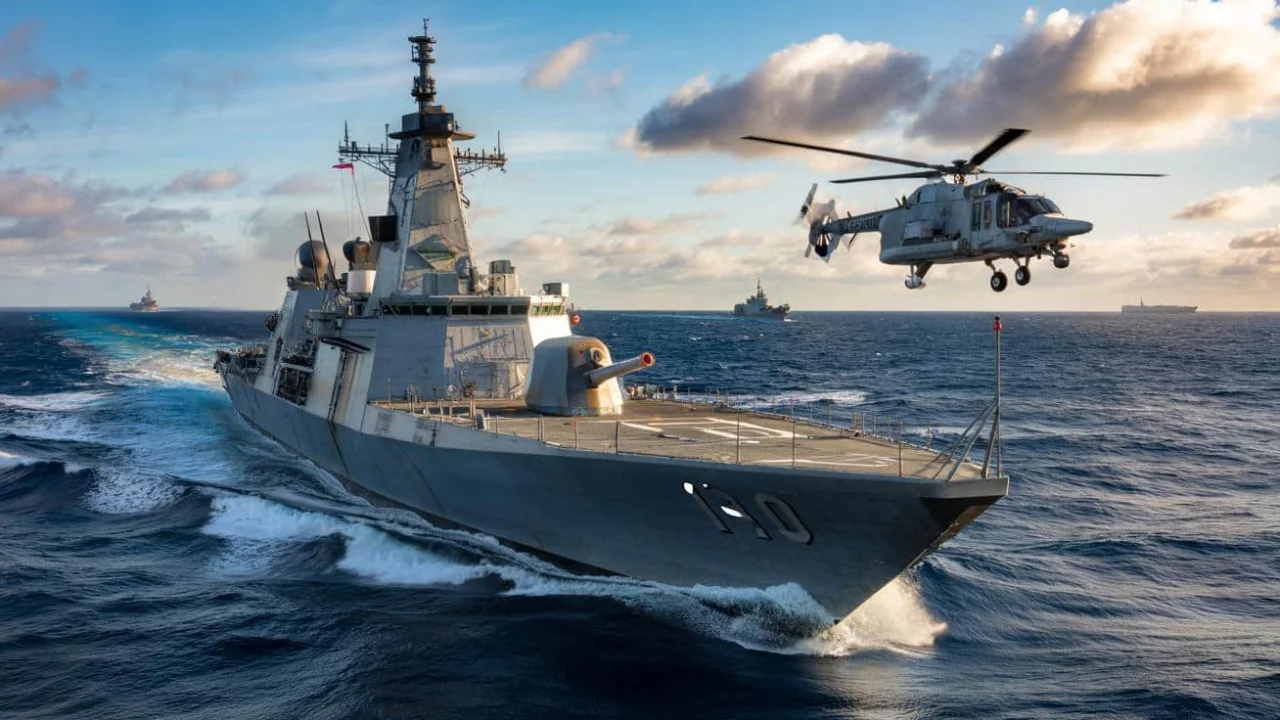
Captain Marie Dubois gripped the bridge railing as the Amiral Ronarc’h cut through another North Sea wave. She’d commanded smaller vessels before, but nothing quite like this. This wasn’t just another warship—it was France’s bet on the future, carrying technology that could reshape naval warfare for decades to come.

Her crew of 145 sailors had trained for months for this moment. Now, far from the familiar waters of Brest, they were about to put their new French FDI frigate through the ultimate test. Every system, every procedure, every split-second decision would be scrutinized over the coming months.
For Captain Dubois and her crew, this deployment wasn’t just about proving their ship’s capabilities. It was about demonstrating that France could still build world-class warships that other nations would want to buy.

France’s Next-Generation Frigate Takes to the Seas
The Defense and Intervention Frigate (FDI) Amiral Ronarc’h has begun what the French Navy calls a “long duration deployment”—a several-month journey that will take the vessel through three distinct maritime environments. The French FDI frigate will operate in the North Sea, North Atlantic, and Mediterranean, testing its systems under vastly different conditions.
“This deployment represents the final proving ground before the ship enters active service,” explains naval analyst Jean-Pierre Moreau. “Every major French warship goes through this process, but the stakes are particularly high for the FDI program.”

The Amiral Ronarc’h represents the first of five French FDI frigates planned for the French Navy. Built by Naval Group, these ships are designed to replace aging La Fayette-class frigates while incorporating cutting-edge technology that France hopes will attract international buyers.
Unlike traditional sea trials that last weeks, this deployment stretches across months and includes real-world scenarios. The crew will face everything from Arctic conditions in the North Sea to the challenging Mediterranean environment where migrant rescue operations and anti-smuggling missions are routine.

What Makes the French FDI Frigate Special
The technical specifications of the French FDI frigate tell only part of the story. At 122 meters long and displacing 4,500 tons, the Amiral Ronarc’h packs impressive capabilities into a relatively compact hull.
| Specification | Details |
|---|---|
| Length | 122 meters |
| Displacement | 4,500 tons |
| Crew | 145 personnel |
| Speed | 27+ knots |
| Range | 6,000 nautical miles |
| Main Gun | 76mm OTO Melara |
| Missiles | 32 VLS cells |
The ship’s key innovations include:

- Advanced radar systems capable of tracking multiple threats simultaneously
- Modular mission bay that can be reconfigured for different operations
- Reduced radar signature through stealth design features
- Integrated combat management system linking all weapons and sensors
- Capability to operate unmanned systems including drones and underwater vehicles
“The FDI’s modular design philosophy means it can adapt to different mission requirements quickly,” notes defense expert Claire Bertrand. “One day it might be conducting anti-submarine warfare, the next it could be supporting humanitarian operations.”
The French FDI frigate also incorporates lessons learned from recent naval conflicts. The war in Ukraine has shown how important electronic warfare and drone defense have become. The Amiral Ronarc’h includes sophisticated jamming systems and close-in weapon systems designed to counter small, fast-moving threats.
Why This Deployment Matters Beyond France
While the French Navy will ultimately operate five FDI frigates, the real prize lies in export sales. Greece has already ordered three French FDI frigates, with deliveries expected to begin in 2025. Other European nations are watching the Amiral Ronarc’h’s performance closely.
“Naval Group is competing in a crowded market,” explains maritime security analyst Dr. Philippe Laurent. “British, German, and Italian shipbuilders are all vying for the same contracts. The FDI’s performance during this deployment could influence purchasing decisions worth billions of euros.”
The timing of the deployment is particularly significant. European nations are reassessing their naval capabilities following Russia’s invasion of Ukraine. Countries like Poland, Romania, and the Baltic states are considering major naval investments to protect their coastlines and maritime trade routes.
The French FDI frigate offers these nations several advantages over competitors. Unlike larger destroyers, the FDI can operate in shallow coastal waters while still packing significant firepower. Its relatively modest crew requirements also make it attractive to navies struggling with personnel shortages.
During the Mediterranean portion of the deployment, the Amiral Ronarc’h will likely encounter the kinds of real-world challenges that potential buyers want to see addressed. These include migrant rescue operations, anti-smuggling patrols, and potential confrontations with aggressive vessels from non-NATO countries.
“European navies need ships that can handle both high-end warfare and day-to-day security missions,” says former French Navy commander Admiral François Dupont. “The FDI program was specifically designed to meet both requirements affordably.”
The deployment also serves as an extended demonstration for international observers. Defense attachés and naval officers from allied nations will have opportunities to visit the ship and observe its capabilities firsthand. These interactions often prove more valuable than glossy brochures when it comes to closing deals.
For France’s defense industry, the stakes couldn’t be higher. Naval Group needs export success to justify continued investment in surface ship technology. The French government has made naval exports a strategic priority, seeing them as essential for maintaining France’s position as a major defense power.
The several-month deployment of the French FDI frigate represents more than just testing—it’s a statement of intent. France is betting that its combination of proven technology, reasonable cost, and operational flexibility will win over European allies looking to modernize their fleets in an increasingly dangerous world.
FAQs
How long will the French FDI frigate deployment last?
The deployment is expected to last several months, with operations planned across the North Sea, North Atlantic, and Mediterranean.
What is the main purpose of this long duration deployment?
The deployment serves as a comprehensive stress test of all ship systems, crew training, and operational procedures before the frigate enters formal active service.
How many FDI frigates will France build?
France plans to build five FDI frigates for its own navy, with the first ship Amiral Ronarc’h already launched and now undergoing sea trials.
Which countries have ordered French FDI frigates?
Greece has ordered three FDI frigates, with deliveries expected to begin in 2025. Other European nations are considering similar purchases.
What makes the FDI different from other modern frigates?
The FDI features a modular design that allows rapid reconfiguration for different missions, advanced stealth features, and the ability to operate unmanned systems like drones.
Where is the French FDI frigate currently operating?
The Amiral Ronarc’h began its deployment in the North Sea and will progressively move to the North Atlantic and Mediterranean during the several-month mission.
About the Author