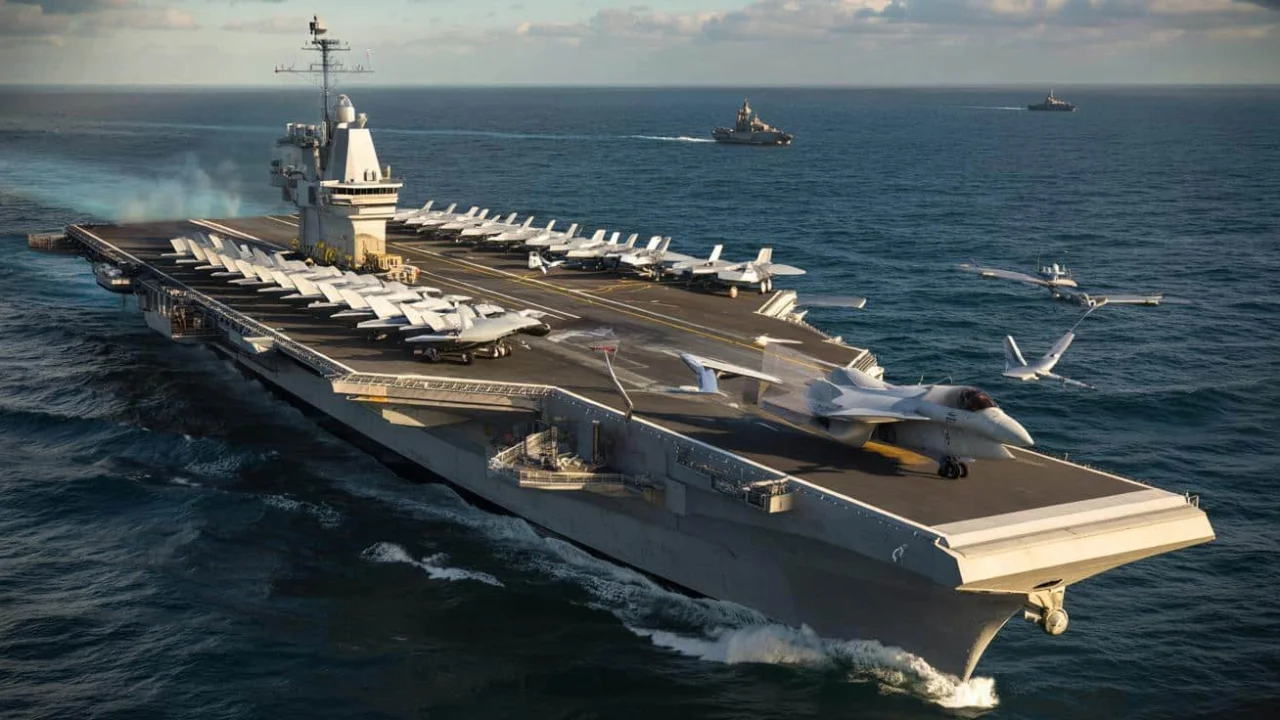
When Marie Dubois looks at her teenage son practicing with model aircraft in their Toulon garden, she sees more than just a hobby. As a naval engineer working on France’s current aircraft carrier Charles de Gaulle, she knows that her son might one day serve aboard a vessel that doesn’t even exist yet—but will define French naval power for the next half-century.
That future just became reality. France has officially greenlit production of its next-generation aircraft carrier, and families like Marie’s across the country are about to witness one of the most ambitious military projects in modern European history.
The decision affects everyone from shipyard workers in Saint-Nazaire to taxpayers funding this massive undertaking, proving that some choices made in government offices ripple through entire communities for decades.
France Makes Its Biggest Naval Bet in Generations
The French government has officially authorized full-scale construction of the PANG aircraft carrier, marking a pivotal moment for the nation’s maritime defense strategy. President Emmanuel Macron announced the move during a visit to French troops in Abu Dhabi, confirming that this nuclear-powered giant will replace the aging Charles de Gaulle by 2038.
“France has formalized the decision to build its new nuclear-powered aircraft carrier, locking in the replacement of Charles de Gaulle from 2038,” defense officials confirmed in recent statements.
This announcement came more than a year earlier than expected, sending a clear message to both allies and potential adversaries. The PANG aircraft carrier represents France’s commitment to maintaining its position as one of the few nations capable of projecting power globally through sovereign naval capabilities.
The timing reflects growing geopolitical tensions worldwide. Macron framed the decision in stark terms, describing the current era as “an age of predators” where France must maintain credible strength at sea. The new carrier will embody “power at the service of freedom on the high seas,” according to the president’s vision.
What Makes the PANG Aircraft Carrier Special
The PANG aircraft carrier isn’t just a replacement—it’s a technological leap forward. Here’s what sets this vessel apart from its predecessor and most other carriers worldwide:
| Feature | PANG | Charles de Gaulle |
|---|---|---|
| Length | 300+ meters | 261 meters |
| Aircraft Capacity | 32+ aircraft | 40 aircraft |
| Propulsion | Next-gen nuclear | Nuclear (K15) |
| Service Entry | 2038 | 2001 |
| Estimated Cost | €7+ billion | €3.3 billion |
The PANG will feature several groundbreaking capabilities:
- Advanced nuclear propulsion system providing virtually unlimited range
- Electromagnetic aircraft launch system (EMALS) for more efficient operations
- Enhanced radar and defense systems for modern threats
- Compatibility with next-generation fighter aircraft
- Improved crew facilities and automation reducing personnel requirements
“The PANG represents the culmination of decades of French naval engineering excellence,” explains Admiral Jean-Pierre Martinez, a former naval strategist. “This isn’t just about replacing an old ship—it’s about maintaining France’s ability to operate independently anywhere in the world.”
The carrier will serve as the centerpiece of French carrier strike groups, working alongside frigates, submarines, and support vessels to project French influence across global waters. Unlike many nations that rely on allied protection, France maintains one of the few truly independent naval capabilities outside the United States.
How This Massive Project Impacts Real Life
The PANG aircraft carrier production will create ripple effects across French society and beyond. The project represents one of Europe’s largest defense investments, with implications reaching far beyond military circles.
For French workers, this means job security spanning decades. Shipyard employees in Saint-Nazaire, where the carrier will be built, can expect steady employment through 2038. Thousands of specialized positions will emerge, from nuclear engineers to aircraft systems technicians.
“My grandfather built ships, my father works on the Charles de Gaulle, and now I’ll probably spend my career on PANG,” says Thomas Leroy, a 25-year-old naval engineering student from Brittany. “It’s like our family business, except the business is defending France.”
The economic impact extends beyond direct employment. French defense contractors will benefit from billions in contracts, while suppliers across Europe contribute specialized components. This creates a web of economic activity supporting tens of thousands of jobs indirectly.
For French taxpayers, the PANG represents a significant investment in national security. The estimated cost exceeds €7 billion, spread over more than a decade. However, supporters argue this cost pales compared to the value of maintaining strategic independence.
The international implications are equally significant. France’s commitment to the PANG aircraft carrier reinforces its position as a key NATO ally while maintaining autonomous capabilities. This matters for countries that rely on French naval protection in regions like the Mediterranean and West Africa.
“France is sending a message that it won’t be dependent on others for its security,” notes Dr. Catherine Morel, a defense analyst at the Institute for Strategic Studies. “In an uncertain world, that independence has real value for French citizens and European stability.”
The project also represents a technological showcase for French industry. Success with the PANG aircraft carrier could lead to export opportunities, as other nations seek advanced naval capabilities. Brazil, India, and several European countries have expressed interest in French naval technology.
For military families, the PANG means their loved ones will serve aboard one of the world’s most advanced warships. The improved facilities and automation will provide better working conditions compared to older vessels, while the extended service life ensures career stability for naval personnel.
Environmental considerations also play a role. The nuclear propulsion system eliminates traditional fuel requirements, reducing the carrier’s environmental footprint during operations. However, nuclear waste management and eventual decommissioning present long-term challenges that future generations will inherit.
The PANG aircraft carrier production schedule means French naval power will face a critical transition period around 2038. Managing this handover while maintaining operational capabilities requires careful planning and substantial resources devoted to crew training and systems integration.
FAQs
When will the PANG aircraft carrier enter service?
The PANG is scheduled to replace the Charles de Gaulle in 2038, with construction beginning immediately following the official production authorization.
How much will the PANG aircraft carrier cost French taxpayers?
Current estimates place the total cost at over €7 billion, spread across the construction period through 2038.
Will the PANG be larger than France’s current aircraft carrier?
Yes, the PANG will be significantly larger than Charles de Gaulle, measuring over 300 meters in length compared to the current carrier’s 261 meters.
What makes the PANG different from other aircraft carriers?
The PANG will feature next-generation nuclear propulsion, electromagnetic aircraft launch systems, and advanced radar capabilities that place it among the world’s most sophisticated carriers.
Which countries might be interested in similar French naval technology?
Brazil, India, and several European nations have shown interest in French naval technology, potentially creating export opportunities for French defense contractors.
How many jobs will PANG production create in France?
The project will directly employ thousands of workers in shipyards and defense contractors, with tens of thousands more jobs supported indirectly across the supply chain.
About the Author