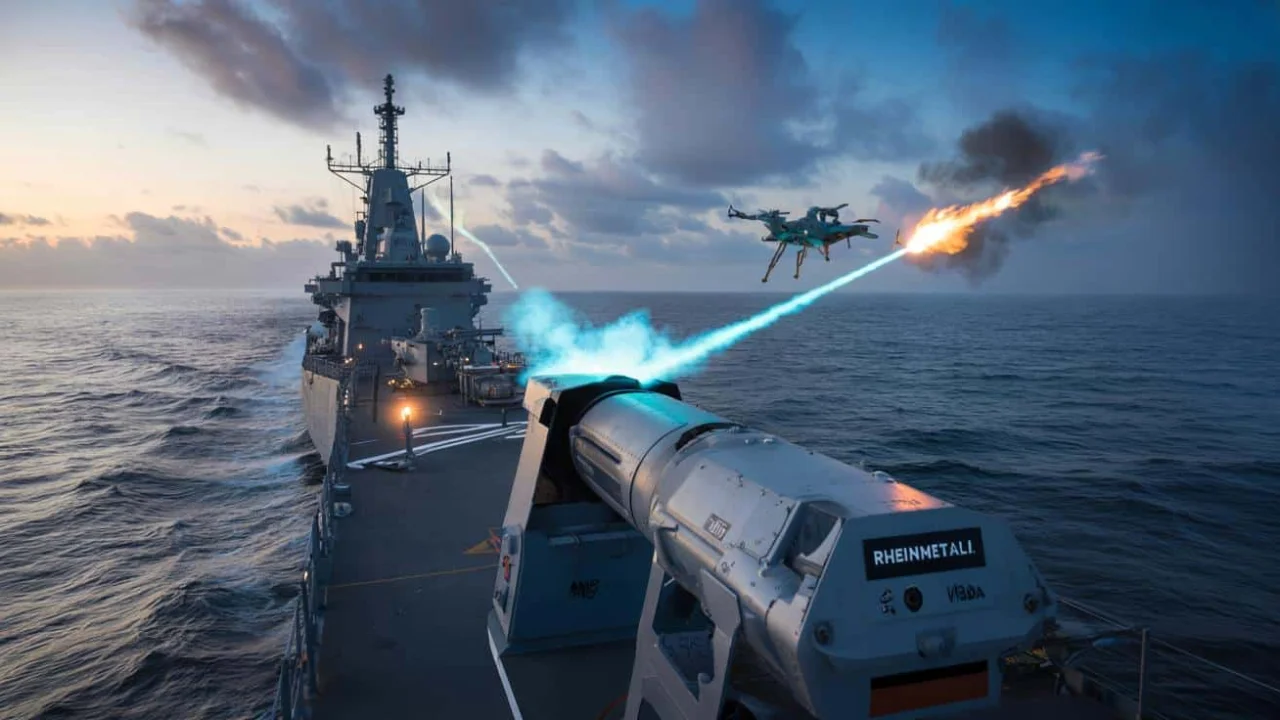
Captain Sarah Mitchell was scanning the horizon from the bridge of her destroyer when a swarm of small dots appeared on the radar screen. Drones – dozens of them – approaching fast from multiple directions. In the old days, this would have meant launching expensive missiles or hoping the ship’s guns could track and hit such small, agile targets. But today, she simply nodded to her weapons officer, who activated a system that looked more like a telescope than a weapon. Within seconds, precise beams of light began systematically neutralizing the incoming threats, one by one.
This scenario isn’t science fiction anymore. It’s becoming reality as Europe’s naval forces prepare for a new era of maritime warfare, where laser weapons will stand guard alongside traditional guns and missiles.
The future of naval defense is taking a major leap forward as two German defense powerhouses announce plans to transform their experimental laser technology into a commercial reality.

Why This Partnership Matters Now
Rheinmetall and MBDA Germany are moving beyond the testing phase to establish a dedicated joint venture for naval laser weapon systems. The new company, set to launch in the first quarter of 2026, represents a significant shift from experimental technology to operational naval defense systems.
This isn’t their first collaboration. The two companies have been working together since 2019, developing and testing laser systems that have already proven themselves under real-world conditions. Their naval laser demonstrator spent an entire year at sea, conducting over 100 live firing and tracking tests against various targets.

“The demonstrator program exceeded all expectations,” says a defense industry analyst familiar with the project. “Having a system perform flawlessly during a full year of maritime operations gives both the military and politicians the confidence needed to move forward.”
The timing reflects growing concerns about modern naval threats, particularly the proliferation of small, fast-moving drones that can overwhelm traditional defense systems. Current missile-based defenses, while effective, come with significant costs – sometimes requiring a $100,000 missile to stop a $1,000 drone.

Breaking Down the Technology and Timeline
The naval laser weapon system being developed focuses on short to very short-range defense, designed to complement rather than replace existing weapons systems. Here’s what makes this technology game-changing:
- Precision targeting of small, agile threats like drones and missiles
- Virtually unlimited ammunition (as long as the ship has power)
- Cost-effective engagement compared to traditional missiles
- Silent operation with minimal signature detection
- Rapid engagement capability against multiple targets
| Development Phase | Timeline | Key Milestone |
|---|---|---|
| Partnership Formation | 2019 | Initial collaboration begins |
| Sea Trials | 2023-2024 | 100+ live firing tests completed |
| Joint Venture Launch | Q1 2026 | Commercial entity established |
| Deployment Target | 2027-2028 | First operational systems |
The system operates using high-energy laser beams that can disable or destroy incoming threats through precise application of focused energy. Unlike kinetic weapons that rely on physical projectiles, laser systems can engage targets at the speed of light, making them particularly effective against fast-moving aerial threats.
“What we’re seeing is the maturation of directed-energy weapons from laboratory curiosities to operational naval systems,” explains a former naval officer now working in defense technology. “The physics have always worked – it was the engineering challenges of making them ship-ready that took time.”
The new joint venture will initially focus on systems for the German Navy, but the companies clearly have broader ambitions. European allies facing similar threats from drone swarms and advanced missiles represent a significant market opportunity.
Real-World Impact on Naval Operations
For naval crews, this technology promises to fundamentally change how ships defend themselves. Traditional close-in weapons systems require physical ammunition that must be loaded, stored, and eventually resupplied. Laser weapons, by contrast, draw power directly from the ship’s electrical systems.
This shift has practical implications that extend far beyond the technology itself. Ships equipped with naval laser weapons could operate for extended periods without needing to return to port for ammunition resupply. In contested waters or during extended deployments, this capability could prove decisive.
The cost economics are equally compelling. While the initial installation of laser systems requires significant investment, the operational costs per engagement are dramatically lower than conventional weapons. A single laser shot costs roughly the equivalent of running the system for a few seconds, compared to missiles that can cost tens of thousands of dollars each.
“From a fleet commander’s perspective, having weapons that don’t consume physical ammunition changes your entire tactical calculus,” notes a retired navy admiral who has consulted on directed-energy weapons. “You can engage threats without worrying about running out of shots.”
The technology also addresses emerging threats that traditional weapons struggle to counter effectively. Small commercial drones modified for military use, swarms of coordinated unmanned vehicles, and other asymmetric threats are becoming increasingly common in maritime conflicts.
For civilian shipping and commercial vessels operating in contested waters, the presence of laser-equipped naval escorts could provide enhanced protection without the collateral damage risks associated with explosive weapons in crowded shipping lanes.
The German Navy’s early adoption of this technology positions European naval forces at the forefront of directed-energy weapon deployment. Other NATO allies are watching closely, with several countries reportedly considering similar systems for their own fleets.
“This isn’t just about Germany getting new weapons,” explains a defense policy researcher. “It’s about establishing European leadership in a critical military technology that will define naval warfare for the next generation.”
The success of this joint venture could accelerate adoption across allied navies, potentially creating new standards for naval defense systems and changing how maritime forces approach threat engagement in an era of increasingly sophisticated and numerous airborne threats.
FAQs
What exactly is a naval laser weapon?
It’s a directed-energy system that uses focused laser beams to disable or destroy targets like drones, missiles, and small boats by delivering precise bursts of energy.
How much does it cost to fire a laser weapon compared to a missile?
A laser engagement costs roughly the equivalent of a few seconds of electrical power, while missiles can cost $50,000 to $100,000 or more per shot.
When will these systems be ready for actual naval deployment?
The companies are targeting the second half of this decade, with operational systems potentially available by 2027-2028.
Can laser weapons work in all weather conditions?
Weather can affect laser performance, particularly heavy rain or fog, but modern systems are designed to operate effectively in most maritime conditions.
Will laser weapons replace traditional naval guns and missiles?
No, they’re designed to complement existing weapons systems, particularly for close-range defense against small, fast-moving targets like drones.
How many shots can a laser weapon fire before needing resupply?
Unlike conventional weapons, laser systems don’t use physical ammunition – they can continue operating as long as the ship has electrical power available.
About the Author