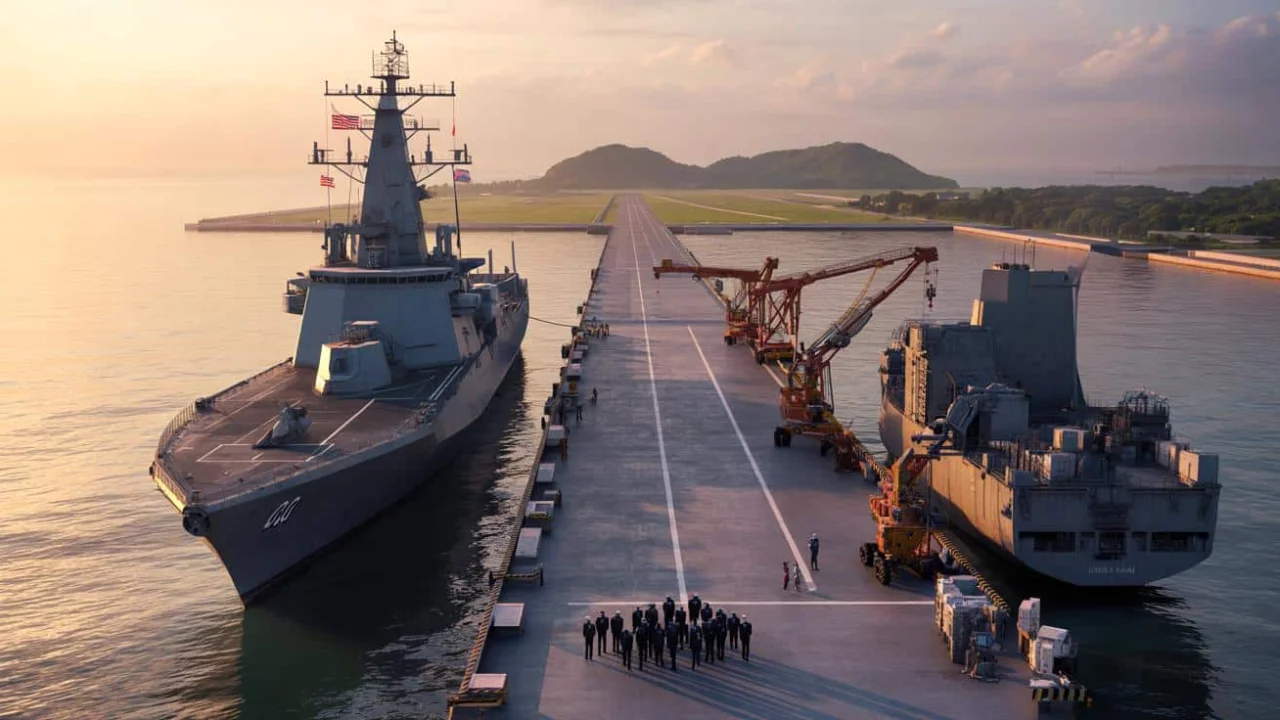
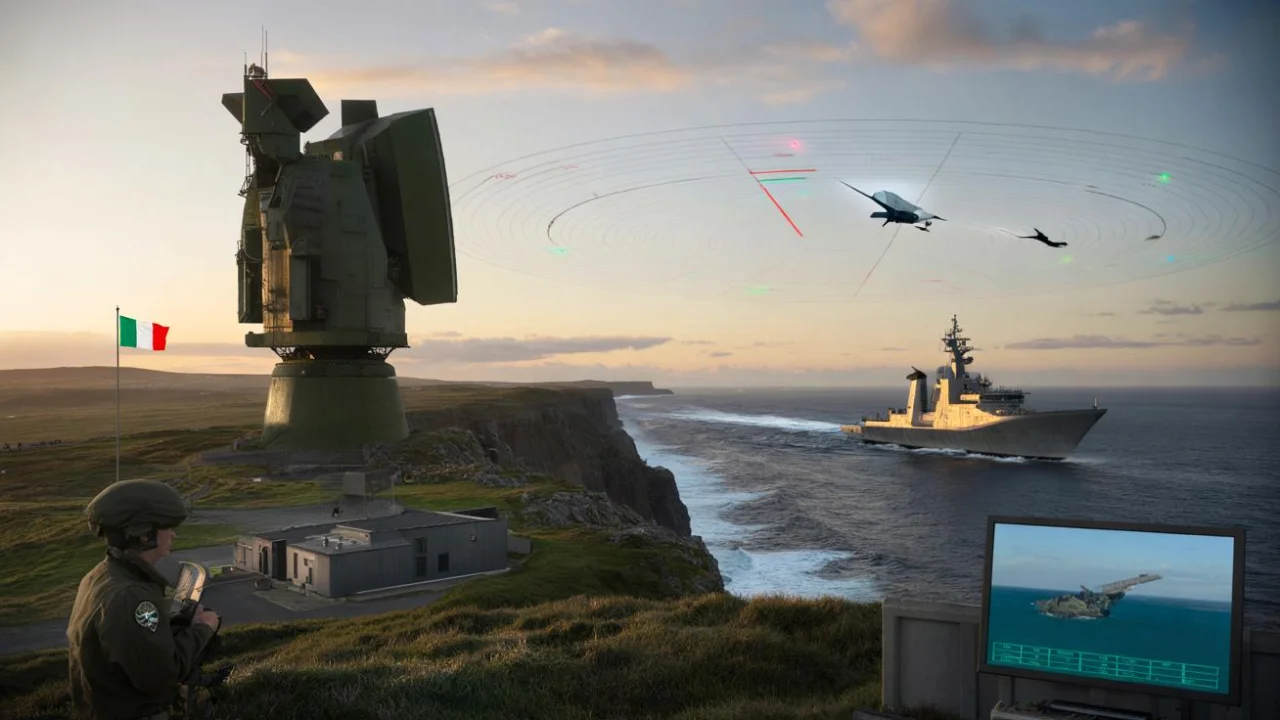
When Captain Sarah Mitchell watched her crew lower the American flag at sunset over Ream Naval Base last week, she couldn’t help but notice the Chinese construction cranes still towering in the distance. The irony wasn’t lost on anyone aboard the USS Cincinnati – they were the first US warship to dock at a port that China had built from the ground up.
For the local fishermen who watched the gray American vessel slip into harbor, it was just another ship. But for diplomats in Washington and Beijing, this moment represented something far more significant: Cambodia’s delicate dance between two superpowers.
The scene captured perfectly what’s happening across Southeast Asia today – small nations trying to benefit from both American security partnerships and Chinese investment, while avoiding getting crushed between them.
When American Steel Meets Chinese Concrete
The USS Cincinnati’s arrival at Ream Naval Base wasn’t just a routine port call. This littoral combat ship became the first US warship to dock at a facility that has become a symbol of China’s growing military influence in Southeast Asia.
Ream Naval Base sits on Cambodia’s southern coast, overlooking the Gulf of Thailand. For years, US officials have watched nervously as Chinese funding transformed this sleepy naval facility into what could become Beijing’s second overseas military hub.
“This visit sends a clear message that Cambodia wants to maintain relationships with all major powers,” said Dr. James Chen, a Southeast Asia analyst at the Maritime Security Institute. “Hun Manet is trying to show he’s not just his father’s son when it comes to foreign policy.”
The timing couldn’t be more symbolic. Cambodia’s new Prime Minister Hun Manet has been signaling a shift away from his father’s heavily pro-China stance. Allowing a US warship into what many consider China’s backyard represents his boldest move yet.
But this diplomatic balancing act comes with real risks. Chinese officials haven’t publicly commented on the American visit, but Beijing’s silence speaks volumes about their displeasure.
The Numbers Behind Cambodia’s Strategic Shift
Understanding Cambodia’s position requires looking at the hard facts of who’s invested what, and what’s at stake for each player.
| Country | Investment in Cambodia (2020-2024) | Military Aid/Projects | Key Strategic Interest |
|---|---|---|---|
| China | $7.8 billion | Ream Naval Base expansion | Indian Ocean access |
| United States | $1.2 billion | Training programs, equipment | Containing Chinese influence |
| Japan | $2.1 billion | Coast guard vessels | Regional stability |
The infrastructure investments tell the story clearly:
- China funded 80% of Ream’s $280 million expansion
- New pier can accommodate destroyers and frigates
- Upgraded facilities include weapons storage and maintenance areas
- Deep-water access allows larger naval vessels
- Strategic location provides access to critical shipping lanes
“The numbers don’t lie – China has been Cambodia’s primary benefactor for infrastructure development,” explained Marina Rodriguez, a former State Department official. “But money doesn’t always buy loyalty, especially when a new generation takes power.”
US military engagement has focused more on training and capacity building rather than major construction projects. American programs have trained over 1,200 Cambodian military personnel since 2018, emphasizing professional military education and humanitarian operations.
What This Means for Southeast Asia’s Future
The USS Cincinnati’s visit represents more than just one ship calling at one port. It signals a potential shift in how smaller nations navigate great power competition.
For ordinary Cambodians, these geopolitical chess moves have real consequences. Chinese investment has brought jobs and infrastructure, but also concerns about debt dependency. American engagement offers military training and aid, but comes with demands for political reforms.
Regional neighbors are watching closely. Vietnam, Thailand, and Malaysia all face similar pressures to choose sides between Washington and Beijing. Cambodia’s approach could become a template for others.
“Hun Manet is testing whether Cambodia can have its cake and eat it too,” said Professor Lisa Park from the ASEAN Studies Center. “Can they keep Chinese money flowing while rebuilding ties with America? The next few months will tell us a lot.”
The economic implications extend beyond Cambodia’s borders. The Gulf of Thailand serves as a crucial shipping route for regional trade. Control or influence over facilities like Ream could affect commerce throughout Southeast Asia.
Military analysts note that China’s presence at Ream would significantly extend Beijing’s naval reach. Currently, Chinese warships must travel thousands of miles from Hainan Island to project power in the Indian Ocean. A permanent presence in Cambodia would change those calculations dramatically.
For the United States, maintaining access to Cambodian ports helps preserve what Washington calls “freedom of navigation” in contested waters. The symbolic value of the USS Cincinnati’s visit may prove as important as any tactical advantage.
Local communities around Ream have mixed feelings about becoming a focal point of superpower rivalry. Some welcome the economic opportunities that come with increased military activity. Others worry about becoming collateral damage if tensions escalate.
“We just want to fish and live peacefully,” said Sok Vanna, whose family has worked these waters for three generations. “Whether the ships are American or Chinese doesn’t matter to us – as long as they don’t interfere with our nets.”
The broader question remains whether small nations can successfully play great powers against each other without getting burned. History suggests this strategy works only when carefully managed and when the stakes remain relatively low.
As the USS Cincinnati sailed away from Ream, it left behind more questions than answers. Will China retaliate diplomatically or economically? Can Cambodia maintain this balancing act long-term? And what happens when the next crisis tests these carefully cultivated relationships?
One thing seems certain: Cambodia’s experiment in hedging between superpowers has only just begun. The success or failure of this approach will influence how other nations in the region navigate an increasingly complex geopolitical landscape.
FAQs
Why is this the first US warship visit to Ream Naval Base significant?
Ream was built and expanded primarily with Chinese funding, making it a symbol of Beijing’s military influence in Southeast Asia. A US warship docking there signals Cambodia’s attempt to balance relationships with both superpowers.
What is China’s strategic interest in Cambodia’s naval facilities?
Ream Naval Base would give China a potential second overseas military hub, extending Beijing’s naval reach into the Indian Ocean and providing access to crucial shipping lanes in Southeast Asia.
How much has China invested in Cambodia compared to the United States?
Between 2020-2024, China invested approximately $7.8 billion in Cambodia compared to $1.2 billion from the United States, with China focusing heavily on infrastructure projects like the Ream Naval Base expansion.
What does this mean for other Southeast Asian countries?
Cambodia’s balancing act between China and the US could serve as a template for other regional nations facing similar pressures to choose sides in the growing superpower competition.
Is Cambodia moving away from its pro-China stance?
Under new Prime Minister Hun Manet, Cambodia appears to be recalibrating its foreign policy to maintain relationships with both China and the US, rather than relying heavily on Beijing as his father did.
What are the risks of Cambodia’s balancing strategy?
Cambodia risks economic retaliation from China, which has been its primary investor, while also potentially disappointing US expectations for political reforms and stronger security cooperation.
About the Author