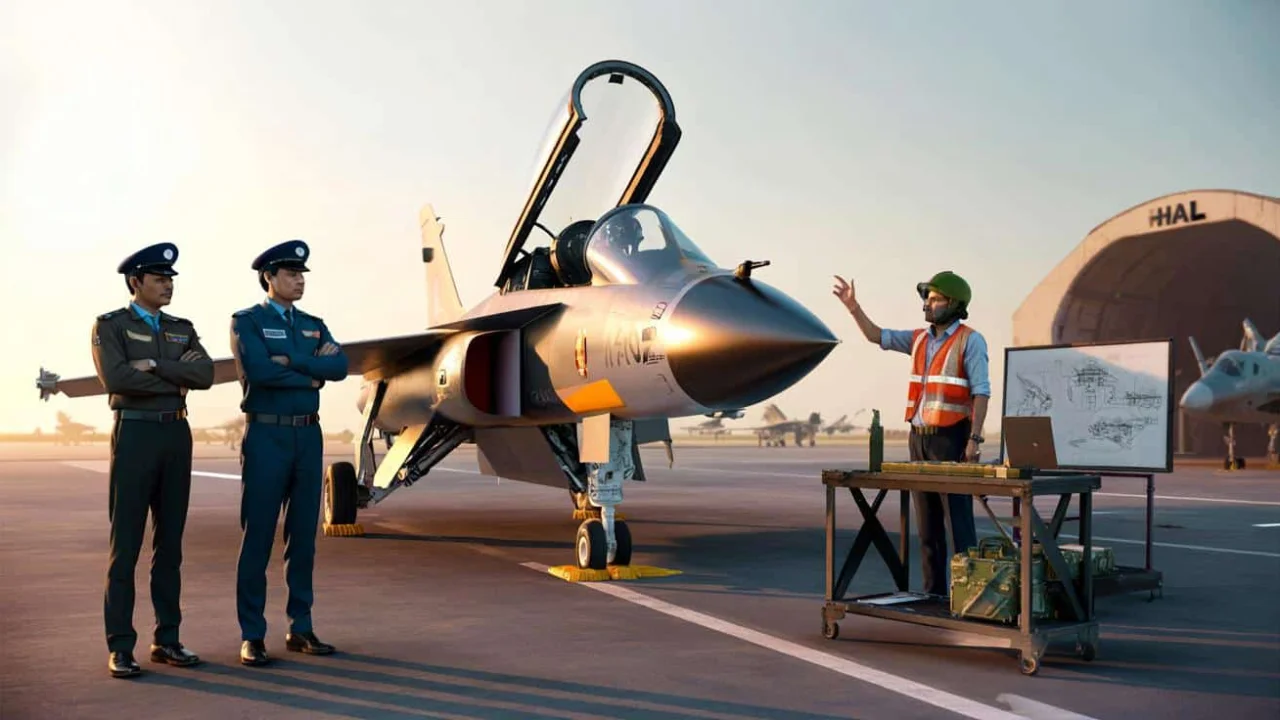
Imagine walking into a factory where five brand-new fighter jets sit gleaming under industrial lights, their engines installed, their airframes complete. The workers are proud—months of precise engineering have gone into these machines. But these jets will never leave the ground.

Not because they can’t fly. They’ve already passed test flights. The problem is simpler and more complex: nobody can agree on what “ready” actually means.
This scene playing out in Bengaluru captures everything that’s broken—and hopeful—about India’s push to build its own military aircraft. The standoff between Hindustan Aeronautics Limited (HAL) and the Indian Air Force over these Tejas Mk1A fighters isn’t just about five jets. It’s about who gets to shape the future of the Indian aerospace industry.

When “Ready” Becomes a Four-Letter Word
The clash erupted in February 2026 when HAL announced their five Tejas Mk1A fighters were “physically ready” for delivery. Company officials pointed to completed airframes, installed engines, and successful test flights as proof they’d met production targets.
The Indian Air Force saw things differently. Air Staff Quality Requirements (ASQRs) hadn’t been fully met, they argued. Radar performance, electronic warfare systems, mission computers—dozens of technical specifications still needed certification.
“HAL is essentially asking us to accept planes that look finished but aren’t battle-ready,” explains a former IAF officer who requested anonymity. “That’s like buying a car because it has four wheels and an engine, without checking if the brakes work.”
But HAL’s frustration runs deeper. For years, they’ve watched the Air Force order minimal quantities of Indian-made aircraft while purchasing foreign jets worth billions. The Tejas Mk1A order stands at just 97 aircraft—barely enough to sustain production lines.

Defense analyst Rajesh Kumar notes, “HAL feels like they’re being held to impossible standards while foreign manufacturers get the benefit of the doubt. There’s institutional mistrust on both sides.”
The Numbers Behind the Standoff
The financial and strategic stakes of this dispute extend far beyond five grounded jets. Here’s what the conflict means in concrete terms:
| Aspect | Current Status | Impact |
|---|---|---|
| Tejas Mk1A Orders | 97 aircraft | ₹48,000 crore contract |
| HAL Production Capacity | 16 jets annually | Below break-even point |
| IAF Squadron Shortage | 31 squadrons vs 42 needed | 11 squadron gap |
| Foreign Fighter Imports | ₹1.15 lakh crore planned | Rafale, F-16 competitions |
The dispute centers on several key technical areas where HAL and the IAF disagree:
- Electronic Warfare Suite: IAF wants full spectrum capability, HAL claims current systems meet specified requirements
- Radar Integration: Software compatibility issues with the Israeli EL/M-2052 radar system
- Mission Computer: Real-time processing speed and data fusion capabilities under scrutiny
- Maintenance Systems: Ground support equipment and logistics chain readiness questioned
- Weapons Integration: Full certification pending for Derby and Python air-to-air missiles
Industry insider Priya Nair observes, “Both sides have valid points, but the constant back-and-forth is killing confidence in indigenous programs. International partners are watching this closely.”
What This Fight Really Means for India’s Aviation Dreams
The HAL-IAF standoff represents a deeper struggle over India’s aerospace future. Three major consequences are already becoming clear.
First, production delays are cascading through the entire supply chain. Small and medium enterprises that manufacture components for the Tejas face uncertain order volumes. Workers at HAL’s Bengaluru facility report anxiety about job security as production timelines stretch.
Second, international credibility takes a hit every time Indian-made aircraft face public disputes over readiness. Foreign air forces considering the Tejas for export are closely monitoring how India’s own military treats the plane.
The Malaysian Air Force recently postponed evaluations of the Tejas pending resolution of IAF certification issues. Export orders worth potentially ₹25,000 crore hang in the balance.
Third, the conflict undermines India’s broader “Atmanirbhar Bharat” self-reliance initiative. When the country’s premier aerospace company and air force can’t agree on basic aircraft acceptance criteria, it sends mixed signals about India’s manufacturing capabilities.
“This isn’t just about HAL or the IAF,” argues former defense secretary Ajay Shukla. “It’s about whether India can mature into a reliable aerospace manufacturing nation or remain dependent on foreign suppliers.”
The timing couldn’t be worse. China is rapidly expanding its military aviation capabilities while Pakistan upgrades its fighter fleet with Chinese assistance. India’s squadron shortage means older aircraft like the MiG-21 remain in service longer than planned, creating safety and capability gaps.
Meanwhile, private sector companies like Tata Advanced Systems and Mahindra Aerospace are watching closely. Their future participation in defense manufacturing depends partly on how smoothly Indian aerospace programs can execute.
The resolution of this standoff will likely determine whether the Indian aerospace industry can break free from its chronic delays and cost overruns, or remains trapped in a cycle of bureaucratic gridlock.
Foreign aerospace giants like Boeing, Lockheed Martin, and Dassault are quietly positioning themselves to benefit from any breakdown in indigenous programs. Their message to Indian decision-makers is simple: why struggle with homegrown solutions when proven foreign alternatives exist?
But surrendering to foreign dependency would mean abandoning decades of investment in indigenous capabilities. The five grounded Tejas fighters in Bengaluru represent more than metal and electronics—they embody India’s ambition to join the exclusive club of nations that design and build their own combat aircraft.
FAQs
What exactly is the HAL-IAF dispute about?
HAL claims five Tejas Mk1A fighters are ready for delivery, but the IAF refuses to accept them until all technical requirements are met.
How many Tejas aircraft has the IAF actually ordered?
The IAF has ordered 97 Tejas Mk1A aircraft worth ₹48,000 crore, which HAL considers insufficient for sustainable production.
Why does this matter for India’s defense capabilities?
The IAF currently operates 31 fighter squadrons against a required strength of 42, creating a critical capability gap that delays make worse.
Could this affect Tejas export prospects?
Yes, international customers are closely watching how India’s own air force treats the aircraft, with Malaysia already postponing evaluations.
What happens if HAL and the IAF can’t resolve their differences?
Continued delays could force India to rely more heavily on expensive foreign fighter imports while undermining confidence in indigenous aerospace programs.
How does this compare to other countries’ fighter programs?
Most successful aerospace nations maintain closer cooperation between manufacturers and military users, avoiding the kind of public disputes seen in India.
About the Author
