Imagine walking into a classified military warehouse and stumbling upon blueprints for a weapon that could have changed everything. That’s exactly what happened when leaked documents recently surfaced, revealing details about Russia’s most secretive tank project from the early 2000s.
The papers showed specifications for a 58-ton monster that Russian engineers believed could outmatch any NATO tank on the battlefield. But here’s the twist – Moscow killed the entire program just before it reached production, choosing instead to pursue what would eventually become the troubled T-14 Armata.
Now, thanks to these leaked blueprints and new 3D reconstructions, we’re getting our first real look at what might have been the most advanced Russian tank project ever conceived.

The Tank That Was Supposed to Change Everything
The T-95, officially known as Object 195, wasn’t just another Russian tank upgrade. This was Moscow’s attempt to build something completely revolutionary – a main battle tank that would make Western armor look obsolete overnight.
Development began in the late 1990s under strict secrecy. Russian engineers weren’t trying to improve the T-72 or T-90. They wanted to create something entirely new from the ground up.
“The T-95 represented a fundamental shift in Russian tank philosophy,” explains military analyst Viktor Murakhovsky. “Instead of incremental improvements, they were going for a complete technological leap.”
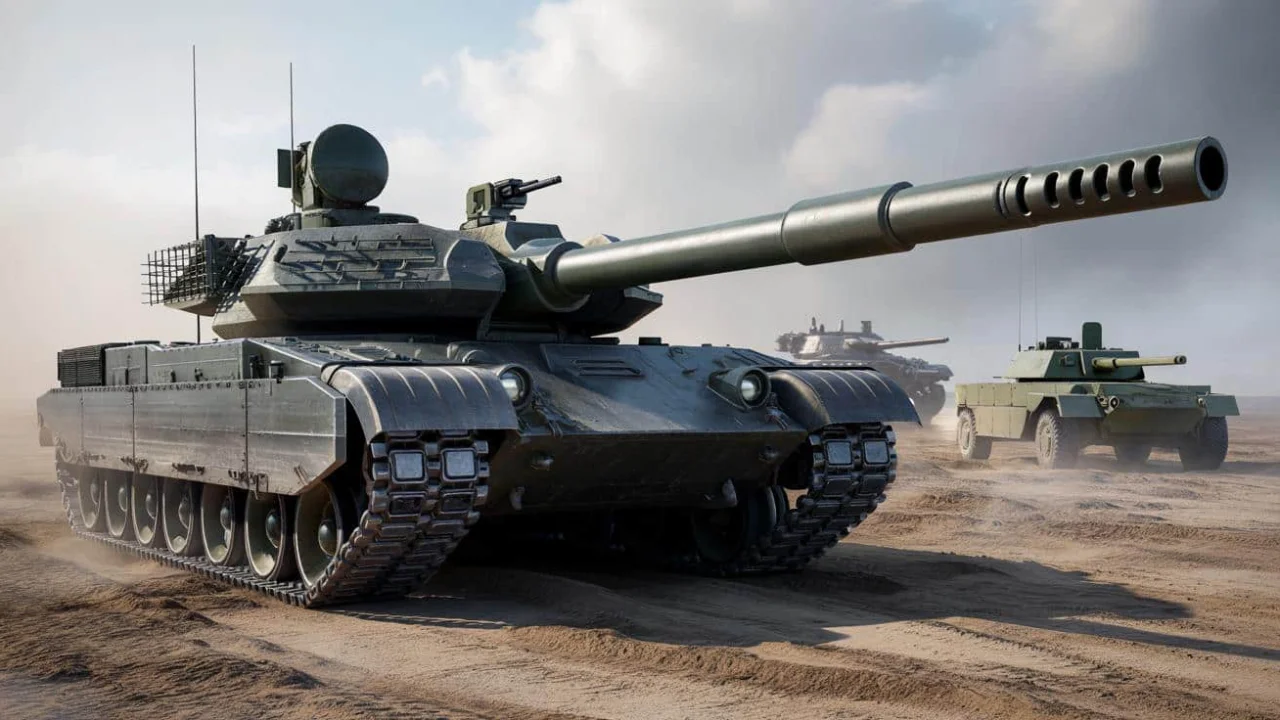
The centerpiece was a massive 152mm smoothbore gun – significantly larger than the 120mm weapons used by NATO tanks. This cannon could fire specialized ammunition capable of penetrating any existing Western armor at extreme ranges.
But the gun was just the beginning. The tank featured an unmanned turret with an autoloader system, advanced composite armor, and sophisticated electronic warfare capabilities. At 58 tons, it was heavier than most contemporary tanks but still maintained impressive mobility.
What Made This Russian Tank Project So Dangerous
The leaked specifications reveal just how ambitious this Russian tank project really was. Every component pushed existing technology to its limits:

| Specification | T-95 Object 195 | M1A2 Abrams | Leopard 2A6 |
|---|---|---|---|
| Weight | 58 tons | 62 tons | 62.3 tons |
| Main Gun | 152mm smoothbore | 120mm smoothbore | 120mm smoothbore |
| Crew | 3 (unmanned turret) | 4 | 4 |
| Armor Type | Advanced composite | Depleted uranium composite | Composite |
| Active Protection | Arena-M system | None (at the time) | None (at the time) |
The unmanned turret design was particularly revolutionary. By removing the crew from the turret and placing them in an armored capsule in the hull, Russian engineers could use heavier armor and more powerful ammunition without worrying about crew safety in that compartment.
Key advantages included:
- 152mm gun with 40% more firepower than NATO standard weapons
- Advanced active protection system to intercept incoming missiles
- Reduced crew from four to three members
- Modular armor system for different threat environments
- Integrated electronic warfare capabilities
- Advanced fire control system with hunter-killer capability
“The firepower advantage would have been enormous,” notes defense researcher Pavel Felgenhauer. “A 152mm round carries significantly more explosive power and can penetrate armor that would stop a 120mm shell.”
The tank’s advanced fire control system could engage multiple targets simultaneously while on the move. Combined with its powerful gun, this would have given Russian forces a significant edge in tank-versus-tank combat.
Why Russia Killed Its Own Breakthrough
Despite its impressive capabilities, the T-95 program died quietly in 2008. The official reason was cost – each tank would have been extremely expensive to produce and maintain.
But the real reasons ran deeper. The global financial crisis hit Russia hard, forcing defense budget cuts across the board. The T-95’s complex systems required new production facilities, specialized training, and extensive logistical support.
“Russian military leadership faced a choice,” explains former tank commander Aleksey Khlopotov. “They could build a few hundred expensive super-tanks, or modernize thousands of existing vehicles for the same cost.”
The decision proved controversial within Russian military circles. Many officers believed the T-95 represented their best chance to regain technological superiority over NATO forces.
Instead, Russia doubled down on the T-14 Armata program, which promised similar capabilities at lower cost. That decision would later prove problematic as the Armata program faced its own delays and budget overruns.
The timing was particularly unfortunate. Western intelligence agencies had limited knowledge of the T-95’s capabilities, meaning NATO forces weren’t actively developing countermeasures. Russia essentially gave up a significant technological advantage.
Today, leaked blueprints show just how close Moscow came to fielding a truly revolutionary weapon system. The T-95’s 152mm gun and advanced armor would still pose serious challenges to current NATO tanks.
Modern military analysts studying the leaked documents suggest the tank could have forced NATO to completely redesign their armor doctrine. The sheer firepower difference would have made current Western tanks vulnerable at ranges where they couldn’t effectively return fire.
“Looking at these specifications now, it’s clear Russia was much closer to a breakthrough than anyone realized,” concludes tank warfare expert Michael Peck. “The decision to cancel this program may have been one of their biggest strategic mistakes of the 2000s.”
The T-95 remains one of military history’s great “what ifs” – a Russian tank project that could have shifted the global balance of armored warfare, but was quietly buried before it ever saw combat.
FAQs
Why was the T-95 tank project cancelled?
Russia cancelled the program in 2008 due to high costs, complexity, and budget constraints following the global financial crisis.
How powerful was the T-95’s main gun compared to NATO tanks?
The 152mm gun was significantly more powerful than the 120mm weapons used by NATO, providing about 40% more firepower and better armor penetration.
Could the T-95 have defeated modern Western tanks?
Based on leaked specifications, the T-95’s superior firepower and advanced armor would have posed serious challenges to NATO tanks of that era.
What happened to the T-95 technology after cancellation?
Some technologies were later incorporated into the T-14 Armata program, though the revolutionary 152mm gun system was abandoned.
How many T-95 prototypes were built?
Only a few prototypes were completed before the program was cancelled, with exact numbers remaining classified.
Why didn’t Russia restart the T-95 program later?
By the time Russia had more defense funding available, they had already committed to the T-14 Armata program and modernizing existing tank fleets.
About the Author
