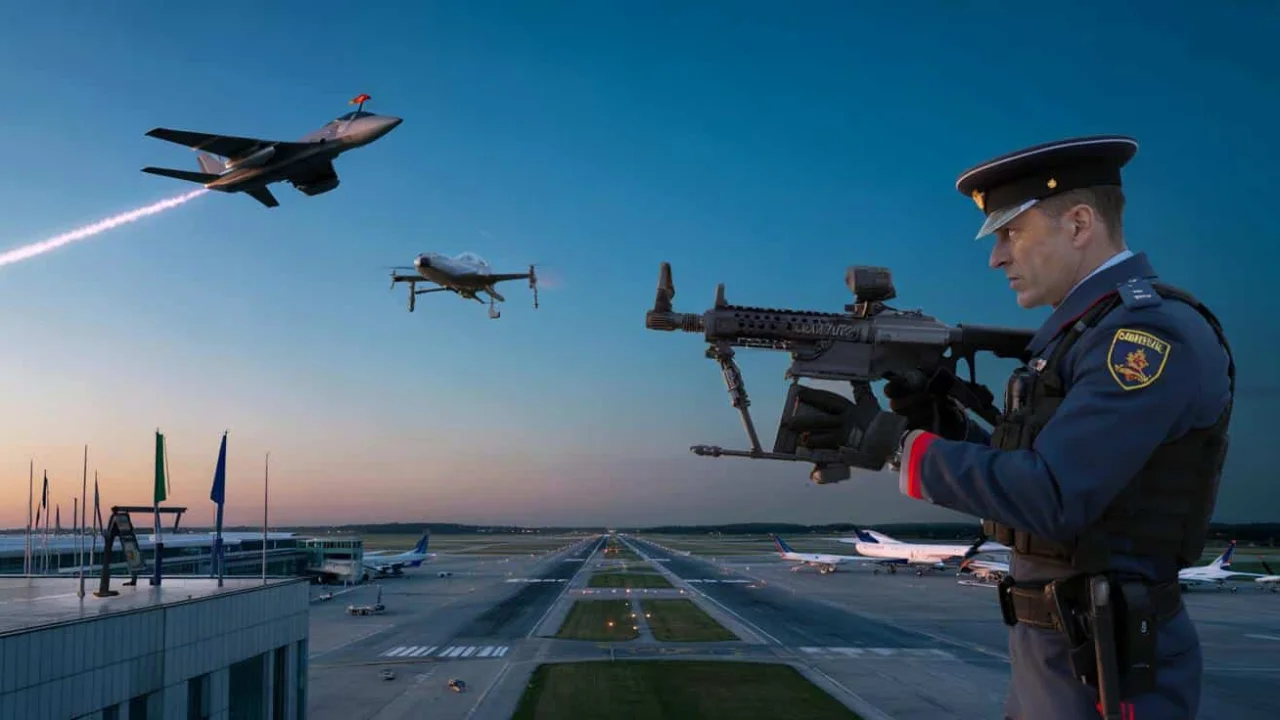
Last Tuesday morning, air traffic controllers at Charles de Gaulle Airport spotted something unusual on their screens. A small blip, moving erratically at low altitude, heading straight toward one of Europe’s busiest airports. Within minutes, security teams were mobilized, flights were briefly diverted, and specialized units rushed to intercept what turned out to be an unauthorized drone.

The incident lasted just twenty minutes, but it highlighted a growing reality: France’s skies are no longer just the domain of commercial aircraft and military jets. Small, silent, and increasingly sophisticated drones are forcing the country to completely rethink how it protects its airspace.
What happened at Charles de Gaulle wasn’t an isolated case. Similar incidents have been reported near nuclear facilities, military bases, and critical infrastructure across France. Each time, the same question echoes through security briefings: what if the next drone isn’t just lost or curious, but deliberately hostile?

Why France Is Taking Drone Threats So Seriously
The war in Ukraine changed everything about how military planners view drone warfare. What once seemed like science fiction became daily reality as small, cheap drones wreaked havoc on billion-dollar tanks and strategic installations.
French defense officials watched these developments with growing alarm. If consumer drones could be weaponized so effectively in Eastern Europe, what was stopping similar attacks in France?

“We’re not dealing with a theoretical threat anymore,” explains a senior official from France’s Ministry of Armed Forces. “Every week we track dozens of unauthorized drone flights near sensitive sites. Most are harmless, but we can’t afford to assume they all are.”
The numbers tell the story. French authorities recorded over 2,400 unauthorized drone incidents in 2023, compared to just 800 in 2020. These hostile drone incursions range from accidental overflights by hobbyists to deliberate surveillance missions targeting military installations.

Recent drone overflights in neighboring Poland, Romania, and Denmark have only intensified French concerns. Intelligence reports suggest some of these incidents may be linked to foreign state actors testing European air defenses.
France’s Multi-Layered Defense Strategy
France’s response to hostile drone incursions involves multiple layers of technology and rapid response protocols. The centerpiece is the SCCOA (Système de Commandement et de Contrôle des Opérations Aériennes), a sophisticated network that connects radar systems, fighter jets, and ground-based defenses into one unified command structure.

Here’s how France’s anti-drone system works in practice:
- Detection Phase: Advanced radar networks continuously scan French airspace for unusual activity
- Classification Phase: AI-powered systems analyze flight patterns to distinguish between authorized and potentially hostile aircraft
- Response Phase: Depending on the threat level, responses range from radio warnings to electronic jamming or physical interception
- Neutralization Phase: Specialized teams deploy counter-drone weapons, including jamming guns and net-capture systems
The technology arsenal is impressive but practical. French security forces now carry portable jamming devices that can disable most commercial drones within a 2-kilometer radius. These “drone guns” look like futuristic rifles but emit radio frequencies that disrupt the connection between a drone and its operator.
| Defense Layer | Technology Used | Effective Range | Primary Purpose |
|---|---|---|---|
| Early Warning | Radar Networks | 50+ kilometers | Initial detection |
| Identification | RF Scanners | 10-15 kilometers | Signal analysis |
| Soft Kill | Jamming Systems | 2-5 kilometers | Signal disruption |
| Hard Kill | Net Guns/Lasers | 500 meters | Physical capture |
“The key is layered defense,” notes a cybersecurity expert who has worked with French military contractors. “You can’t rely on just one technology because drone threats are so varied. Some are sophisticated military-grade systems, others are modified toy helicopters.”
Real-World Impact on Daily Life
These counter-drone measures affect ordinary French citizens more than most people realize. Airport delays increasingly stem from drone incidents rather than just weather or mechanical problems. Popular tourist sites like the Eiffel Tower now have permanent no-fly zones enforced by electronic surveillance.
The economic implications are substantial. Each major airport shutdown due to hostile drone incursions costs airlines and passengers millions in delays and cancellations. The 2018 Gatwick Airport drone crisis, while in the UK, served as a wake-up call for French aviation authorities about how quickly drone incidents can paralyze air travel.
French businesses operating near sensitive sites face new restrictions. Delivery companies must now register flight paths for commercial drones, and photographers need special permits to use drones anywhere near military installations or nuclear facilities.
“My wedding photography business had to completely change how we work,” says Marie Dubois, a photographer from Lyon. “We used to fly drones freely for aerial shots, but now we spend hours getting permits and checking restricted zones.”
Nuclear power plants represent a particular concern. France generates about 70% of its electricity from nuclear energy, making these facilities attractive targets for surveillance or potential attack. Enhanced security measures now include 24/7 drone monitoring around all nuclear sites.
The psychological impact shouldn’t be underestimated either. French citizens are becoming more aware that hostile drone incursions represent a new type of security threat that traditional defenses weren’t designed to handle.
Private security companies are experiencing boom times as businesses rush to protect themselves. Companies like CS Group and Thales have developed specialized anti-drone solutions specifically for the French market, combining radar detection with automated response systems.
Looking ahead, France is investing heavily in artificial intelligence to improve drone threat detection. Machine learning algorithms are being trained to distinguish between legitimate drone operations and potentially hostile activities based on flight patterns, electronic signatures, and behavioral analysis.
The challenge remains significant. As drone technology becomes cheaper and more sophisticated, the potential for hostile drone incursions will likely increase. France’s multi-layered approach represents one of Europe’s most comprehensive responses, but it’s an arms race where the technology keeps evolving on both sides.
FAQs
How often do hostile drone incursions occur in France?
French authorities recorded over 2,400 unauthorized drone incidents in 2023, though most were accidental rather than deliberately hostile.
What happens if someone flies a drone illegally in France?
Penalties range from fines of up to €75,000 to potential prison sentences, depending on where the drone was flown and whether it posed a security threat.
Can French authorities shoot down drones?
Yes, but they prefer electronic jamming or net capture systems. Physical destruction is reserved for cases involving immediate threats to critical infrastructure.
Are there areas where drone flights are completely banned?
Absolute no-fly zones exist around nuclear facilities, military bases, airports, and major government buildings, with violations treated as serious security breaches.
How effective are France’s anti-drone systems?
Current systems can detect and neutralize most consumer and commercial drones, but military-grade systems remain challenging to counter effectively.
Will drone restrictions in France become stricter?
Likely yes, as authorities balance security concerns with legitimate commercial and recreational drone use, with new regulations expected to focus on registration and tracking systems.
About the Author