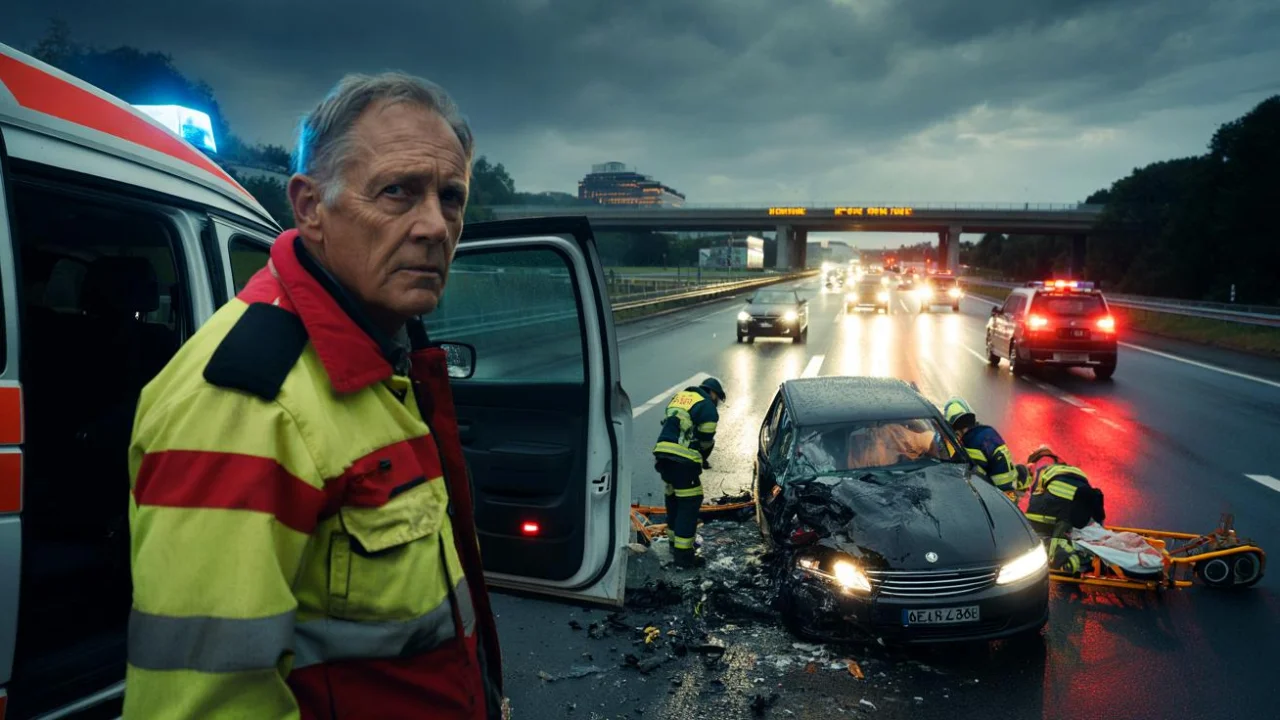
The radio crackles to life at 2:47 AM. “Emergency vehicle needed on the A5, multiple casualties.” Hans Martin Rotert has heard this call thousands of times during his 35-year career as a German paramedic. But even in retirement, these words still make his stomach drop.

He remembers racing through the darkness, blue lights cutting through empty highways, knowing that someone’s world was about to change forever. Tonight, as he sits in his quiet home in Baden-Württemberg, that familiar weight settles in his chest again.
At 69, Rotert has seen enough carnage on Germany’s famous unrestricted motorways to fuel nightmares for several lifetimes. Now he’s speaking out, demanding that politicians finally impose a Germany motorway speed limit before more families are destroyed by preventable tragedies.

When Speed Becomes a Death Sentence
Germany remains the only country in the world where drivers can legally push their vehicles to extreme speeds on major highways. While most European nations cap motorway speeds at 80-90 mph, large sections of the German autobahn network have no speed restrictions whatsoever.
“I’ve scraped too many bodies off these roads,” Rotert told regional broadcaster SWR. “Every time I see a politician defending unlimited speeds, I think about that 12-year-old boy who died because someone was going too fast to stop in time.”
The incident that haunts Rotert most happened on a quiet stretch of the A5 motorway. A family car traveling at normal speed was struck from behind by a vehicle moving at over 140 mph. The impact killed a child instantly while leaving his mother fighting for her life.
What makes this tragedy even more devastating is how preventable it was. Germany’s own transport research institute has repeatedly shown that speed limits save lives, yet political resistance remains fierce.

| Country | Motorway Speed Limit | Annual Road Deaths per 100,000 |
|---|---|---|
| Germany | No limit (many sections) | 4.2 |
| France | 81 mph (130 km/h) | 3.4 |
| United Kingdom | 70 mph (113 km/h) | 2.9 |
| Netherlands | 62 mph (100 km/h) | 3.8 |
The Real Cost of Speed
Emergency responders like Rotert understand the brutal mathematics of high-speed crashes better than anyone. When vehicles collide at extreme speeds, the human body simply cannot survive the forces involved.
“People think modern cars are so safe that speed doesn’t matter,” explains Dr. Sarah Weber, a trauma surgeon at Freiburg University Hospital. “But physics doesn’t care how many airbags you have. At 120 mph, a collision becomes unsurvivable.”

The consequences extend far beyond the immediate victims. German emergency services report that high-speed accidents require significantly more resources:
- Multiple ambulances and specialized rescue equipment
- Highway closures lasting several hours
- Psychological support for first responders dealing with severe trauma
- Long-term rehabilitation costs that can exceed €500,000 per survivor
Rotert estimates he’s responded to over 800 serious motorway accidents during his career. The vast majority involving speeds above 100 mph resulted in fatalities.
“When I started this job in the 1980s, we had fewer cars and they weren’t as powerful,” he recalls. “Now we have vehicles that can easily hit 150 mph, but the same human reaction times and stopping distances.”
Recent studies by the German Road Safety Council show that implementing a nationwide 81 mph limit could prevent up to 140 deaths annually. Yet cultural attachment to unlimited speed remains strong, with many Germans viewing it as a fundamental freedom.
A Nation Divided on Safety
The debate over Germany motorway speed limits has become one of the most contentious political issues in the country. Supporters argue that restrictions would save lives and reduce emissions, while opponents claim they would hurt Germany’s automotive industry and national identity.
Transport Minister Andreas Scheuer dismisses calls for change, stating: “German drivers are among the world’s most skilled, and our engineering standards are exceptional. Speed limits would solve nothing.”
But frontline workers like Rotert see a different reality. They witness the aftermath when skill and engineering meet the laws of physics at 140 mph.
Environmental groups have joined safety advocates in pushing for change. Germany’s Green Party leader Robert Habeck argues that speed limits could reduce transport emissions by up to 6% while making roads safer for everyone.
The automotive industry remains split. While BMW and Mercedes traditionally opposed limits, some executives now quietly support moderate restrictions. Volkswagen CEO Herbert Diess recently suggested that 81 mph limits might actually benefit electric vehicle adoption.
Public opinion polls show Germans increasingly favor some form of speed regulation. A 2023 survey found 64% support for a 87 mph limit, up from just 42% in 2015.
Yet political momentum remains slow. The upcoming Baden-Württemberg state election could prove crucial, as Green Party candidates promise immediate action on speed limits if elected.
Rotert hopes his decades of experience might finally tip the balance. “I’m not asking politicians to end driving,” he emphasizes. “I’m asking them to end preventable dying.”
For families who’ve lost loved ones to high-speed crashes, the debate feels abstract. They know that reasonable limits could have saved their children, parents, and siblings.
As Germany grapples with this issue, one question remains: how many more tragedies will it take before unlimited speed becomes a relic of the past?
FAQs
Why doesn’t Germany have motorway speed limits like other countries?
Germany’s unlimited speed tradition dates back to the 1930s when the autobahn network was built, and it’s become deeply embedded in national culture and automotive industry identity.
How fast do people actually drive on German motorways?
While speeds vary widely, studies show many drivers regularly exceed 100 mph on unrestricted sections, with some reaching 140 mph or higher during off-peak hours.
Would speed limits really reduce accidents significantly?
German transport research indicates that implementing 81 mph limits could prevent approximately 140 deaths and over 500 serious injuries annually based on current traffic patterns.
What do German emergency responders think about speed limits?
Most paramedics, firefighters, and police officers strongly support speed restrictions, having witnessed firsthand how extreme speeds turn minor accidents into fatal disasters.
Are there any sections of German motorways with speed limits?
Yes, about 30% of the autobahn network already has speed restrictions due to construction zones, urban areas, or accident-prone stretches, typically set at 62-87 mph.
How does this compare to accident rates in neighboring countries?
Germany’s motorway fatality rate is higher than most European nations with comprehensive speed limits, though the difference isn’t dramatic due to other safety factors.
About the Author