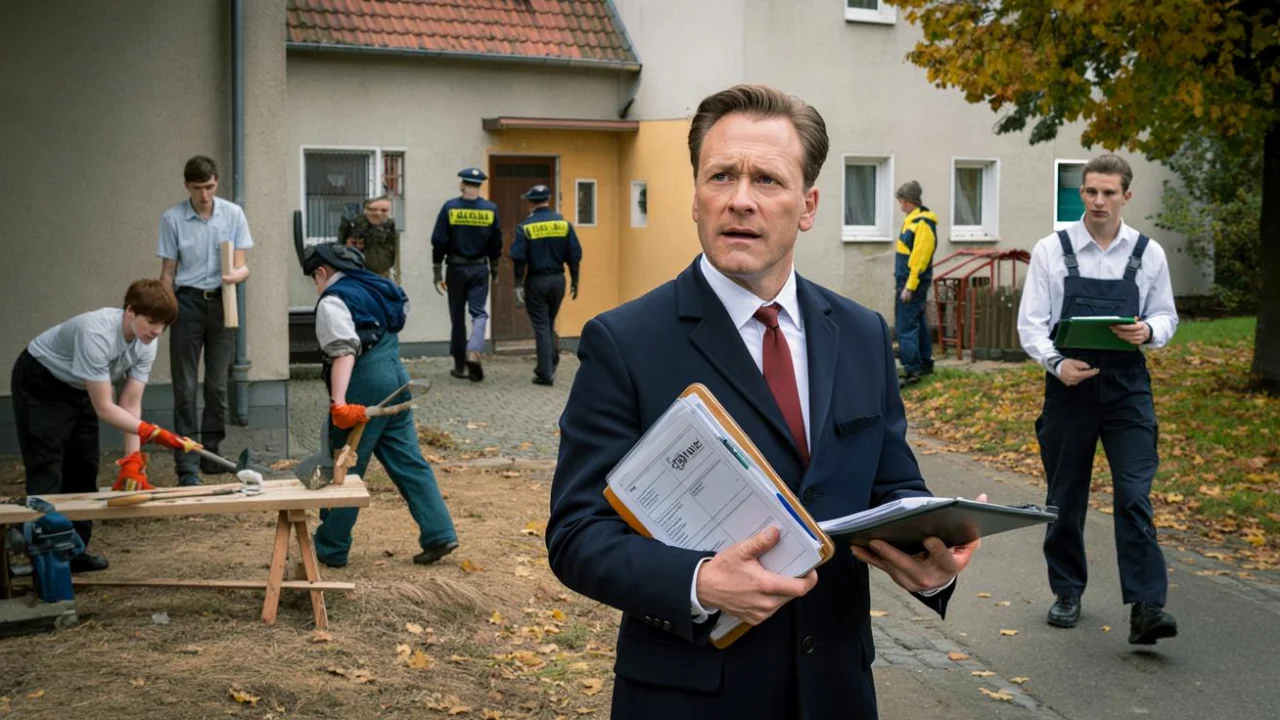
Marcus had been collecting unemployment benefits for eight months when the letter arrived. The 23-year-old from Nordhausen thought it was another routine appointment with his job counselor. Instead, he found himself face-to-face with a radical new requirement: show up for community work every day, or lose his welfare payments entirely.

“At first, I was angry,” Marcus admits. “But after two weeks of cleaning parks and helping at the local food bank, something changed. I actually felt useful again.”
Marcus’s story isn’t unique anymore in this small German district, where a controversial experiment is reshaping how welfare recipients work—and surprising everyone involved, including the politicians who started it.

When a Social Democrat challenged his own party’s welfare philosophy
The drama began in Nordhausen, a district in eastern Germany’s Thuringia region, where local businesses couldn’t find apprentices while youth unemployment kept climbing. District administrator Matthias Jendricke, a member of the center-left Social Democratic Party (SPD), watched this contradiction with growing frustration.
His job center staff delivered a wake-up call that changed everything. Young welfare recipients were openly telling counselors: “I don’t want to do anything, I just want the money.” When threatened with benefit cuts, some shrugged and said, “Go ahead and cut it, my grandmother will top it up.”

Traditional sanctions weren’t working. Germany’s standard approach allows job centers to reduce Bürgergeld payments by up to 30% for those refusing reasonable work offers. But Jendricke realized that many young people had family safety nets that made these penalties meaningless.
“We were dealing with a generation that saw no connection between effort and reward,” explains Dr. Sarah Weber, a labor economist who has studied the Nordhausen experiment. “The existing system inadvertently created a culture where welfare became a lifestyle choice rather than a temporary support.”

So Jendricke did something radical for an SPD politician: he implemented a work-first welfare program that his own party colleagues in Berlin strongly opposed.
The surprising results of mandatory work for welfare recipients
The Nordhausen model requires all able-bodied welfare recipients under 25 to perform 30 hours of community work weekly to receive their full benefits. The work includes park maintenance, assisting elderly residents, supporting local food banks, and helping with municipal projects.

Here’s what nobody expected to happen:
- Youth unemployment in the district dropped by 40% within the first year
- Local apprenticeship applications increased by 60%
- Mental health improvements were reported among 75% of participants
- Community satisfaction with young people rose dramatically
- Several participants started their own small businesses after gaining confidence
| Metric | Before Program | After 18 Months | Change |
|---|---|---|---|
| Youth unemployment rate | 18.2% | 10.9% | -40% |
| Apprenticeship applications | 340 | 544 | +60% |
| Long-term welfare dependency | 45% | 22% | -51% |
| Community volunteer hours | 1,200 | 8,900 | +642% |
Even more surprising was the psychological impact. “Many participants told us they felt valued by their community for the first time in years,” notes Maria Hoffmann, who runs the program’s coordination office.
The work isn’t make-work busywork either. Participants have renovated playgrounds, supported elderly residents with shopping, organized community events, and helped local farmers during harvest season. The community work addresses real needs while building genuine skills.
What this means for Germany’s national welfare debate
The Nordhausen experiment has created a political firestorm that reaches far beyond one small district. Jendricke finds himself at odds with his own SPD party leadership, who view mandatory work requirements as a step backward from progressive welfare policies.
“The national party thinks I’m betraying social democratic values,” Jendricke says. “But I think we’re actually living them—giving people dignity through meaningful contribution rather than passive dependency.”
Conservative politicians across Germany are watching closely, with several districts expressing interest in similar programs. Meanwhile, union leaders and traditional welfare advocates warn about potential exploitation of vulnerable people.
The debate reflects deeper tensions in German society about work, welfare, and social responsibility. Critics argue that requiring welfare recipients work amounts to forced labor and punishes people for economic circumstances beyond their control.
Supporters counter that the current system traps people in long-term dependency and fails both welfare recipients and taxpayers. “We’re not punishing anyone,” argues local business owner Klaus Weber. “We’re creating pathways back to independence and self-respect.”
The program’s success has attracted attention from policy researchers across Europe. Some see it as a potential model for addressing youth unemployment and welfare dependency in other regions facing similar challenges.
However, questions remain about scaling such programs and ensuring they don’t become exploitative. The personal attention and community support possible in a small district like Nordhausen might not translate to larger urban areas.
For now, Marcus and dozens of other young people in Nordhausen continue showing up for their community work assignments. Many have moved on to apprenticeships or regular employment. Others are planning further education.
“I never thought I’d say this, but being required to work actually set me free,” Marcus reflects. “It broke a cycle I didn’t even realize I was trapped in.”
FAQs
What exactly are welfare recipients required to do in Nordhausen?
They perform 30 hours weekly of community service including park maintenance, helping elderly residents, supporting food banks, and assisting with municipal projects.
Can welfare recipients refuse the work requirement?
Yes, but they risk losing their benefits entirely, unlike the traditional system where cuts are limited to 30%.
Has the program faced legal challenges?
Several legal challenges are pending, with critics arguing the requirements violate federal welfare laws and constitutional protections.
Are other German districts adopting similar programs?
At least six other districts are considering pilot programs based on the Nordhausen model, though none have launched yet.
What do welfare recipients themselves think about the program?
Surveys show 68% of participants view the program positively after completing it, though initial resistance was high.
How does this compare to welfare systems in other countries?
Similar work requirements exist in parts of the United States and United Kingdom, but Germany’s approach emphasizes community benefit rather than private sector placement.
About the Author