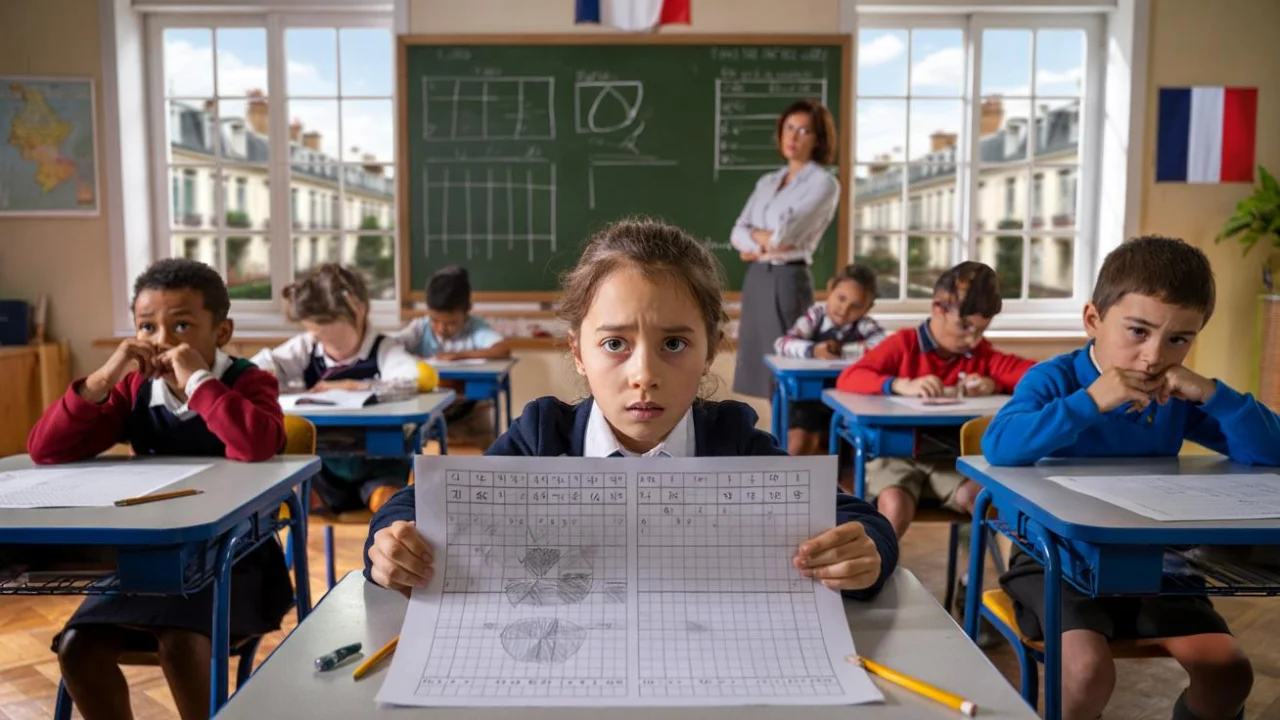
Marie-Claire stared at the maths problem on her daughter’s homework sheet, feeling that familiar knot in her stomach. The 12-year-old had come home from school frustrated, saying she didn’t understand fractions anymore. “Mum, everyone in my class got this wrong,” Sophie explained, pointing at what looked like a straightforward question about comparing two simple fractions.

This scene is playing out in thousands of French homes right now. What Marie-Claire didn’t know was that her daughter’s struggle represents a much bigger crisis in French year 7 maths education—one that recent national testing has brought into sharp focus.
The results are in from France’s first-ever nationwide assessment of year 7 pupils, and they’ve revealed something shocking. When faced with basic fraction problems, 92% of 11 and 12-year-olds couldn’t provide the correct answer to what educators considered a simple question.
The Great French Maths Reality Check
In September 2025, nearly 788,000 French pupils in cinquième (equivalent to year 7) sat down for compulsory national tests. The government wanted a clear snapshot of where students stood in core subjects. What they discovered in maths has sent ripples of concern through the education system.
These weren’t trick questions or advanced problems. The focus was on what French educators call “automatismes”—the basic skills that should be automatic by this age. Think mental arithmetic, simple fractions, and quick reasoning. Yet less than half of all pupils reached what officials consider a “satisfactory” level.

“We expected some gaps, but not quite this scale,” admits Dr. Laurent Dubois, a maths education researcher at the Sorbonne. “When 92% of children can’t handle a basic fraction comparison, we’re looking at a fundamental breakdown in how we’re teaching number sense.”
The specific question that stumped so many students involved comparing fractions like 3/4 and 5/8. While adults might quickly convert these to decimals or find common denominators, most year 7 pupils simply couldn’t work out which was larger.

Breaking Down the Numbers
The national assessment results paint a concerning picture of French year 7 maths abilities. Here’s what the data reveals:
| Skill Area | % of Pupils Achieving Satisfactory Level | Key Problem Areas |
|---|---|---|
| Mental Calculation | 52% | Basic multiplication, division |
| Fractions | 8% | Comparing, simplifying, converting |
| Simple Equations | 41% | Solving for unknown values |
| Quick Reasoning | 39% | Problem-solving strategies |
The fraction results are particularly alarming. Only 8% of pupils showed solid understanding of fraction concepts, meaning the vast majority struggle with:

- Comparing fractions of different denominators
- Converting fractions to decimals
- Understanding fraction equivalence
- Adding simple fractions
- Recognizing fractions on number lines
Social background plays a huge role in these outcomes. Pupils from disadvantaged areas perform significantly worse, with some regions showing fraction mastery rates below 5%. Meanwhile, students in affluent districts achieve rates closer to 15%—still worryingly low, but highlighting the inequality gap.
“The fraction problem isn’t just about maths,” explains Claire Moreau, a primary school teacher with 20 years of experience. “It shows kids aren’t really understanding what numbers mean. They’re learning procedures without grasping the underlying concepts.”
What This Means for French Families
These findings have immediate consequences for parents, teachers, and students across France. The ripple effects are already being felt in secondary schools, where teachers are discovering they need to reteach fundamental concepts they assumed students already knew.
For parents like Marie-Claire, the results explain why homework time has become such a battle. When children don’t understand fractions properly, they struggle with everything from cooking measurements to understanding percentages in later maths topics.
Teachers are reporting they need to spend significantly more time on basic skills that should have been mastered in primary school. This pushes back more advanced topics and puts pressure on an already packed curriculum.
“I’m having to teach fractions from scratch to year 7 pupils,” says Michel Bernard, a secondary maths teacher in Lyon. “These aren’t struggling students—these are average kids who’ve somehow slipped through without really understanding how numbers work.”
The education ministry is now scrambling to address these gaps. Emergency measures include:
- Additional teacher training on fraction instruction
- New diagnostic tools for identifying struggling pupils early
- Revised primary school maths curricula
- Extra support hours for pupils with significant gaps
Universities are also expressing concern about the knock-on effects. Students arriving with weak foundational maths skills struggle in subjects ranging from economics to engineering. This could impact France’s competitiveness in technical fields for years to come.
But there’s hope in these sobering statistics. Now that the problem is clearly identified, targeted interventions can begin. Some schools are already piloting new approaches that focus on visual and practical fraction work, helping students build genuine understanding rather than just memorizing procedures.
The question remains whether France’s education system can adapt quickly enough to address these fundamental gaps. With nearly a million year 7 pupils affected, the challenge is enormous—but so is the opportunity to rebuild maths education from the ground up.
FAQs
What exactly was the maths question that 92% of French year 7 pupils got wrong?
The question involved comparing simple fractions, such as determining which is larger between 3/4 and 5/8, a skill typically expected by age 11-12.
How does this compare to other countries’ maths performance?
While specific comparisons weren’t provided, international studies typically show much higher rates of fraction understanding among year 7 pupils in countries like Singapore and Finland.
Are French schools changing their teaching methods because of these results?
Yes, the education ministry is implementing emergency measures including teacher retraining and curriculum revisions to focus more on conceptual understanding of numbers.
Does this affect private schools as well as state schools?
The assessment included both state and state-funded private schools, with similar concerning results across both sectors, though some variation exists.
What can parents do if their child is struggling with basic maths?
Parents can focus on practical applications of fractions at home, use visual aids like fraction circles, and seek additional support from teachers or tutors specializing in foundational maths skills.
When will we see if these interventions are working?
The next round of national assessments will take place in September 2026, providing the first indication of whether the emergency measures are having an impact.
About the Author