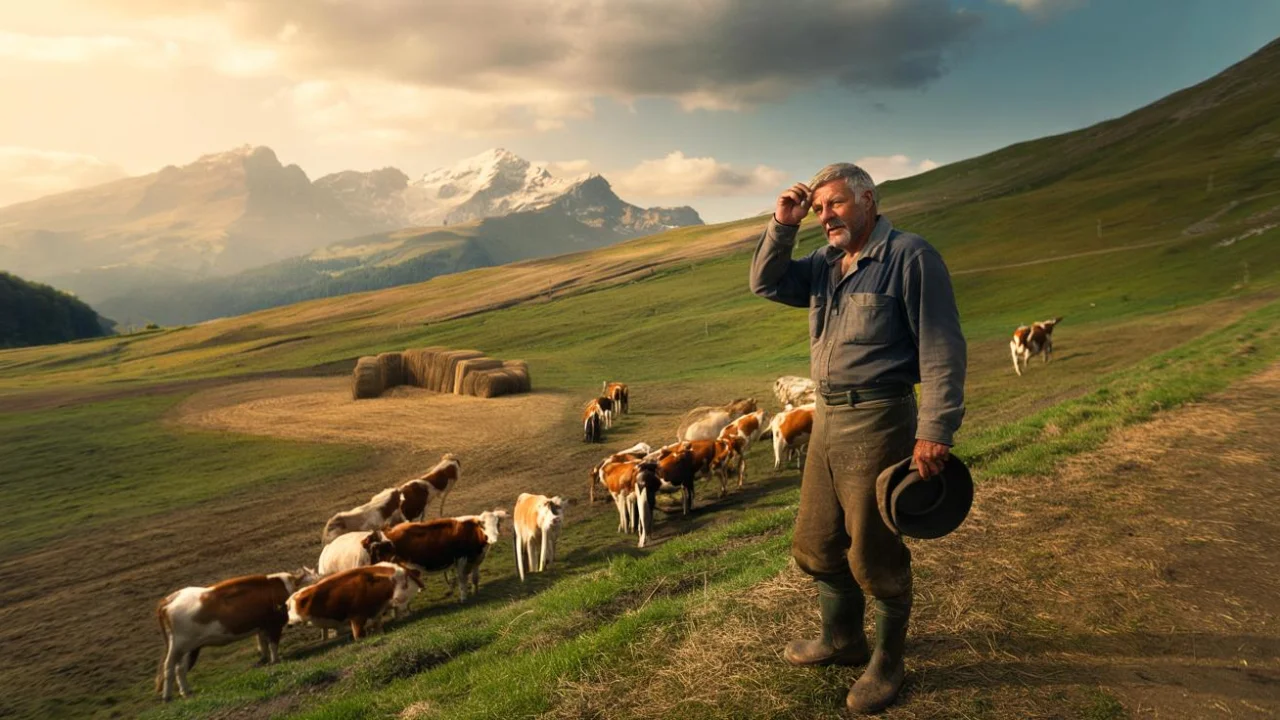
André Montmayeur stood in his Alpine pasture last summer, counting his cows for what felt like the hundredth time. The grass beneath their hooves was brown and brittle, nothing like the lush green carpet he remembered from his childhood. At 52, this French dairy farmer had seen enough seasons to know when something was fundamentally wrong.

His neighbor stopped by that evening with the same worried expression they all wore these days. “How many are you feeding now?” the man asked, gesturing toward the herd. André’s answer surprised them both: “Fewer than last year. And I’m sleeping better because of it.”
What André discovered goes against everything traditional farming taught him. Sometimes the smartest move isn’t to fight harder – it’s to step back and rethink the entire game.
When Climate Change Forces Your Hand
High in the French Alps, dairy farmer André Montmayeur has made a decision that would have seemed unthinkable a decade ago: deliberately shrink his herd to cope with climate change. His farm, Gaec Cap 13, once ran 170-180 dairy cows plus youngstock – nearly 300 livestock units total on 308 hectares.
The turning point came in 2019. The drought was fierce, grass stopped growing by midsummer, and feed stores emptied months earlier than expected. Montmayeur found himself buying expensive forage just to keep his animals fed.
“We were asking whether we’d even find enough food for the animals,” Montmayeur recalls. “The stress was constant and the bills were brutal.”
His experience reflects a growing crisis across Alpine regions. Summers stretch longer and hotter each year. Rain comes in unpredictable bursts instead of steady showers. Grass that once thrived through July now burns out before it can be properly grazed.
Climate change has forced dairy farmers everywhere to reconsider their herd management climate change strategies. But Montmayeur’s solution surprised even agricultural experts: instead of fighting the weather, he decided to work with it.
The Numbers Behind Smarter Herd Management
Montmayeur’s new approach centers on what researchers call “sustainable stocking rates” – matching herd size to what the land can actually support during tough years, not just good ones.
His transformation involved several key changes:
- Reduced total livestock from 300 units to approximately 240 units
- Improved grazing rotation to let pastures recover properly
- Invested in drought-resistant forage varieties
- Built additional water storage capacity
- Focused on higher-quality milk production rather than volume
The results tell a compelling story about modern herd management climate change adaptation:
| Metric | Before (2019) | After (2023) |
|---|---|---|
| Total Livestock Units | 300 | 240 |
| Annual Feed Costs | €85,000 | €62,000 |
| Milk Quality Premium | 2% | 8% |
| Drought Emergency Purchases | €23,000 | €4,000 |
| Net Farm Income | €45,000 | €58,000 |
“The math seemed crazy at first,” admits agricultural consultant Marie Dubois, who worked with Montmayeur on his transition. “Fewer cows usually means less income. But when you factor in lower feed costs, better milk premiums, and reduced stress, the numbers actually improve.”
Montmayeur also discovered unexpected benefits. His remaining cows are healthier, producing higher-quality milk that commands premium prices. The reduced grazing pressure allowed his pastures to recover, creating better forage even during dry spells.
A Model That’s Spreading Across the Mountains
What started as one farmer’s desperate adaptation has become a blueprint for climate-resilient dairy farming. Across the Alpine regions of France, Switzerland, and Austria, other producers are following similar herd management climate change strategies.
The approach addresses multiple climate challenges simultaneously. Smaller herds need less water during droughts. They put less pressure on pastures during heat waves. And they require fewer emergency feed purchases when weather patterns disrupt normal growing seasons.
Dr. Laurent Perret from the French National Institute for Agricultural Research explains the broader implications: “What André discovered is that resilience often trumps raw productivity. A farm that can weather climate shocks consistently will outperform one that maximizes output in good years but struggles during bad ones.”
The strategy isn’t just about cutting numbers randomly. Successful farmers focus on:
- Keeping their most productive, climate-adapted animals
- Improving soil health to capture and retain more rainfall
- Diversifying income through agritourism or direct sales
- Building stronger relationships with local milk processors who value quality
Montmayeur now works part-time as a consultant, helping other farmers navigate similar transitions. His message is simple but powerful: “You can’t control the weather, but you can control how you respond to it.”
The ripple effects extend beyond individual farms. Local milk processors are adjusting their models to work with smaller, higher-quality producers. Rural communities are finding that sustainable farms provide more stable employment than boom-and-bust operations.
Environmental benefits add another layer of value. Reduced herd sizes mean lower methane emissions per hectare. Better-managed pastures store more carbon. And farms that don’t need emergency feed shipments have smaller transportation footprints.
“This isn’t about giving up on farming,” emphasizes Montmayeur. “It’s about farming smarter, not harder. My grandfather always said the land will tell you what it wants – we just need to listen.”
FAQs
Why would a farmer voluntarily reduce their herd size?
Climate change has made traditional high-intensity farming riskier and more expensive, especially during droughts when feed costs spike dramatically.
Does producing less milk mean less income?
Not necessarily. Lower feed costs, quality premiums, and reduced emergency expenses often result in higher net profits despite lower volume.
How do farmers decide which animals to keep?
They typically retain their most productive, heat-tolerant, and healthy animals while selling those that require more intensive management.
Is this approach working in other regions?
Yes, similar herd management climate change strategies are being adopted across Europe, Australia, and parts of North America facing drought pressure.
What role does government policy play in supporting these changes?
Many countries now offer subsidies for sustainable farming transitions, drought-resistant infrastructure, and climate adaptation measures.
Can small-scale farmers afford to make these changes?
The transition often pays for itself within 2-3 years through reduced operating costs, though initial planning and infrastructure investments may require support.
About the Author