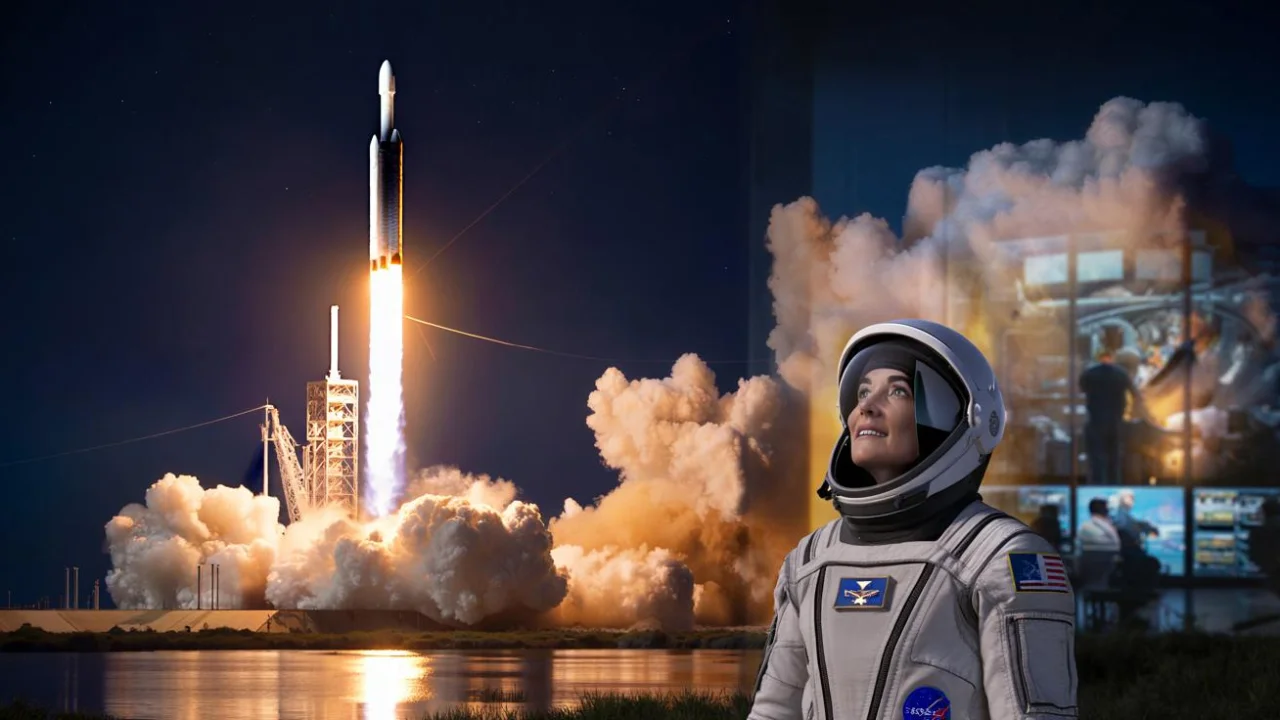
Picture this: a mother in Lyon wakes up her eight-year-old daughter at dawn, pointing to the television screen where a rocket thunders into the Florida sky. “That’s Sophie,” she whispers, tears streaming down her face. “A French woman, just like you could be someday.”

Moments like these ripple across France as Sophie Adenot becomes the first French woman to journey to space in over two decades. Her launch aboard SpaceX’s Crew-12 mission represents more than just another trip to the International Space Station—it’s proof that barriers can still be broken, even in 2024.
For millions watching around the world, Sophie Adenot’s journey to the ISS carries personal meaning. She’s not just an astronaut; she’s someone’s role model, someone’s inspiration, someone’s reminder that the impossible remains within reach.

When Dreams Meet Reality at Cape Canaveral
Friday morning at Cape Canaveral felt electric with anticipation. At 11:15 a.m. Paris time, the SpaceX Falcon 9 rocket pierced through a pale Florida sky, carrying four crew members toward their new home 400 kilometers above Earth.
Sophie Adenot sat strapped inside the Crew Dragon capsule alongside American astronauts Jessica Meir and Jack Hathaway, plus Russian cosmonaut Andrey Fedyaev. The international crew represents the best of human cooperation, even as geopolitical tensions swirl below.
“Weather delays reminded us that even the most advanced technology still bows to Mother Nature,” said former NASA administrator Charles Bolden. “But when that rocket finally lifted off, you could feel the collective exhale from mission control.”
The journey to the ISS isn’t a straight shot, despite the station orbiting just overhead. Instead, the crew must complete a careful thirty-hour orbital dance, circling Earth roughly twenty times before docking. Think of it as the ultimate parallel parking maneuver—except you’re traveling at 28,000 kilometers per hour.

The Woman Behind the Mission
Sophie Adenot brings an impressive resume to her ISS mission. At 43, she’s an aerospace engineer who spent years as a helicopter test pilot, navigating some of the most challenging flight conditions imaginable.
Her path to space began long before joining the European Space Agency. Born in 1981, Adenot grew up during an era when female astronauts remained relatively rare. She pursued engineering studies with determination, later becoming one of France’s most skilled test pilots.
The significance of her mission extends beyond personal achievement. She’s the first French woman to reach the ISS since Claudie Haigneré’s groundbreaking 1996 and 2001 flights. That’s a 25-year gap—an entire generation of French girls who haven’t seen themselves represented in space.
| Mission Details | Information |
|---|---|
| Launch Date | February 2024 |
| Mission Duration | 8-9 months |
| Crew Size | 4 astronauts |
| Rocket | SpaceX Falcon 9 |
| Spacecraft | Crew Dragon |
| Launch Site | Cape Canaveral, Florida |
“Sophie represents the evolution of space exploration,” explains Dr. Maria Santos, a space policy expert at the European Space Research Institute. “She’s not just going to space—she’s carrying the hopes and dreams of an entire generation of young women who see themselves in her success.”
During her extended stay aboard the ISS, Adenot will conduct numerous scientific experiments. Her background in aerospace engineering makes her particularly valuable for technical maintenance tasks that keep the station operational.
What This Means for Space Exploration
Sophie Adenot’s ISS mission arrives at a pivotal moment for international space cooperation. While tensions between nations continue on Earth, the space station remains a beacon of what humans can accomplish together.
The economic impact extends beyond symbolism. France’s space industry employs over 18,000 people directly, with thousands more in supporting roles. Successful missions like Crew-12 help justify continued investment in European space capabilities.
Educational institutions across France are already incorporating Adenot’s mission into their curricula. Schools report increased interest in STEM subjects, particularly among young girls who finally see themselves represented in space exploration.
“When kids see someone who looks like them achieving the impossible, it rewires their understanding of what’s possible,” notes Dr. Sarah Mitchell, an educational psychologist specializing in STEM motivation. “Sophie’s impact will be felt in classrooms for decades to come.”
The mission also showcases Europe’s growing independence in space access. While still relying on SpaceX for crew transport, European space agencies are developing their own capabilities for future missions.
- First French woman in space in 25 years
- Mission duration of 8-9 months aboard the ISS
- Part of ongoing international cooperation in space
- Inspiration for next generation of European astronauts
- Advancement of scientific research in microgravity
The ripple effects of Sophie Adenot’s ISS journey extend far beyond her individual achievement. Young girls across France and Europe now have a contemporary role model in space exploration, someone whose career path they can study and potentially follow.
Her mission timing coincides with increased European investment in space technology. The European Space Agency recently approved record funding for human spaceflight programs, partly motivated by successes like Adenot’s selection and training.
“Every successful mission builds momentum for the next one,” explains retired astronaut Jean-François Clervoy. “Sophie’s presence on the ISS proves that European astronauts can compete at the highest levels of space exploration.”
The scientific work planned during her eight-to-nine-month stay includes experiments in materials science, biology, and Earth observation. These investigations could lead to breakthroughs in medicine, manufacturing, and climate research.
As Sophie Adenot settles into life aboard the International Space Station, her story continues inspiring people worldwide. From that mother in Lyon explaining space travel to her daughter, to engineering students reconsidering their career paths, the impact of representation in space exploration cannot be overstated.
Her successful launch proves that barriers continue falling, even in humanity’s most challenging endeavors. The next generation of space explorers will grow up knowing that anyone—regardless of gender or nationality—can reach for the stars and actually grasp them.
FAQs
How long will Sophie Adenot stay on the ISS?
Sophie Adenot’s mission is planned to last between eight and nine months aboard the International Space Station.
Is Sophie Adenot the first French woman in space?
No, but she’s the first French woman to visit the ISS in 25 years, since Claudie Haigneré’s missions in 1996 and 2001.
What experiments will Sophie Adenot conduct on the ISS?
She’ll work on various scientific investigations including materials science, biological research, and Earth observation studies.
How long does it take to travel from Earth to the ISS?
The journey takes approximately 30 hours, during which the crew orbits Earth about 20 times before docking.
Who else is on the Crew-12 mission with Sophie Adenot?
The crew includes American astronauts Jessica Meir and Jack Hathaway, plus Russian cosmonaut Andrey Fedyaev.
What was Sophie Adenot’s career before becoming an astronaut?
She worked as an aerospace engineer and helicopter test pilot before joining the European Space Agency’s astronaut program.
About the Author
