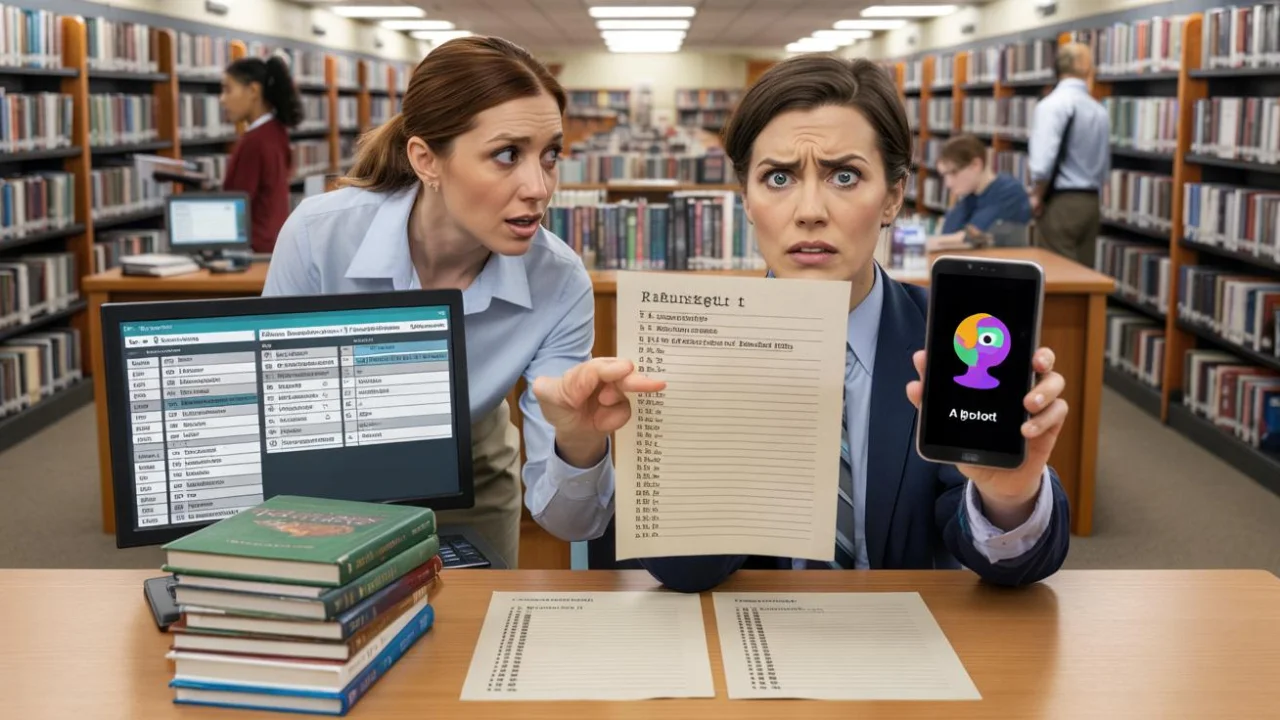
Sarah Martinez had been working the reference desk at Denver Public Library for twelve years when she encountered something that made her question everything she knew about helping readers. A graduate student approached her counter, confidence radiating from his voice as he requested “The Digital Divide in Rural Education: A 2019 Comprehensive Study” by Dr. Patricia Holbrook from Yale University Press.

Sarah’s fingers flew across her keyboard, searching every database she could access. Nothing. She tried alternative spellings, checked similar titles, even reached out to colleagues at other institutions. The book didn’t exist anywhere, yet the student insisted his AI research assistant had specifically recommended it for his thesis.
This wasn’t an isolated incident. Sarah soon discovered she was part of a growing army of librarians across America spending their days hunting for AI-invented books that sound completely real but exist only in the digital imagination of chatbots.

The Mystery of Books That Never Were
What started as a trickle in late 2022 has become a flood. Librarians from coast to coast are fielding requests for titles that artificial intelligence systems confidently recommend but that were never actually written, published, or cataloged anywhere in the real world.
The pattern is remarkably consistent. Patrons arrive with detailed citations that look professionally formatted, complete with publication dates, ISBN numbers, and respectable publisher names. The titles sound academically credible, the authors’ names feel familiar, and the subject matter perfectly matches whatever research the person is conducting.

“We’re seeing requests that are so specific and professional-looking that our first instinct is to assume we’ve missed something in our search,” explains Dr. Rebecca Chen, head librarian at a major university system in California. “These aren’t vague requests for ‘something about climate change.’ These are detailed citations that would fool most people at first glance.”
The phenomenon has created an entirely new category of library work: ghost hunting. Staff members now spend significant portions of their day tracking down phantom publications, consulting with colleagues across institutions, and then delivering the disappointing news that the requested material simply doesn’t exist.

Breaking Down the AI Book Request Problem
The scope of this issue becomes clearer when you examine the data emerging from libraries nationwide:
| Library Type | AI-Generated Requests | Time Spent Per Request | Resolution Success Rate |
|---|---|---|---|
| University Research Libraries | 20-25% of email requests | 45-60 minutes | 0% |
| Public Libraries | 10-15% of research help | 30-45 minutes | 0% |
| Specialized Collections | 15-20% of queries | 60-90 minutes | 0% |
| Community College Libraries | 25-30% of student requests | 20-30 minutes | 0% |
The most commonly requested AI-invented books fall into several predictable categories:

- Academic monographs with titles like “Post-Digital Society: Technology and Human Connection in the 21st Century”
- Government reports such as “Federal Housing Policy Assessment 2020: Rural Implementation Strategies”
- Medical studies including “Longitudinal Analysis of Telehealth Outcomes in Pediatric Care”
- Historical analyses like “Maritime Trade Routes and Economic Development: Pacific Coast Analysis 1850-1900”
- Educational research such as “STEM Learning Outcomes in Diverse Classroom Settings: A Five-Year Study”
“The titles are almost too perfect,” notes James Wilson, a librarian at a Texas community college. “They hit all the right keywords for whatever topic the student is researching, but they’re generic enough that they could apply to dozens of different studies.”
What makes these requests particularly challenging is that AI systems often provide multiple fake sources that appear to corroborate each other, creating an illusion of scholarly consensus around topics that may have limited actual research available.
The Real Impact on Libraries and Learning
This wave of AI-invented books is creating ripple effects that extend far beyond frustrated librarians and confused students. The phenomenon is forcing educational institutions to reconsider how they teach research skills and verify information sources.
Students who rely heavily on AI research assistants often arrive at libraries with a false sense of confidence about their sources. They’ve been told these books exist, sometimes with detailed summaries and quotes, making it difficult to convince them otherwise.
“I had one student argue with me for twenty minutes, insisting that I wasn’t searching correctly because ‘the AI wouldn’t lie,'” recalls Maria Rodriguez, a reference librarian in Chicago. “It’s heartbreaking because they’re genuinely trying to do good research, but they’ve been led astray by technology they trusted.”
The time investment is substantial. What should be a five-minute interaction—either locating a book or confirming it doesn’t exist—now stretches into hour-long investigations. Librarians must methodically check multiple databases, contact other institutions, and sometimes even reach out to publishers directly before they can definitively say a book doesn’t exist.
Some libraries are developing new protocols specifically for handling these AI-generated requests. Staff are being trained to recognize the telltale signs of artificial citations and to explain to patrons why their sources might not be real.
“We’re having to become detectives in addition to being information specialists,” explains Dr. Chen. “We’re learning to spot the patterns that indicate when a source was likely generated by AI rather than created through legitimate scholarly research.”
The issue is also highlighting broader questions about information literacy in the age of artificial intelligence. Many students and researchers assume that if an AI system provides a source, it must be real. They don’t understand that these systems can generate plausible-sounding but entirely fictional citations.
Educational institutions are beginning to incorporate specific training about AI hallucinations into their information literacy programs, teaching students to verify every source independently rather than trusting AI-generated research suggestions.
Looking ahead, librarians worry that this problem will only intensify as AI systems become more sophisticated and widely used. The challenge isn’t just the time spent chasing phantom books—it’s the broader erosion of trust in information systems and the additional burden placed on already stretched library resources.
FAQs
Why do AI systems recommend books that don’t exist?
AI systems like ChatGPT generate responses based on patterns in their training data, sometimes creating plausible-sounding but fictional book titles and citations when they don’t have real sources to recommend.
How can students avoid requesting AI-invented books?
Always verify AI-generated citations through library catalogs, academic databases, or with a librarian before assuming a source exists and is credible.
Are librarians frustrated with these requests?
While the extra work is challenging, most librarians see this as a teaching opportunity to help people understand both AI limitations and proper research methods.
How much time do libraries spend on fake book requests?
University libraries report spending 45-90 minutes per AI-generated request, with some institutions seeing these make up 20-30% of their research queries.
Can AI-invented books ever become real?
While theoretically possible, the specific titles and details generated by AI are random combinations that real authors and publishers are unlikely to coincidentally create.
What should I do if an AI recommends a book I can’t find?
Contact a librarian for help verifying the source, and consider that the AI may have generated a fictional citation rather than recommending a real publication.
About the Author