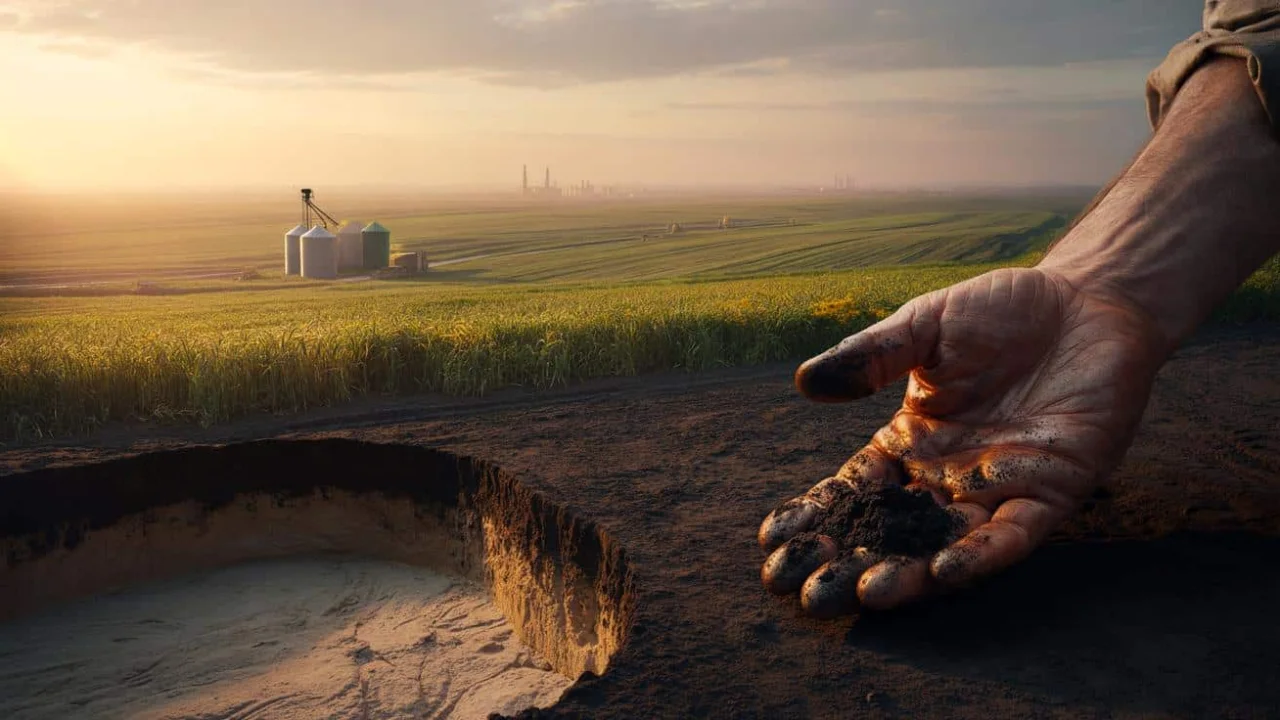
Maria Petrov still remembers the day her grandmother taught her to read the soil. At seven years old, she watched the elderly woman scoop up a handful of earth from their family farm in southern Ukraine, rolling it between weathered fingers like prayer beads.

“See how it holds together but doesn’t stick?” her grandmother whispered, eyes twinkling. “This is chernozem, little one. This black earth fed your great-great-grandfather, and it will feed your children’s children.”
That handful of soil seemed ordinary to young Maria. Today, as a 34-year-old agricultural engineer, she understands her grandmother was holding something more valuable than diamonds – the foundation of global food security.

The Dark Secret Beneath Three Nations
Chernozem black earth doesn’t look like much from a distance. Across the vast plains of Ukraine, Russia, and Kazakhstan, these dark soils stretch endlessly under big skies, seemingly unremarkable to the untrained eye.
But dig down just a few inches, and you’ll discover why this soil has shaped the destiny of empires. The black earth layer can extend up to one full meter deep – a treasure trove of organic matter that took millennia to form.

“I’ve worked with soils across five continents, and nothing comes close to chernozem’s natural fertility,” explains Dr. Andreas Mueller, a soil scientist from Vienna’s Agricultural University. “It’s like nature spent thousands of years preparing the perfect growing medium.”
This remarkable soil formed over thousands of years on ancient grasslands. Each growing season, prairie grasses would sprout, flourish, die, and decompose in place. Cold winters preserved the organic matter while warm summers encouraged deep root systems. Layer by layer, season after season, the earth accumulated carbon and nutrients.

The result? Soil so rich it can support massive grain production with minimal fertilizer input.
Why Numbers Don’t Tell the Whole Story
The scientific data behind chernozem black earth reads like a farmer’s wish list:

| Soil Characteristic | Chernozem | Typical Farmland |
|---|---|---|
| Organic Matter Content | 8-15% | 2-4% |
| Soil Depth | Up to 1 meter | 15-30 cm |
| Wheat Yield Potential | 6-8 tons/hectare | 3-5 tons/hectare |
| Water Retention | Excellent | Moderate |
| Natural Fertility | Very High | Requires Heavy Inputs |
But statistics can’t capture the real impact of this soil. Walk through a Ukrainian village during harvest season and you’ll see the numbers come alive:
- Grain trucks lined up before dawn on country roads
- Elevators working around the clock to process wheat, barley, and corn
- Families whose entire livelihoods depend on this black earth
- Export terminals pushing millions of tons to global markets
“During peak harvest, our small elevator processes 500 tons of grain daily,” says Viktor Kowalski, who manages grain storage in central Ukraine. “All of this comes from soil that our ancestors never had to fertilize heavily. The earth just gives.”
The three nations sitting on major chernozem deposits – Ukraine, Russia, and Kazakhstan – collectively account for nearly 30% of global wheat exports. Ukraine alone, despite its modest size, ranks among the world’s top five grain exporters.
When Soil Becomes a Weapon
This agricultural abundance has transformed chernozem black earth into something more than farmland – it’s become a geopolitical asset. Countries dependent on grain imports watch nervously when tensions rise in Eastern Europe.
Recent conflicts have highlighted just how crucial these soils are to global food security. When supply chains from chernozem regions face disruption, wheat prices spike worldwide. Bread becomes more expensive in Cairo. Livestock feed costs rise in Bangladesh.
“We’re not just growing crops here,” explains Elena Kozlov, an agronomist working across Kazakhstan’s northern plains. “We’re growing food security for dozens of nations. That’s a responsibility that weighs on you.”
Climate change adds another layer of complexity. These soils formed under specific temperature and precipitation patterns. As weather becomes more unpredictable, scientists worry about preserving the delicate balance that created chernozem over millennia.
Modern farming practices present their own challenges. While chernozem black earth is naturally fertile, intensive agriculture can still degrade even the world’s best soil if not managed carefully.
Conservation efforts now focus on:
- Reducing tillage to preserve soil structure
- Implementing crop rotation to maintain organic matter
- Limiting chemical inputs that might disrupt soil biology
- Monitoring erosion in vulnerable areas
The stakes couldn’t be higher. Lose this soil, and you lose the ability to feed hundreds of millions of people.
“My grandmother always said the land doesn’t belong to us – we belong to the land,” reflects Maria Petrov, now managing the same farm where she first learned about chernozem. “Every decision we make has to honor what took nature thousands of years to build.”
As global population continues rising and climate challenges intensify, the world’s dependence on chernozem black earth will only grow. This ancient soil, formed grain by grain and season by season, remains one of humanity’s most valuable resources.
Hidden beneath vast grasslands, deeper than most people will ever dig, lies the foundation of global food security. It’s not glamorous, but it’s absolutely essential – the dark earth that feeds the world.
FAQs
What makes chernozem different from regular soil?
Chernozem contains 3-4 times more organic matter than typical farmland and can be up to one meter deep, compared to 15-30 cm for most agricultural soils.
Where is chernozem found?
The largest chernozem deposits are located in Ukraine, Russia, and Kazakhstan, with smaller areas in parts of the United States, Canada, and Argentina.
How long did chernozem take to form?
This rich black earth developed over thousands of years through repeated cycles of grassland growth, death, and decomposition on ancient steppes.
Why is chernozem called “black gold”?
The nickname reflects its incredible agricultural value – chernozem can produce high crop yields with minimal fertilizer input, making it extremely valuable for farming.
Can chernozem be created artificially?
While soil can be improved through organic matter addition, creating true chernozem would take thousands of years under specific climate and vegetation conditions.
Is chernozem at risk from climate change?
Yes, changing temperature and rainfall patterns could affect the delicate balance that maintains chernozem’s exceptional fertility over time.
About the Author
