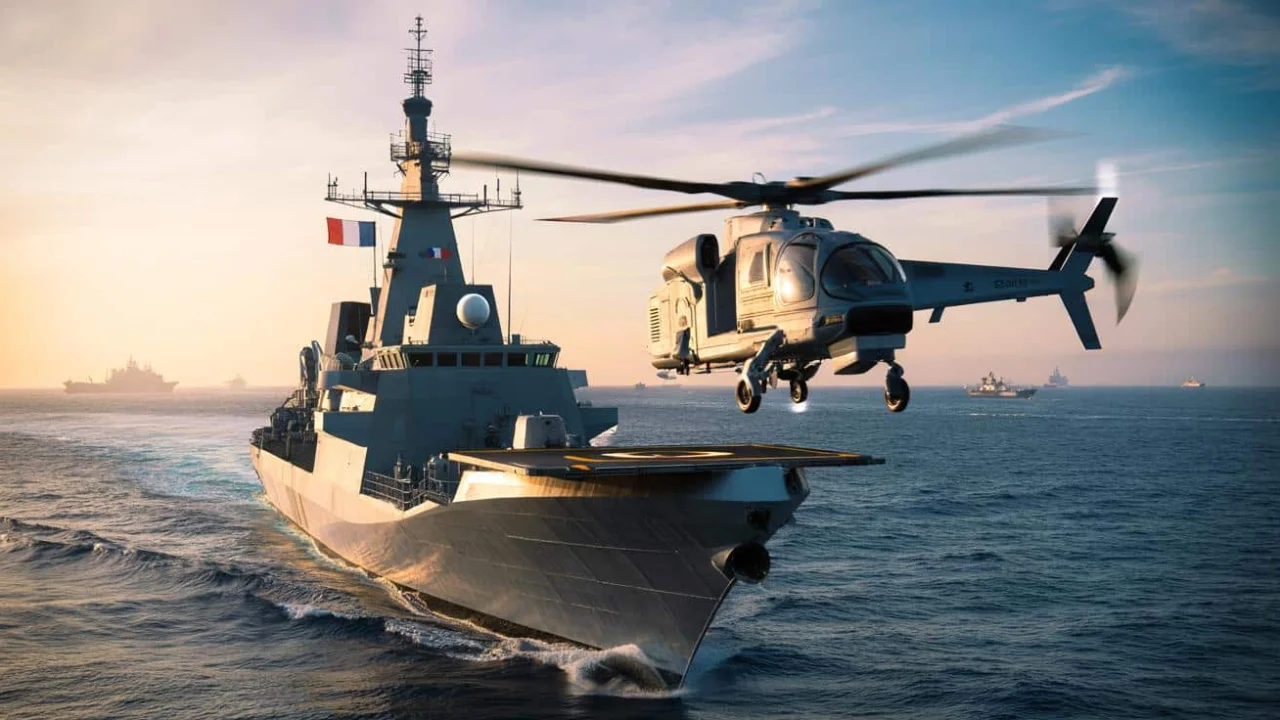
Captain Marie Dubois stands on the bridge of her frigate, scanning the Mediterranean horizon through binoculars. Twenty years ago, her view would extend maybe 12 nautical miles before the Earth’s curve swallowed everything beyond. Today, she watches a small helicopter-like drone climb into the morning sky, knowing it will become her eyes and ears across an area ten times larger than what any lookout could see.

This isn’t science fiction anymore. It’s happening right now, and France just made a decision that will change naval operations forever.
In January 2026, France became the first nation to place a production order for Airbus’ revolutionary VSR700 naval drone. While other countries debated and delayed, the French Navy quietly signed a deal that transforms them from naval technology followers into global pioneers.

Why France’s Bold Move Changes Everything
The contract might seem modest—just six VSR700 systems for the French Navy. But this represents something much bigger than numbers suggest. After years of watching prototypes and test flights, France decided to bet real money on a technology that could redefine how navies operate.
“We’re not just buying drones; we’re buying a new way of thinking about naval warfare,” explains Admiral Jean-Philippe Rolland, former French Navy strategist. “These systems extend our reach in ways that would have required multiple ships just a decade ago.”

The VSR700 isn’t your typical military drone. Built by Airbus Helicopters in partnership with Naval Group, it’s designed specifically for naval drone deployment from the cramped confines of a warship. Each system includes the unmanned helicopter, ground control stations, and all the support equipment needed to operate from a ship’s deck.
What makes this different from land-based drones is the integration. The VSR700 doesn’t just fly around taking pictures—it becomes part of the ship itself, feeding data directly into combat systems and working alongside traditional radars and sensors.

Breaking Down the Game-Changing Technology
The French Navy’s VSR700 systems pack serious capability into a relatively small package. Here’s what makes them special:
| Capability | Details | Impact |
|---|---|---|
| Flight Endurance | 8+ hours continuous operation | All-day surveillance coverage |
| Range | 200+ nautical miles from ship | 10x greater area coverage |
| Sensors | Maritime radar, electro-optical cameras, AIS receiver | Complete maritime picture |
| Integration | Direct feed to ship’s combat system | Real-time tactical decisions |
The sensor package tells the real story. Each drone carries:

- Maritime surveillance radar that can spot and track ships far beyond the horizon
- Electro-optical cameras for day and night visual identification of contacts
- AIS receivers to intercept and analyze signals from civilian vessels
- Secure data links that feed everything directly back to the ship
But the real breakthrough isn’t the hardware—it’s how Naval Group integrates everything. The drone data flows directly into the Steeris Mission System, treating the aircraft like another sensor on the ship. Commanders don’t need separate screens or operators; the drone becomes part of their normal workflow.
“The integration aspect is what sets this apart from hobby-grade systems,” notes Dr. Sarah Mitchell, defense technology analyst. “This isn’t about flying a remote-controlled helicopter with a camera. It’s about extending the ship’s sensor network into three dimensions.”
How This Changes Naval Operations Forever
Think about what this means for a single warship on patrol. Previously, that ship operated in a bubble of awareness maybe 25 miles across. With the VSR700, that same ship can monitor an area roughly the size of Ireland, tracking dozens of contacts simultaneously.
The implications ripple across everything navies do:
- Anti-piracy operations can cover vastly larger areas with fewer ships
- Search and rescue missions get exponentially more effective
- Maritime security patrols can monitor entire shipping lanes
- Intelligence gathering becomes persistent rather than episodic
For France specifically, this technology arrives at a perfect moment. French naval forces operate across multiple oceans, from the Caribbean to the Indian Ocean, often with limited resources. Naval drone deployment allows smaller forces to maintain presence across larger areas.
“We’re essentially multiplying the effectiveness of every ship,” explains Commander Philippe Garnier, a French naval aviation specialist. “One frigate with a VSR700 can now do the surveillance work that previously required a small fleet.”
The timing matters too. While the United States Navy has focused on larger, more complex systems, and other European nations debate requirements, France moved decisively. The first VSR700 systems enter service in 2028, giving France a multi-year head start in operational experience.
This experience advantage could prove crucial. Naval drone operations require new procedures, training programs, and tactical doctrine. The nation that figures this out first gains advantages that extend well beyond the technology itself.
Other navies are watching closely. Several countries have expressed interest in the VSR700, but France’s operational experience will heavily influence how these systems evolve. Early adopter feedback typically drives upgrades, modifications, and next-generation development.
The broader impact extends to France’s defense industry. Airbus and Naval Group now have a real customer using their systems in actual operations. This operational feedback loop accelerates development and creates export opportunities that paper studies simply cannot match.
“Having France as the launch customer gives us credibility with other potential buyers,” notes an Airbus executive familiar with the program. “There’s nothing like proven operational capability to open doors.”
The VSR700 program also represents a shift in how European defense cooperation works. Rather than waiting for multinational agreements that can take decades to negotiate, France decided to move independently while keeping doors open for allies to join later.
FAQs
How big is the VSR700 naval drone?
The VSR700 is roughly the size of a small helicopter, designed to operate from standard naval helicopter landing platforms without requiring major ship modifications.
When will these drones actually start flying missions?
The first French Navy VSR700 systems enter operational service in 2028, with initial deployment likely on France’s newest frigates and patrol vessels.
Can other countries buy these naval drones?
Yes, Airbus is actively marketing the VSR700 internationally, with several nations expressing interest following France’s production order.
How does this compare to other military drones?
Unlike land-based military drones, the VSR700 is specifically designed for naval operations, with specialized sensors for maritime surveillance and systems that integrate directly with ship-based combat systems.
What makes France the first to deploy this technology?
While other nations have tested similar systems, France became the first to place a firm production order and commit to operational deployment, moving from prototype to actual naval service.
How much does naval drone deployment cost?
Specific costs haven’t been disclosed, but the investment includes not just the aircraft but complete systems integration, training, and support infrastructure for long-term operations.
About the Author