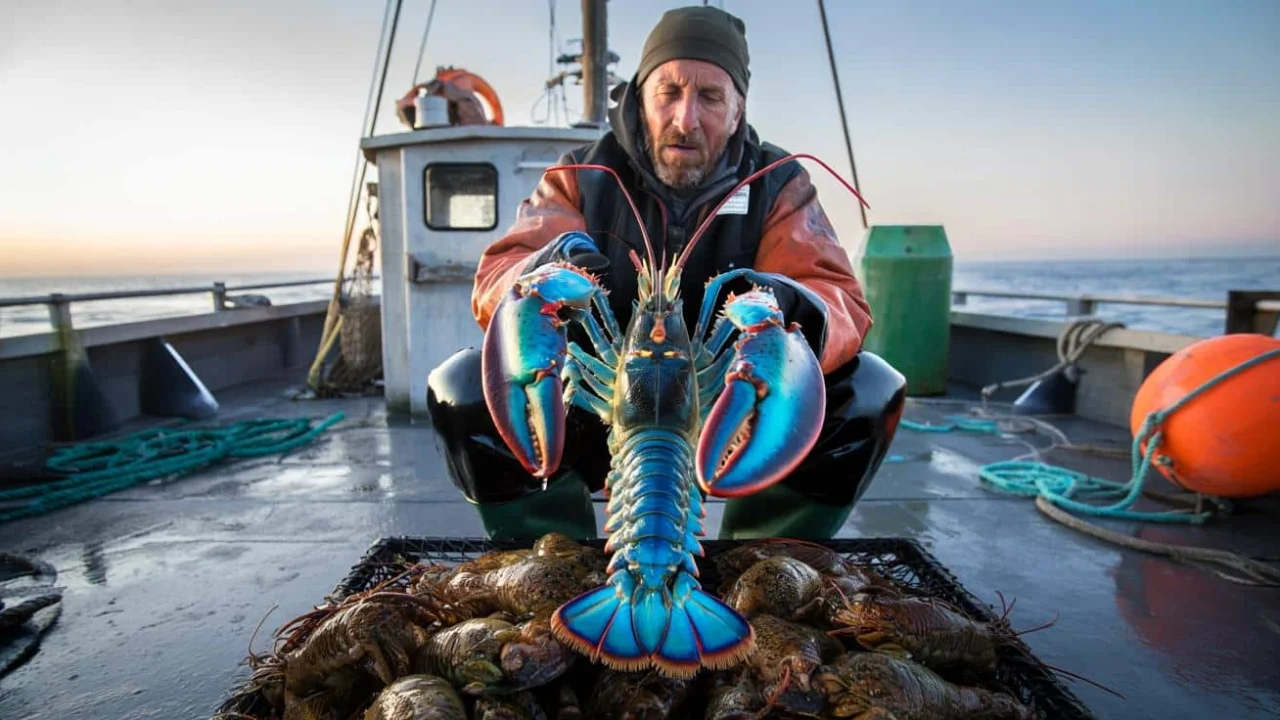
Brad Myslinski had hauled thousands of lobster traps in his twenty-year career off the Massachusetts coast. Every morning brought the same routine: check the traps, sort the catch, toss back the undersized ones. But on that ordinary July morning in 2024, something caught his eye that made him freeze mid-motion. Among the usual brown-green lobsters thrashing in his crate, one shell blazed with an electric blue so vivid it looked like it belonged in a tropical aquarium, not the cold Atlantic waters.

He rubbed his eyes, thinking the early morning sun was playing tricks on him. When he looked again, the impossible blue lobster was still there, its shell gleaming like a sapphire against the weathered wooden deck of his boat, Sophia & Emma.
“I’ve seen thousands of lobsters in my life,” Myslinski later told reporters, “but nothing prepared me for that moment. It was like finding a unicorn in your backyard.”

The Science Behind Nature’s Rarest Lottery Win
What Myslinski had stumbled upon was one of nature’s most extraordinary genetic anomalies: a blue lobster. Marine biologists estimate that only one American lobster in roughly two million displays this striking azure coloration. But for a commercial fisherman to actually catch one? Those odds plummet to an almost incomprehensible one in 200 million.
The blue coloration results from a genetic mutation that causes the lobster to overproduce a particular protein called crustacyanin. This protein binds with a red carotenoid pigment called astaxanthin, creating the lobster’s normal brown-green camouflage. In blue lobsters, an excess of this protein shifts the color spectrum dramatically toward blue.

“It’s essentially a genetic lottery,” explains Dr. Sarah Chen, a marine biologist at Woods Hole Oceanographic Institution. “The same way some humans are born with different eye colors, these lobsters carry a rare genetic variation that completely changes their appearance.”
The mutation doesn’t affect the lobster’s health, behavior, or lifespan. Blue lobsters eat the same diet, grow at the same rate, and live the same 50-100 year lifespans as their ordinary cousins. The only difference is their stunning appearance, which ironically makes survival in the wild much more challenging.

From Ocean Floor to Celebrity Status
Recognizing the rarity of his catch, Myslinski immediately contacted local educators and marine scientists. Within hours, the blue lobster had found a new home at Northeastern University’s Marine Science Center in Nahant, Massachusetts.
Local high school students were invited to name their new resident, settling on “Neptune” after the Roman god of the sea. The timing couldn’t have been better – Neptune arrived just as the center was expanding its public education programs.

Here’s what makes Neptune’s story particularly fascinating:
- The lobster weighs approximately 1.5 pounds and measures 12 inches from nose to tail
- Based on size, marine biologists estimate Neptune is roughly 7-10 years old
- The vibrant blue coloration covers the entire shell, claws, and legs uniformly
- Neptune shares a habitat with local species including tautog fish, sculpins, and green sea urchins
- The lobster displays normal feeding behavior, preferring mussels and small crabs
- Thousands of visitors have already come to see Neptune since arriving at the center
| Lobster Color Variant | Estimated Odds | Cause |
|---|---|---|
| Normal (Brown-Green) | Standard | Normal protein production |
| Blue | 1 in 2 million | Excess crustacyanin protein |
| Red (alive) | 1 in 10 million | Lack of blue-green pigments |
| Yellow | 1 in 30 million | Partial pigment deficiency |
| Split-colored | 1 in 50 million | Bilateral genetic expression |
| Albino | 1 in 100 million | Complete absence of pigments |
“Neptune has become our most popular resident,” says Maria Rodriguez, education coordinator at the Marine Science Center. “Kids press their faces against the tank trying to get a better look. Adults pull out their phones immediately. It never gets old watching people’s reactions.”
Why This Discovery Matters Beyond the Wow Factor
While Neptune’s celebrity status brings smiles and social media buzz, the discovery carries deeper implications for marine science and conservation efforts. Blue lobsters serve as living laboratories for understanding genetic diversity in marine populations.
The rarity of blue lobsters makes them valuable for studying how genetic mutations spread through populations and survive in harsh ocean environments. Each blue lobster provides scientists with DNA samples that help map genetic variation within American lobster populations along the Atlantic coast.
“These rare color variants help us understand the genetic health of lobster populations,” notes Dr. James Mitchell, a geneticist studying crustacean evolution. “A population that can produce these kinds of mutations typically has good genetic diversity, which is crucial for long-term survival.”
The discovery also highlights the importance of sustainable fishing practices. Myslinski’s decision to contact scientists rather than sell Neptune to the highest bidder reflects a growing awareness among commercial fishermen about their role in marine conservation.
Most blue lobsters caught by fishermen historically ended up on dinner plates, their rarity unknown to those who caught them. Today, increased communication between fishing communities and research institutions means more of these genetic treasures find their way to aquariums and research facilities.
Neptune’s story has already inspired educational programs reaching thousands of students across New England. The Marine Science Center uses Neptune as a gateway to teach broader lessons about marine biodiversity, genetics, and ocean conservation.
For Myslinski, the experience has been life-changing. “I always knew the ocean held surprises, but this reminded me that there’s still magic out there,” he reflects. “Every trap I pull now, there’s this tiny voice wondering what else might be waiting down there.”
Neptune continues thriving in captivity, serving as both a scientific specimen and an ambassador for ocean conservation. The blue lobster has already outlived the average lifespan of lobsters in commercial fishing operations, where most are caught within their first few years of life.
FAQs
How long do blue lobsters live?
Blue lobsters have the same lifespan as regular lobsters, typically 50-100 years in ideal conditions, though most are caught much younger.
Can blue lobsters reproduce and pass on their color?
Yes, blue lobsters can mate with regular lobsters, but the blue coloration is recessive, so offspring usually appear normal unless both parents carry the gene.
Are blue lobsters safe to eat?
Absolutely, blue lobsters are identical to regular lobsters in terms of taste and safety, though they turn the same red color when cooked.
How much is a blue lobster worth?
While they have no additional market value for food, blue lobsters can be worth thousands of dollars to aquariums and collectors due to their rarity.
Where are blue lobsters most commonly found?
Blue lobsters occur randomly throughout the Atlantic lobster’s range, from Canada to North Carolina, with no specific geographic concentration.
What should someone do if they catch a blue lobster?
Contact local marine science institutions or aquariums immediately, as these specimens are invaluable for research and education programs.
About the Author