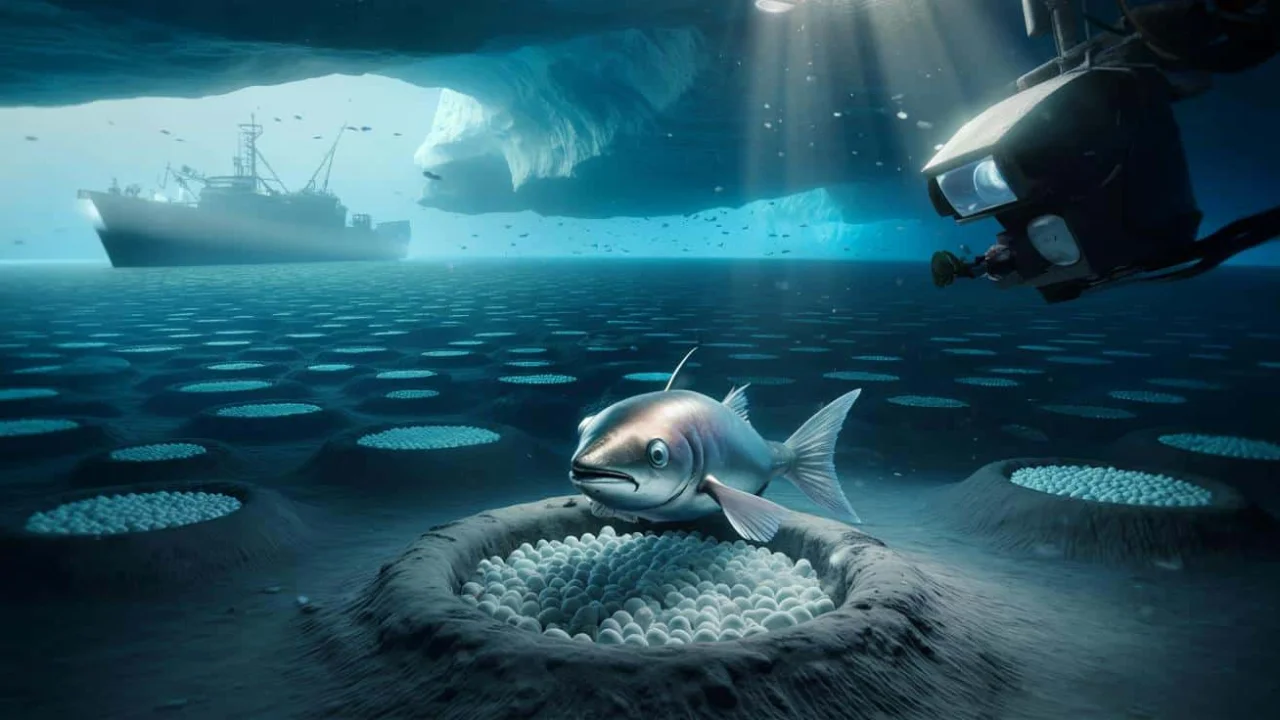
Dr. Sarah Chen stares at her computer screen in disbelief, her coffee growing cold beside a stack of research papers. The underwater footage from Antarctica plays on repeat—thousands upon thousands of perfectly circular nests stretching into the darkness like an alien cityscape. “I’ve been studying marine ecosystems for twenty years,” she whispers to her colleague, “and I’ve never seen anything like this.”

What started as routine research has become something much bigger. The discovery of the world’s largest fish breeding colony beneath Antarctic ice should be a cause for celebration. Instead, it’s sparked a heated debate that cuts to the heart of how we protect our planet’s most fragile places.
The timing couldn’t be more controversial. These antarctic fish nests sit directly beneath waters that several nations want to open for commercial fishing and deep-sea mining.

The Discovery That Changed Everything
Picture this: a German research vessel called Polarstern gliding through the Weddell Sea, one of the most remote corners of our planet. The crew expected another routine day of sonar scanning—maybe some interesting ice formations, perhaps a few scattered fish.
Instead, their cameras revealed what marine biologist Dr. Autun Purser calls “the most incredible sight of my career.” The seafloor erupted with life. Round craters, each perfectly sculpted by pale icefish with translucent bodies, stretched as far as their equipment could see.

The numbers tell an almost unbelievable story. Scientists counted approximately 60 million active antarctic fish nests spread across 240 square kilometers—an area larger than Paris. Each nest contains up to 1,700 eggs, representing what could be the largest fish breeding colony ever discovered on Earth.
“We kept thinking the colony would end,” explains Dr. Purser. “But every camera deployment showed the same thing—more nests, more fish, more life than we ever imagined possible in this frozen world.”

These aren’t ordinary fish. Jonah’s icefish have evolved without red blood cells, their clear blood perfectly adapted to the oxygen-rich Antarctic waters. They’ve likely been using this breeding ground for thousands of years, generation after generation returning to the same protected waters beneath the ice.
The Numbers Behind the Discovery
The scale of this underwater metropolis becomes clearer when you break down the data:

| Discovery Metric | Measurement |
|---|---|
| Total nest count | 60 million active nests |
| Area covered | 240+ square kilometers |
| Eggs per nest | Up to 1,700 |
| Estimated biomass | 60,000+ tonnes |
| Discovery location | Weddell Sea, Antarctica |
| Water depth | 420-535 meters |
What makes these antarctic fish nests even more remarkable is their perfect organization. Each nest is a carefully constructed bowl of stones and pebbles, with a male icefish standing guard over thousands of developing eggs. The colony forms distinct neighborhoods, with clusters of nests separated by barren areas.
Key characteristics of the breeding colony include:
- Nests arranged in precise circular patterns
- Male fish actively defending their territories
- Optimal water temperature between -1.8°C and 0°C
- Strong ocean currents bringing constant food supply
- Protected location beneath thick seasonal ice cover
- Evidence of multi-generational use spanning decades
“The organization is mind-blowing,” notes marine ecologist Dr. Lisa Martinez. “These fish have created what amounts to an underwater city, complete with neighborhoods, traffic patterns, and resource distribution systems.”
Why This Discovery Has Everyone Fighting
Here’s where the celebration turns sour. The exact location where scientists found these antarctic fish nests falls within waters that several countries want to exploit commercially. The area is being considered for krill fishing operations and potential deep-sea mining activities.
Environmental groups are furious. “We’ve just discovered the Amazon rainforest of the ocean floor,” argues conservation biologist Dr. Robert Hayes. “And instead of protecting it, we’re debating whether to fish it empty or mine the life out of it.”
The controversy highlights a frustrating pattern in environmental protection. Time and again, scientists discover incredible ecosystems just as industrial interests eye the same areas for exploitation. The Antarctic Treaty System, designed to protect the continent, has loopholes that allow certain commercial activities in international waters.
Commercial fishing representatives counter that sustainable harvesting is possible without disturbing the nests. They point to existing quotas and monitoring systems as proof that industry and conservation can coexist.
But scientists aren’t convinced. The icefish colony depends on a delicate balance of water temperature, current patterns, and food availability. Large-scale fishing operations could disrupt these conditions, potentially causing the entire colony to collapse.
Dr. Chen puts it bluntly: “We’re talking about a breeding ground that took thousands of years to establish. One bad fishing season could destroy it forever. Is that a risk we’re willing to take?”
The debate has exposed uncomfortable truths about how we approach conservation. Environmental protection often feels like an afterthought, something we consider only after economic interests have been established. The discovery of these antarctic fish nests forces us to confront whether we’re serious about preserving the planet’s most extraordinary places.
What happens next could set a precedent for environmental protection worldwide. Will we prioritize short-term economic gains over long-term ecological preservation? Or will this underwater metropolis finally force us to put protection first?
The icefish are still there, still guarding their nests, still following instincts older than human civilization. The question is whether we’ll be wise enough to protect what they’ve built.
FAQs
What are antarctic fish nests and why are they important?
Antarctic fish nests are carefully constructed circular breeding areas created by icefish on the seafloor. They’re important because they represent the world’s largest known fish breeding colony and support a massive ecosystem beneath Antarctic ice.
How many fish nests were discovered in Antarctica?
Scientists discovered approximately 60 million active fish nests spread across more than 240 square kilometers of seafloor in the Weddell Sea.
Why is there controversy about the fish nest discovery?
The controversy exists because the nests are located in waters targeted for commercial fishing and potential deep-sea mining operations, raising questions about whether economic interests will override environmental protection.
What type of fish create these Antarctic nests?
Jonah’s icefish create these nests. These fish have evolved without red blood cells and are perfectly adapted to the extremely cold Antarctic waters.
Could fishing operations harm the fish colony?
Yes, scientists worry that large-scale fishing could disrupt water currents, food supplies, and environmental conditions that the fish colony depends on for survival.
What makes this discovery so unique?
This is the largest fish breeding colony ever documented on Earth, hidden beneath Antarctic ice for potentially thousands of years and only recently discovered by chance during a routine research mission.
About the Author