Picture this: you’re digging in your backyard and suddenly hit something metallic. You brush away the dirt and find an ancient sword, perfectly preserved, standing upright like it’s waiting for someone to claim it. Sounds like a fantasy novel, right?

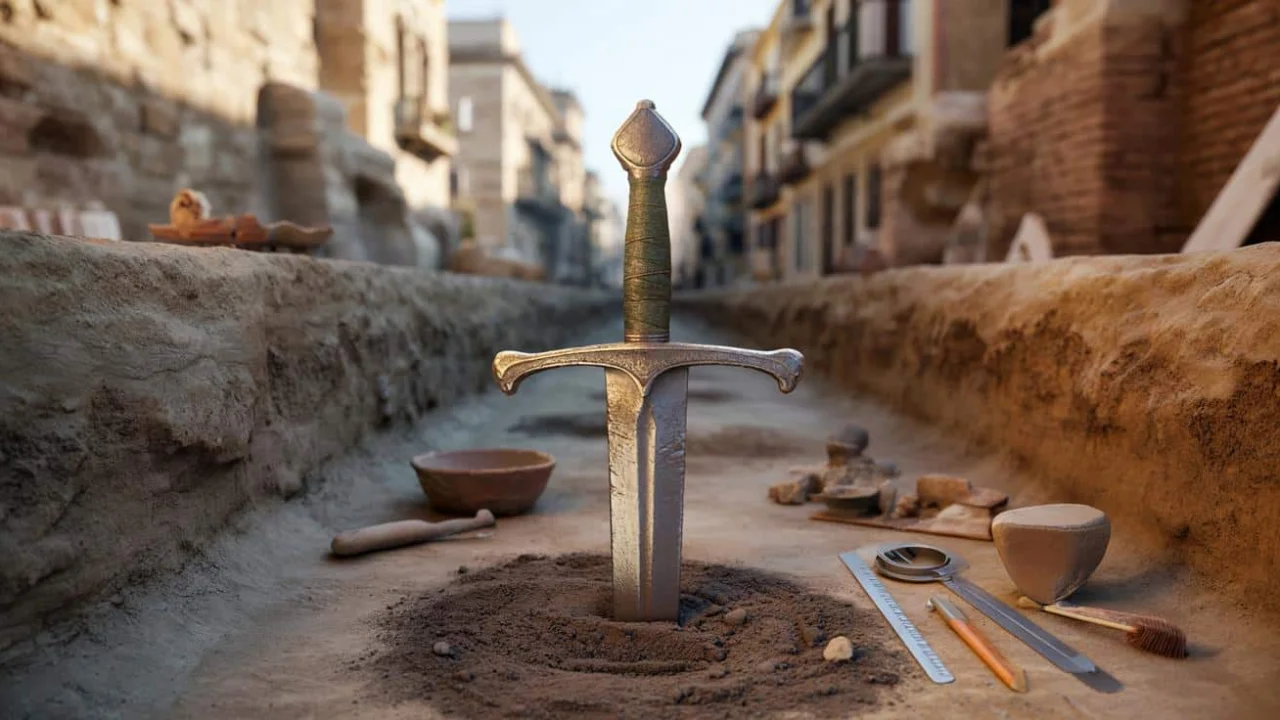
That’s exactly what happened to a team of archaeologists in Valencia, Spain, back in 1994. They weren’t looking for legendary weapons—just doing routine excavation work near some old Roman ruins. But when they pulled that sword from the earth, standing vertical as if someone had just walked away from it, they couldn’t help but think of King Arthur’s famous blade.
Little did they know, their playful nickname “Excalibur” would stick around for three decades while the sword’s true identity remained a complete mystery. Now, after years of advanced testing, researchers have discovered something that challenges everything we thought we knew about medieval Spain.

When Legends Meet Reality: The Valencia Discovery
The Excalibur sword Islamic origins story begins in Valencia’s historic center, where city archaeologists were carefully excavating an old house near the Roman forum. The sword appeared almost dramatically—thrust into the ground vertically, as if its last owner had planted it there intentionally before disappearing into history.
“The image instantly reminded the team of King Arthur’s legendary blade in the stone,” explains Dr. María González, a medieval weapons expert. “It was such a striking visual that the Excalibur nickname felt natural, even though they suspected it had nothing to do with Arthurian legend.”

Back in the 1990s, dating ancient weapons was far more challenging than today. The sword went into storage with the municipal archaeology service, labeled broadly as “medieval” but with no specific time period or cultural origin identified. For nearly thirty years, it sat in the collection, its secrets locked away.
The breakthrough came when Valencia’s archaeology department launched a comprehensive review project for their 75th anniversary. Among thousands of catalogued items, the forgotten Excalibur sword caught researchers’ attention once again.

Modern Science Reveals Ancient Secrets
Leading the new investigation, archaeologist José Miguel Osuna had access to technology that simply didn’t exist in 1994. Advanced spectroscopy, detailed metallurgical analysis, and high-resolution imaging could now reveal the sword’s hidden story layer by layer.
The results were stunning. Every test pointed to the same conclusion: this wasn’t a Christian medieval weapon at all, but an Islamic cavalry sword from the 10th century, when Valencia was part of Al-Andalus under Umayyad rule.

| Analysis Method | Key Finding | Historical Significance |
|---|---|---|
| Metallurgical Study | Steel composition matches Islamic workshops | Proves advanced metalworking techniques |
| Spectroscopy | Dating confirmed to 10th century | Places weapon in Umayyad period |
| Surface Analysis | Decorative patterns show Islamic influence | Reveals cultural artistic traditions |
| Corrosion Layers | Burial environment consistent with era | Supports historical timeline |
The sword’s structure, metal composition, and decorative details all match weapons produced in Islamic workshops during the caliphal era. This discovery forces historians to reconsider how different cultures interacted on the Iberian Peninsula.
“We’re not just looking at a weapon here,” notes Professor Ahmed Hassan, an expert in Islamic metallurgy. “This sword represents the sophisticated craftsmanship and military technology that existed in Al-Andalus, challenging stereotypes about medieval Islamic civilization.”
Key characteristics that identify the Excalibur sword Islamic origins include:
- Distinctive blade curvature typical of Islamic cavalry swords
- Metal alloy composition matching 10th-century Cordoba workshops
- Decorative elements showing Islamic artistic influence
- Construction techniques specific to Umayyad weapon-making traditions
- Size and weight designed for mounted warfare
Rewriting History Books: What This Discovery Means
The Excalibur sword Islamic origins revelation does more than just correct one artifact’s identity—it opens new questions about medieval Spain’s complex cultural landscape. For decades, historians have debated how Christian and Islamic communities coexisted and influenced each other during the Reconquista period.
This sword provides physical evidence of the sophisticated Islamic civilization that flourished in Valencia centuries before the Christian conquest. It challenges the simplified narrative of Christian heroes defeating Muslim invaders, revealing instead a rich, multicultural society where different traditions blended and competed.
“Finding an Islamic sword preserved so well in Valencia’s historic center tells us that Muslim presence there was significant and lasting,” explains Dr. Carmen Rodriguez, a specialist in Iberian medieval history. “This wasn’t just passing military occupation—this was a established community with skilled craftspeople.”
The discovery impacts several areas of historical understanding:
- Military history: Reveals advanced Islamic weapon technology in 10th-century Spain
- Cultural studies: Shows depth of Islamic influence on Iberian Peninsula
- Archaeological methods: Demonstrates importance of re-examining old finds with new technology
- Social history: Provides evidence of established Muslim communities in Valencia
For Valencia specifically, the sword adds a new chapter to the city’s origin story. Rather than beginning with Christian conquest, the city’s medieval history now includes a more prominent Islamic period with sophisticated urban development and skilled artisans.
Museum curators are already planning new exhibitions that will showcase the sword alongside other Islamic-era artifacts from Valencia. The goal is helping visitors understand the region’s multicultural heritage beyond simple conquest narratives.
“This sword forces us to see medieval Spain as it really was—not a battlefield between Christianity and Islam, but a meeting place where different cultures created something unique together,” concludes Professor Hassan.
The Excalibur sword Islamic origins discovery also raises intriguing questions about other medieval artifacts sitting in museum collections worldwide. How many similar weapons have been mislabeled or misunderstood due to limited technology or cultural assumptions?
As researchers continue studying the sword’s metallurgy and construction techniques, they hope to trace its specific workshop origins within the vast Umayyad caliphate. Each detail could reveal new information about trade routes, military organization, and daily life in Islamic Spain.
FAQs
When was the Excalibur sword actually discovered?
The sword was found in 1994 during archaeological excavations in Valencia’s historic center, near the Roman forum ruins.
Why was it called Excalibur if it’s not related to King Arthur?
Archaeologists nicknamed it “Excalibur” because they found it standing vertically in the earth, resembling the legendary sword in the stone from Arthurian legend.
How do we know the sword has Islamic origins?
Advanced testing including spectroscopy, metallurgical analysis, and surface imaging confirmed the sword dates to the 10th century and matches Islamic workshop techniques from the Umayyad period.
What was Al-Andalus?
Al-Andalus was the Muslim-ruled territory on the Iberian Peninsula from 711 to 1492, which included most of modern Spain and Portugal during various periods.
Where can people see this sword today?
The sword is currently held in Valencia’s municipal archaeology collection, with plans for public exhibition as part of new displays about the city’s Islamic heritage.
Does this discovery change our understanding of medieval Spain?
Yes, it provides physical evidence of the sophisticated Islamic civilization that existed in Valencia, challenging simplified narratives about Christian-Muslim conflict during the medieval period.
About the Author