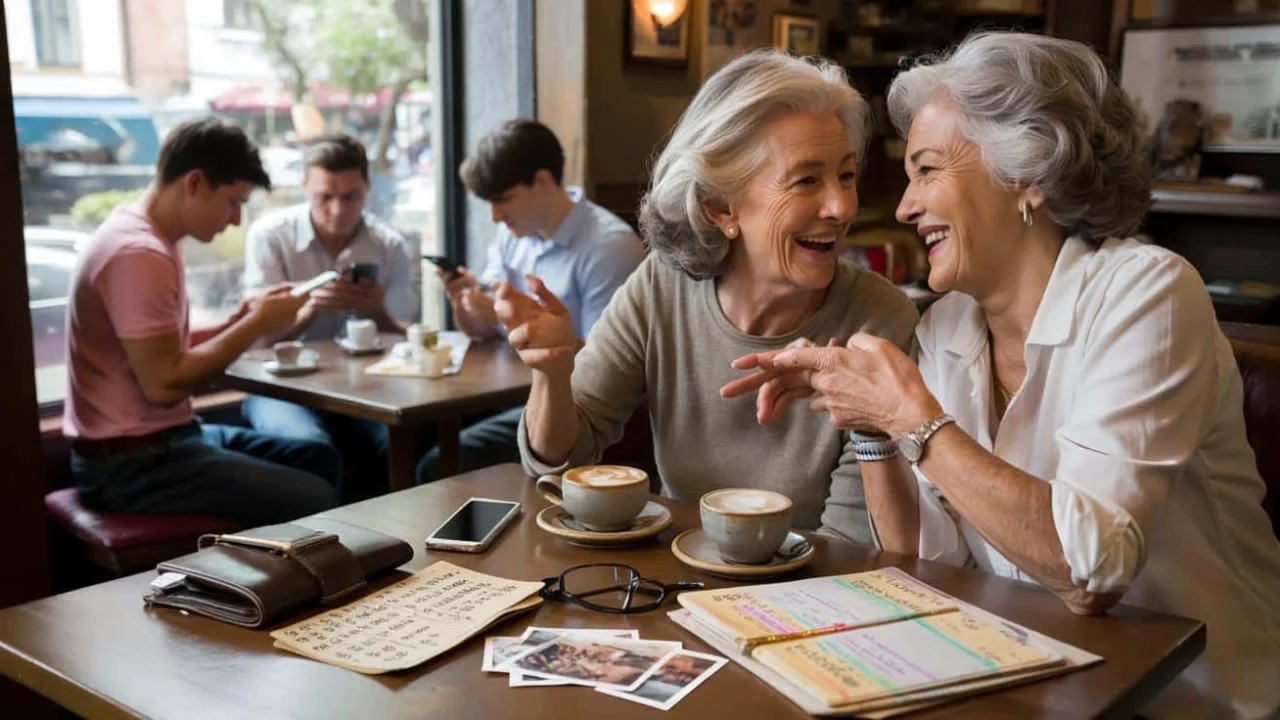
The café was full of glowing screens, but the only real conversation was coming from the corner table. Two women in their late sixties, hair silver and unapologetic, were laughing so hard the waiter had to wait to put down their coffee. No phones on the table. No pictures. Just hands waving, eyes shining, stories flying back and forth like they had all the time in the world.

At the next table, a group of twenty-somethings barely looked up from their feeds. One of them scrolled with the flat, bored thumb of someone who has seen everything and nothing at the same time.
I caught myself glancing between the two worlds and thought: one side looks “young,” the other side looks alive. There’s a difference.

Why Older Women’s Conversations Hold Magic the Digital World Has Lost
Something remarkable happens when you step back and observe how different generations communicate. While younger people text, snap, and scroll their way through relationships, older women conversation styles reveal a depth of connection that feels almost revolutionary in our screen-dominated world.
These women didn’t grow up with the luxury of hiding behind carefully crafted messages or emoji reactions. They learned to navigate conflict, joy, heartbreak, and celebration through direct, unfiltered human exchange. The result? A conversational authenticity that cuts through the noise of modern communication.

“When I see my 70-year-old mother talking with her friends, there’s this intensity of presence I rarely see in younger people,” notes Dr. Sarah Chen, a social psychologist studying intergenerational communication patterns. “They give each other their full attention in ways that feel almost foreign now.”
This isn’t nostalgia talking. It’s about recognizing communication skills that many of us have forgotten we need.

Nine Communication Habits That Make Older Women Masters of Connection
Watch older women in conversation and you’ll notice patterns that create deeper bonds than any digital interaction can match. These aren’t learned behaviors from communication courses – they’re natural responses developed through decades of real-world relationship building.
- Phone calls over text messages – They choose voice connection when it matters most
- Eye contact during conversation – No screen competition for their attention
- Comfortable with silence – They don’t rush to fill every pause with words
- Ask follow-up questions – They dig deeper instead of moving to the next topic
- Share vulnerabilities openly – No filters on authentic emotional expression
- Listen without planning responses – They hear what’s actually being said
- Use physical touch appropriately – A hand on the arm, a hug that lasts long enough
- Remember previous conversations – They circle back to things that mattered
- Create conversation rituals – Regular check-ins that build consistency

Take Margaret, 68, who meets three friends every Tuesday at the same diner. They’ve been doing this for twelve years. No agenda, no group text planning, just showing up. “We solve the world’s problems between the coffee refills,” she laughs. “And somehow, we always leave feeling lighter.”
| Communication Style | Older Women Approach | Digital Generation Approach |
|---|---|---|
| Conflict Resolution | Direct conversation, face-to-face | Text messages, delayed responses |
| Emotional Support | Physical presence, active listening | Emojis, “thoughts and prayers” comments |
| News Sharing | Phone calls with context and reaction | Link sharing without discussion |
| Planning Events | Group calls or in-person discussion | Group chats with scattered responses |
“There’s something about hearing someone’s voice that texting can never replicate,” explains communication expert Dr. Michael Torres. “Older women understand that the pause, the sigh, the little laugh – these carry as much meaning as the actual words.”
What Younger Generations Can Learn From This Conversational Wisdom
The gap isn’t just generational – it’s about relationship depth versus relationship maintenance. While digital tools excel at staying connected with large networks, older women conversation techniques build the kind of bonds that sustain people through life’s real challenges.
Consider how differently these groups handle difficult news. When Sarah, 34, got divorced, she announced it on social media and received hundreds of supportive comments. When her aunt Linda, 62, heard the news, she drove three hours to sit on Sarah’s couch with tissues and homemade soup. No photos were taken.
The difference isn’t that one approach is wrong – it’s that they serve different needs. But when life gets truly difficult, most people crave the kind of presence that older women have mastered.
Research from the University of Michigan shows that face-to-face conversation reduces stress hormones more effectively than any digital communication. The study found that women over 60 maintained more stable mental health partly because of their preference for direct, voice-based communication.
“They’ve never stopped treating conversation as an art form,” notes relationship counselor Dr. Patricia Williams. “While everyone else learned to communicate in 280 characters, they kept the long-form conversation alive.”
This shows up in surprising ways. Older women are more likely to call when someone hasn’t responded to a text – not because they’re pushy, but because they recognize when someone might need to talk. They understand that silence often means something.
Their conversation skills also translate into better conflict resolution. They’re comfortable with uncomfortable topics because they learned to navigate disagreement before the option of blocking someone existed. They work through things instead of around them.
The magic isn’t in rejecting technology – many older women use smartphones and social media effectively. The difference is in understanding what each tool does best and choosing accordingly. They text for logistics but call for feelings. They use email for information but meet in person for important decisions.
This intentional approach to communication creates relationships that can weather decades. While younger friendships sometimes fade when life gets complicated, these women maintain bonds that deepen with time and distance.
FAQs
Why do older women prefer phone calls over texting?
They value the emotional context that voice conversation provides – hearing tone, pace, and those meaningful pauses that text can’t convey.
How can younger people learn these conversation skills?
Start by giving full attention during conversations, asking follow-up questions, and choosing calls over texts for important discussions.
Are digital communication methods actually harmful?
Not harmful, but limited. They’re excellent for coordination and staying connected but can’t replace the depth of direct conversation for emotional support.
What makes older women better at handling conflict in relationships?
They learned to resolve disagreements face-to-face before digital avoidance became an option, making them more skilled at working through problems directly.
Do older women use social media differently than younger people?
Yes – they typically use it to supplement real-world relationships rather than as a primary form of connection, maintaining a clearer boundary between digital and personal interaction.
How do conversation rituals strengthen relationships?
Regular, predictable communication creates consistency and trust, showing that the relationship is a priority worth scheduling time for rather than fitting in when convenient.
About the Author