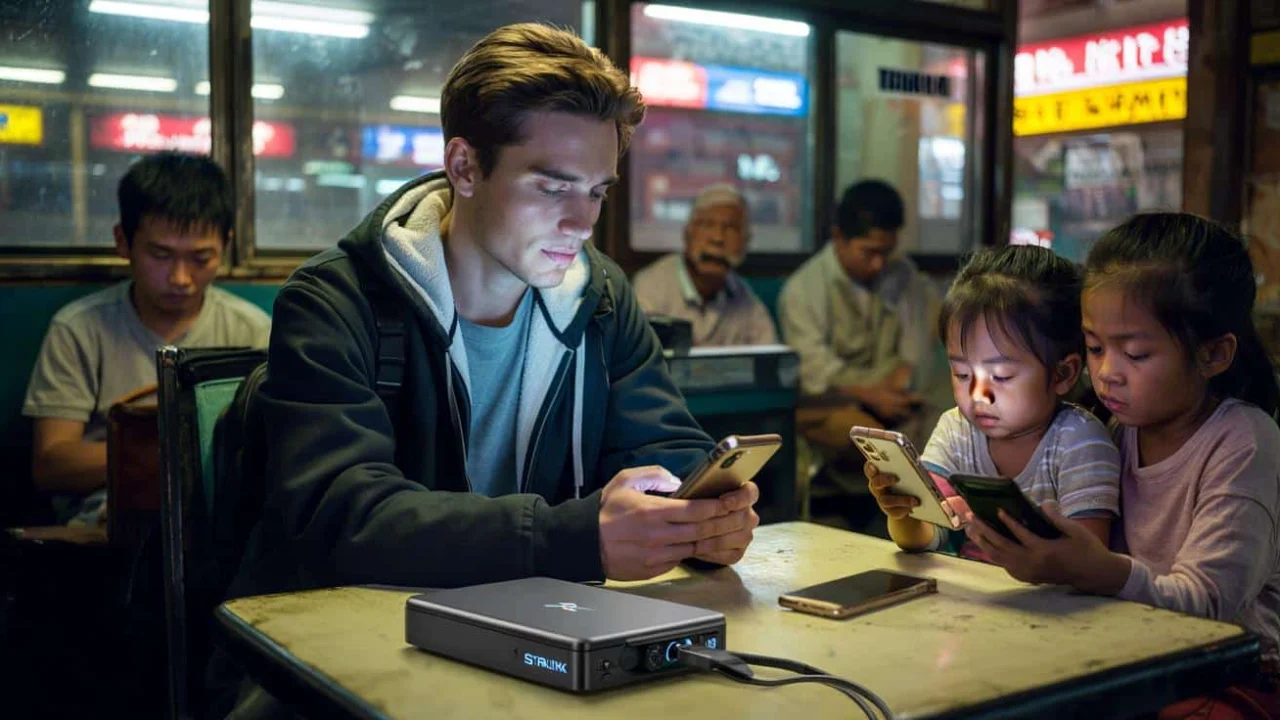
Maria stepped off the bus in a small town outside Guatemala City, her phone showing one bar of signal. Around her, other passengers desperately waved their devices in the air, hunting for a connection to call home. But Maria wasn’t worried. She pulled out a sleek device from her backpack, tapped a few buttons, and suddenly her phone displayed full bars with “Starlink” glowing beneath. Within seconds, she was video-calling her family in perfect HD while everyone else stared in frustration at loading screens.

This scene is playing out more frequently around the world as Starlink mobile internet becomes available to those who can afford it. What looks like technological progress on the surface reveals a troubling truth underneath: we’re creating a two-tiered internet where your bank account determines your access to information.
The promise was beautiful. Satellites would democratize the internet, breaking down barriers and connecting everyone equally. Instead, we’re building digital walls that separate the connected wealthy from everyone else.

The Real Cost of Freedom in the Sky
Starlink mobile internet arrives with marketing that sounds like a revolution. No more dependence on government-controlled networks. No more dead zones. Just pure, uncensored connectivity beaming down from space. The reality hits differently when you look at the price tags.
A typical Starlink mobile plan costs between $150-$200 monthly, plus hardware costs that can reach $600 or more. For perspective, that monthly fee represents more than the average monthly income in 64 countries worldwide. Even in wealthy nations, it’s a luxury expense that puts true internet freedom out of reach for millions.

“We’re seeing the emergence of a premium internet tier,” explains Dr. Sarah Chen, a telecommunications researcher at MIT. “It’s not just about speed anymore—it’s about uncensored, unrestricted access that only some can afford.”
The gap becomes stark in countries where governments restrict internet access. While wealthy tourists and business travelers can bypass censorship with their Starlink connections, local citizens remain trapped behind digital barriers. The same satellite constellation that could liberate everyone instead becomes another privilege of wealth.

Breaking Down the Digital Divide Numbers
The mathematics of Starlink mobile internet reveal the scope of this emerging divide. Here’s what the real-world costs look like across different regions:
| Region | Monthly Plan Cost | Average Monthly Income | Internet Cost as % of Income |
|---|---|---|---|
| Rural Mexico | $150 | $280 | 54% |
| Nigeria | $180 | $95 | 189% |
| Philippines | $160 | $320 | 50% |
| United States | $200 | $5,500 | 3.6% |
| Germany | $175 | $4,200 | 4.2% |
These numbers tell a story that tech executives prefer not to discuss. In developing regions where Starlink mobile internet could provide the most liberation from censorship, the service costs more than people earn. Meanwhile, in wealthy countries where internet freedom already exists, the service is easily affordable.

The hardware requirements make things worse. The mobile terminals needed for Starlink connectivity cost between $500-$800 upfront. That’s equivalent to three months of average wages in many countries that desperately need uncensored internet access.
Beyond individual users, even small businesses and community centers struggle with these costs. A village internet café in rural Kenya that serves hundreds of people monthly would need to charge each user $2-3 per hour just to break even on Starlink mobile internet costs. Most customers can’t pay that much.
What This Means for Global Information Access
The emergence of premium satellite internet is reshaping how information flows around the world. We’re moving toward a system where your economic status directly determines your access to uncensored news, educational resources, and communication tools.
In authoritarian countries, this creates particularly troubling scenarios. Wealthy elites can easily access banned social media, international news, and communication apps through Starlink mobile internet. Meanwhile, regular citizens remain cut off from the same information, dependent on whatever their government chooses to allow.
“We’re accidentally creating digital aristocracy,” warns Marcus Rodriguez, a digital rights advocate. “The very technology meant to democratize information is becoming another tool of inequality.”
The impact extends beyond individual access. Journalists, activists, and educators in restricted regions often can’t afford Starlink mobile internet, limiting their ability to share information with the outside world. The voices most needed in global conversations about freedom and human rights remain the hardest to hear.
Small businesses in remote areas face similar challenges. While multinational corporations can easily afford satellite internet for their operations, local entrepreneurs remain dependent on slower, more restricted connections. This technological gap makes it harder for developing economies to compete globally.
Educational institutions in underserved regions also struggle with Starlink costs. A rural school that could benefit enormously from uncensored access to online learning resources simply can’t justify spending more on internet than on teacher salaries. Students in these areas fall further behind their peers in connected regions.
The situation becomes more complex when governments recognize this divide. Some countries are considering regulations that would subsidize satellite internet for certain users, but these programs often favor politically connected groups rather than those with the greatest need.
“The irony is crushing,” notes telecommunications analyst Dr. Ahmed Hassan. “Space-based internet was supposed to bypass terrestrial inequality, but it’s amplifying economic disparities instead.”
Looking ahead, the challenge isn’t technical—satellites can reach anywhere. The challenge is economic justice. Without dramatic price reductions or innovative funding models, Starlink mobile internet will remain a luxury service that deepens rather than bridges the global digital divide.
Some companies are exploring solutions like community-shared terminals or income-based pricing, but these remain small-scale experiments. The fundamental question persists: should access to uncensored information depend on your ability to pay premium prices?
As more satellite internet providers enter the market, competition might eventually drive costs down. However, current trends suggest that premium connectivity will remain expensive for years to come, leaving billions of people on the wrong side of the digital divide.
FAQs
How much does Starlink mobile internet actually cost?
Plans typically range from $150-$200 monthly, plus $500-$800 for required hardware, making it unaffordable for most people in developing countries.
Can Starlink mobile bypass internet censorship everywhere?
While technically capable of avoiding ground-based restrictions, many countries are developing regulations to control or ban satellite internet services within their borders.
Why don’t satellite internet companies lower their prices for poorer regions?
The high costs of launching and maintaining satellite networks mean companies need to charge premium prices to recover investments, limiting their ability to offer affordable plans.
Are there alternatives to expensive satellite internet for censorship-free access?
VPN services and mesh networks offer some alternatives, but they’re often slower, less reliable, and can still be blocked by determined governments.
Will satellite internet costs eventually come down?
Industry experts expect some price reductions as technology improves and competition increases, but significant cost barriers will likely persist for several years.
How does this affect developing countries specifically?
Developing nations face the worst impact because they have the greatest need for uncensored internet access but the least ability to pay for premium satellite services.
About the Author