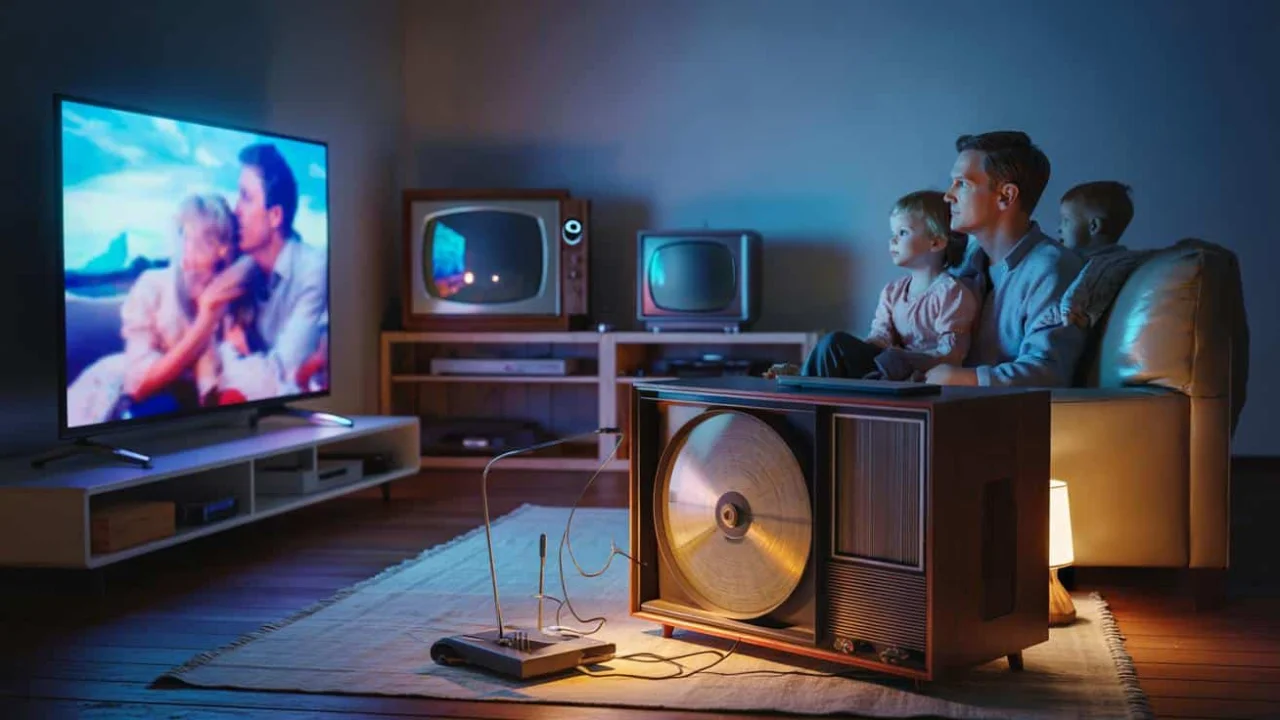
Sarah was cleaning out her grandmother’s attic last weekend when she found something that stopped her in her tracks. Tucked behind dusty boxes sat an enormous wooden cabinet with a tiny screen no bigger than her smartphone. Her grandmother shuffled up the creaky stairs and smiled. “That’s our first television,” she said softly. “Your grandfather saved for months to buy it in 1952. We’d gather the whole neighborhood just to watch fuzzy shapes move across that little screen.”

Today, as Sarah glances at the sleek 65-inch television dominating her own living room, she’s witnessing a quiet milestone. That magical box that once seemed like pure science fiction is celebrating its 100th birthday. On January 26, 1926, television took its first wobbly steps into existence, forever changing how humanity connects with stories, news, and each other.
The device that now streams endless content in crystal-clear 4K began as something far more humble and revolutionary than most people realize.
The Day Moving Pictures Traveled Through Wires
Picture a cluttered workshop in London’s Soho district, filled with the smell of hot metal and electrical components. Scottish inventor John Logie Baird nervously adjusted his contraption one more time before inviting a handful of scientists and journalists to witness something unprecedented.
The television demonstration on January 26, 1926, was nothing like the sleek entertainment centers we know today. Baird’s screen measured roughly the size of a postage stamp. The image flickered between dim gray tones, showing simple moving shapes that barely resembled recognizable objects.

“The quality was absolutely terrible by any standard we’d accept today,” explains technology historian Dr. Margaret Chen. “But for those witnesses, seeing any moving image transmitted remotely was like watching magic happen in real time.”
The mechanical television system relied on a spinning disc with holes arranged in a spiral pattern. As light hit a photoelectric cell, it converted visual information into electrical signals. Another spinning disc at the receiving end reconstructed those signals back into moving pictures.
What made this moment historic wasn’t the picture quality—it was proof that images could travel through wires and cables, opening possibilities that seemed straight out of science fiction novels.
How Television Conquered the World in 100 Years
The journey from Baird’s postage-stamp screen to today’s smart TVs represents one of the most dramatic technological transformations in human history. Here’s how television evolved through its first century:

| Era | Key Development | Screen Size | What Changed |
|---|---|---|---|
| 1926-1930s | Mechanical TV | 1-3 inches | First moving images transmitted |
| 1930s-1950s | Electronic TV | 5-12 inches | Clearer pictures, regular broadcasts |
| 1950s-1980s | Mass adoption | 19-27 inches | Color TV, multiple channels |
| 1990s-2000s | Digital revolution | 32-50 inches | Cable, satellite, DVD players |
| 2010s-Present | Smart TV era | 55-85+ inches | Streaming, internet connectivity |
The transformation wasn’t just about bigger screens or sharper pictures. Each decade brought fundamental changes to how families experienced entertainment:
- 1940s-1950s: Families gathered around single TV sets, sharing viewing experiences together
- 1960s-1980s: Color broadcasting made programs more engaging and realistic
- 1990s-2000s: Cable and satellite expanded choices to hundreds of channels
- 2010s-Present: Streaming services let viewers watch anything, anytime, anywhere
“We’ve gone from appointment viewing—where everyone watched the same show at the same time—to completely personalized entertainment experiences,” notes media analyst Robert Torres. “Your grandmother’s TV brought communities together. Today’s TVs often separate us into individual content bubbles.”
What Television’s Century Means for Your Daily Life
The television sitting in your living room today bears little resemblance to Baird’s experimental device, yet it still serves the same fundamental purpose: bringing distant images and sounds into your personal space.
Consider how television has quietly shaped nearly every aspect of modern life. News happens faster because TV networks can broadcast breaking stories instantly. Political campaigns spend billions on television advertising because moving images influence voters more powerfully than print ads ever could.
Sports became global spectacles because television could transport viewers to stadiums thousands of miles away. Cooking shows taught generations of home cooks. Educational programs brought university-level instruction into living rooms worldwide.
“Television didn’t just change entertainment—it fundamentally altered how information flows through society,” explains communications professor Dr. Lisa Park. “Everything from fashion trends to political movements spreads differently in a world where moving images can reach millions of people simultaneously.”
The economic impact tells an even bigger story. The television industry now generates over $180 billion annually in the United States alone. Streaming services like Netflix and Amazon Prime have created entirely new categories of employment, from content creators to algorithm engineers.
Even the physical design of homes changed because of television. Living rooms got rearranged around TV placement. Family dinner conversations shifted as news broadcasts provided shared talking points. Children’s daily schedules adjusted around cartoon programming blocks.
Looking ahead, television continues evolving at breakneck speed. Today’s smart TVs can recognize voices, suggest content based on viewing habits, and integrate with home automation systems. Some analysts predict that within another decade, traditional TV screens might disappear entirely, replaced by augmented reality displays or holographic projections.
“We’re probably closer to the beginning of television’s story than the end,” suggests futurist technology researcher Dr. James Wright. “The next 100 years of television might make today’s streaming seem as primitive as Baird’s mechanical discs appear to us now.”
As you settle onto your couch tonight and reach for that familiar remote control, take a moment to appreciate the century of innovation humming quietly in front of you. That glowing rectangle represents one hundred years of human creativity, connecting your living room to a global network of stories, information, and shared experiences that would have seemed impossible in 1926.
FAQs
When exactly was television invented?
John Logie Baird demonstrated the first working television system on January 26, 1926, marking television’s official birth date.
How big was the first television screen?
Baird’s original television had a screen roughly the size of a postage stamp, showing dim, flickering black and white images.
Who really invented television?
Television wasn’t invented by one person but developed through decades of work by multiple inventors including Baird, Philo Farnsworth, and Vladimir Zworykin.
When did most families get their first TV?
Television ownership exploded in the 1950s, with most American families acquiring their first TV set between 1950 and 1960.
How has television changed family life?
Television initially brought families together for shared viewing experiences but has gradually shifted toward individual, personalized entertainment consumption.
What’s next for television technology?
Future TV innovations may include augmented reality integration, holographic displays, and even more personalized content delivery systems powered by artificial intelligence.
About the Author
