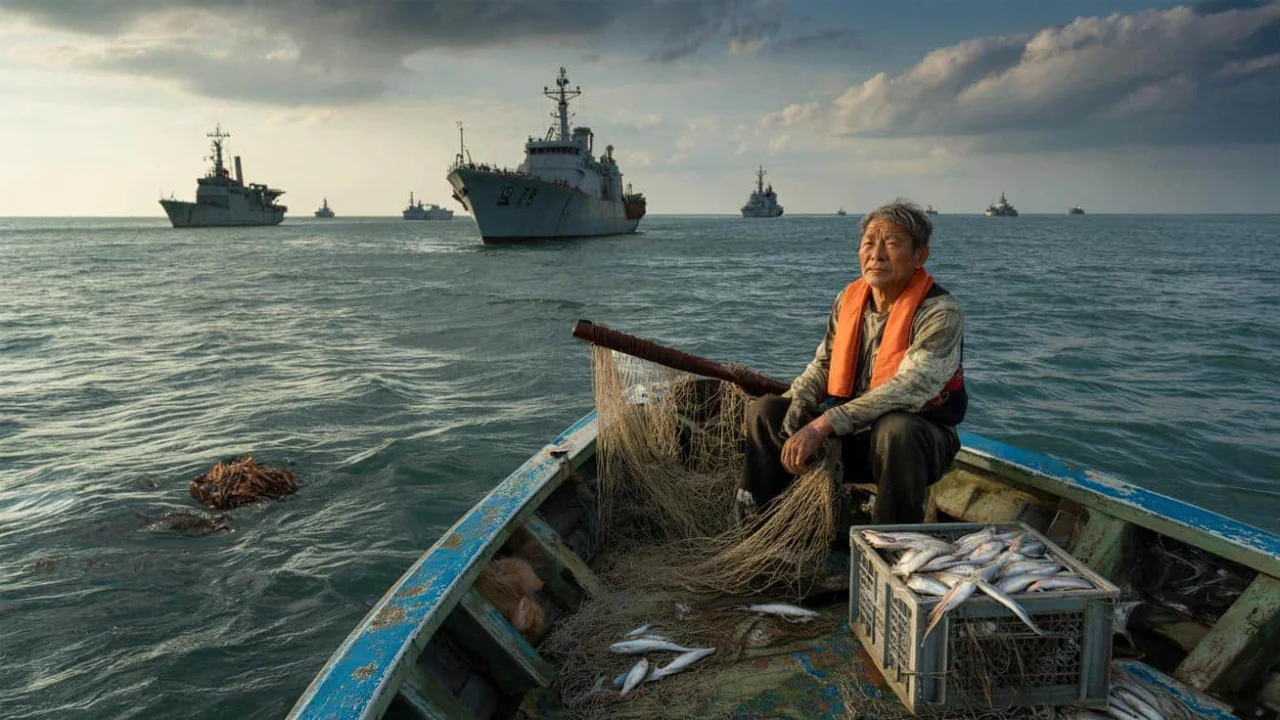
Chen Wei pulls his weathered fishing boat into Pingtan harbor just as the sun breaks through morning fog. He’s been working these waters for thirty years, following the same routes his father taught him. But today, like most days lately, his nets are nearly empty.

“Used to catch enough yellowtail to feed three families,” he says, coiling rope with practiced hands. “Now I’m lucky to fill a single bucket.” The reason isn’t overfishing or climate change, though both play a part. It’s the constant thrum of military vessels patrolling what used to be his most productive fishing spots.
Chen points toward the horizon where Taiwan sits just 80 miles away. “That’s where the big fish used to run. Now it’s where the missiles fly.” His story isn’t unique. Across China’s military waters, from the South China Sea to the Taiwan Strait, fishing families are watching their ancestral hunting grounds transform into strategic battlefields.

When Military Strategy Meets Marine Ecosystems
China’s military expansion into contested waters has created an environmental crisis that goes far beyond displaced fishermen. The transformation of fishing grounds into missile testing zones represents one of the most dramatic reshaping of marine ecosystems in modern history.
Since 2016, China has dramatically increased military activities across approximately 1.4 million square miles of contested waters. This expansion includes regular missile tests, naval exercises, and the establishment of permanent exclusion zones that have fundamentally altered marine life patterns.

“We’re seeing fish populations shift away from traditional spawning grounds,” explains Dr. Sarah Martinez, a marine biologist who has studied the region for over a decade. “The constant noise pollution from naval operations disrupts migration patterns that have existed for thousands of years.”
The impact extends beyond just fish. Coral reefs, which serve as nurseries for countless species, are suffering from increased ship traffic, anchor damage, and pollution from military vessels. Seagrass beds that filter water and provide habitat are being destroyed by propeller wash from patrol boats.

The Numbers Tell a Stark Story
The scale of military activity in China’s contested waters has reached unprecedented levels. Here’s how the militarization is reshaping marine environments:
| Military Activity | Frequency | Marine Impact |
|---|---|---|
| Missile Tests | Weekly in Taiwan Strait | Noise disrupts whale migration |
| Naval Exercises | Monthly large-scale drills | Fishing boats excluded from 40% of traditional grounds |
| Patrol Operations | Daily presence | Constant engine noise affects fish behavior |
| Sonar Training | 3-4 times weekly | Disrupts dolphin echolocation systems |
The environmental cost includes:

- 65% decline in traditional fishing yields in contested areas since 2018
- Documented changes in migration routes of three major fish species
- 30% reduction in coral reef health near military installation sites
- Increased plastic and fuel pollution from military vessels
- Displacement of fishing communities affecting over 200,000 people
“The military sees water as strategic space to control,” notes Professor James Liu, who studies maritime security at National Taiwan University. “Marine life sees it as home. Those two perspectives are incompatible.”
Beyond the immediate noise and disruption, military activities introduce pollutants that accumulate in the food chain. Fuel spills from naval vessels, abandoned equipment, and weapons testing residue create long-term contamination that affects everything from plankton to apex predators.
Real Families, Real Consequences
The transformation of China military waters affects more than statistics and species counts. It’s changing the lives of real people who depend on the sea for survival.
Take the fishing village of Dongshan, where families have worked the same waters for generations. Local fisherman Wang Ming describes how military exclusion zones have cut his fishing area by more than half. “My grandfather’s fishing maps are useless now,” he says. “Half the spots are off-limits, and the other half are too dangerous with all the patrol boats.”
The economic impact ripples through entire coastal communities. Fish markets that once bustled with fresh daily catches now struggle to fill their stalls. Restaurants that specialized in local seafood are importing from distant waters at much higher costs.
“We’re not just losing fish,” explains Lin Mei, who runs a seafood processing plant in Fujian Province. “We’re losing a way of life that connected us to these waters for centuries.”
Marine scientists worry the changes could be permanent. Dr. Martinez points out that fish populations that abandon traditional areas may never return, even if military activities decrease. “Once you disrupt migration patterns that have evolved over millennia, you can’t just flip a switch and bring them back.”
The situation creates a feedback loop where declining fish populations justify further military expansion. As fishing becomes less viable, coastal communities lose their voice in opposing military development. Empty fishing grounds become easier to claim for strategic purposes.
International observers note that China’s approach differs from other nations’ military activities. While all navies impact marine environments, the scale and permanence of exclusion zones in contested waters represents something new.
“Previous generations of fishermen adapted to seasonal changes, weather patterns, and natural fluctuations,” says environmental historian Dr. Chen Xiaoli. “But they never had to adapt to their fishing grounds becoming permanent military zones.”
The story playing out in China’s contested waters reflects broader tensions between military security and environmental protection. As geopolitical competition intensifies, marine ecosystems become collateral damage in struggles for strategic dominance.
For fishermen like Chen Wei, the choice is simple: adapt or leave. Many are choosing to leave. The boats that remain venture farther from shore, use more fuel, and catch fewer fish. The sea that once provided abundance now offers only uncertainty.
Standing on Pingtan’s pier at sunset, you can still see fishing nets drying in the evening light. But there are fewer nets now, and the boats that use them venture into waters that feel less like home and more like a battlefield where marine life has become an unintended casualty of military ambition.
FAQs
How do military activities specifically harm marine life?
Military sonar and engine noise disrupts fish communication, navigation, and feeding patterns, while fuel pollution and equipment damage coral reefs and seagrass beds.
Are fishing communities being compensated for lost access to traditional waters?
Most fishing families receive no compensation for exclusion from military zones, forcing them to find new fishing grounds or abandon the profession entirely.
Can marine ecosystems recover once military activities decrease?
Recovery is possible but can take decades, and some changes like altered migration patterns may become permanent if disruption continues long enough.
How large are the military exclusion zones around contested waters?
Exclusion zones vary but can extend 50-100 nautical miles from military installations, covering areas equivalent to entire traditional fishing territories.
Do other countries create similar environmental impacts with military activities?
While all naval operations affect marine life, the scale and permanence of exclusion zones in China’s contested waters represents an unusually large environmental impact.
What happens to local fishing economies when traditional grounds become military zones?
Fishing yields typically drop 40-70%, forcing boats to travel farther for smaller catches, ultimately making fishing economically unviable for many families.
About the Author