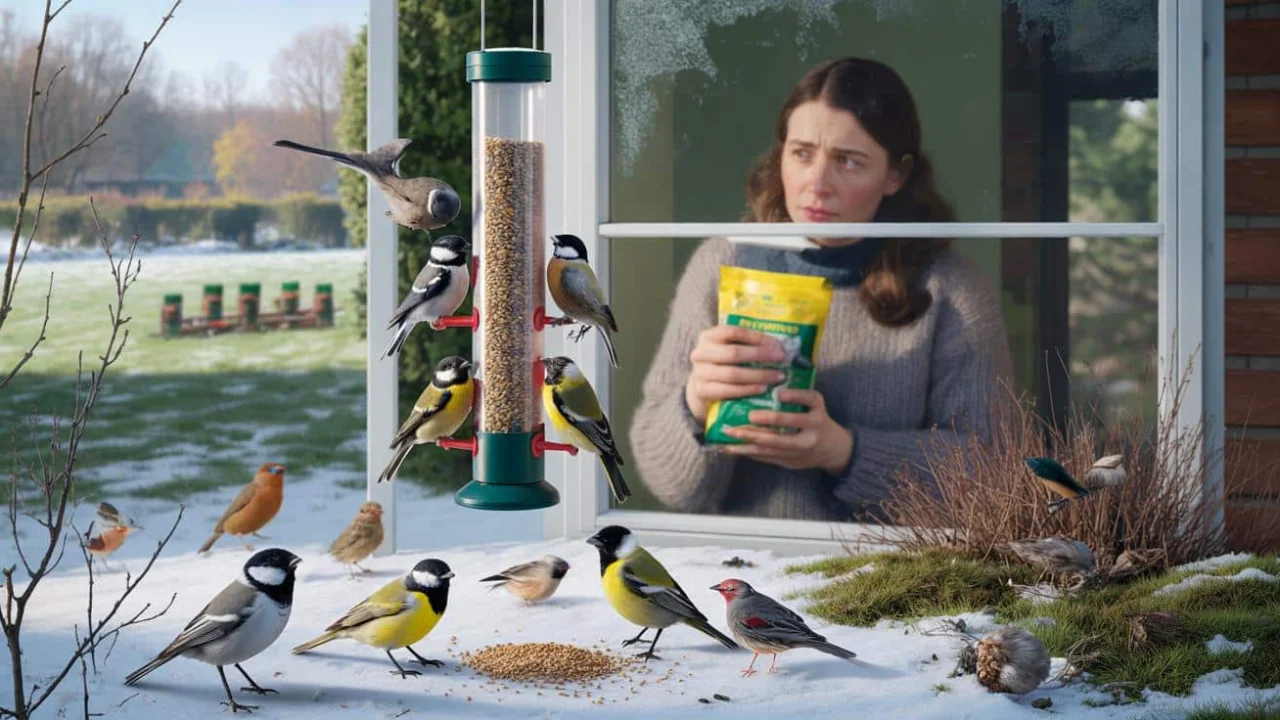
Sarah first noticed something was wrong when the robin stopped coming. For three winters, the same red-breasted bird had perched outside her kitchen window every morning, waiting for his handful of mealworms. Then one February day, he just wasn’t there.

What she found instead was a cluster of house sparrows monopolizing the feeder, aggressive and territorial in ways that seemed different from before. The gentle ritual she’d cherished—her morning coffee paired with quiet bird watching—had turned into something that felt more like a cafeteria brawl.
Sarah’s story echoes in gardens across the country, where winter bird feeding has become as routine as checking the weather. But behind those cozy scenes of birds gathering at backyard feeders lies a scientific debate that’s making some researchers deeply uncomfortable.

The Unintended Consequences of Winter Kindness
When we fill those feeders with sunflower seeds and suet balls, we think we’re performing a simple act of mercy. Birds need calories to survive winter’s harsh grip, and we have plenty to spare. The math seems straightforward enough.
But spend time with the researchers tracking bird populations across Europe, and you’ll hear a different story emerging. Dr. Marcel Klaassen from Deakin University puts it bluntly: “We’re not just feeding birds anymore—we’re accidentally redesigning them.”

The evidence has been building quietly for decades. In areas where winter bird feeding is heaviest, certain species aren’t just surviving better—they’re evolving differently. British great tits, for instance, have developed longer beaks in regions with dense feeder networks. These longer beaks make them more efficient at extracting seeds from plastic dispensers, giving them a survival edge that gets passed down through generations.
Meanwhile, birds that can’t adapt to human feeding stations find themselves increasingly marginalized. The shy species, the ones that prefer natural foraging, get pushed further from suburban areas where food is abundant but only accessible to those bold enough to approach human dwellings.

What the Science Actually Shows
The research reveals patterns that should make any bird lover pause. Here’s what multiple long-term studies across the UK and Netherlands have documented:
- Evolutionary pressure: Birds with traits suited to artificial feeding (longer beaks, bolder behavior) are reproducing more successfully
- Population shifts: Some species become overly dependent on feeders, with reduced natural foraging skills
- Disease concentration: Feeders create hotspots where avian diseases spread rapidly
- Behavioral changes: Birds alter migration patterns and breeding cycles around reliable food sources
- Competition intensification: Dominant species increasingly exclude weaker ones from feeding areas

The numbers tell a stark story when you look at disease transmission rates:
| Disease | Natural Spread Rate | At Feeding Stations |
|---|---|---|
| Trichomonosis | 2-5% of population | 15-25% of population |
| Salmonella | 1-3% of population | 8-12% of population |
| Avian Pox | 3-7% of population | 12-18% of population |
Dr. Kate Plummer from the British Trust for Ornithology explains: “When you concentrate birds around artificial food sources, you’re essentially creating the perfect conditions for pathogens to jump between individuals. It’s like comparing a small dinner party to a packed stadium.”
The Real-World Impact on Bird Populations
Walk through any suburban neighborhood on a winter morning, and you’ll see the effects playing out in real time. The feeders are busy, but look closely at which birds dominate the scene. You’ll likely see the same species over and over: blue tits, great tits, house sparrows, starlings. The birds that have learned to thrive in our reimagined ecosystem.
But where are the yellowhammers? The tree sparrows? The species that once shared these same gardens but couldn’t adapt to our well-intentioned intervention?
The concern isn’t just about individual birds getting sick or strong species bullying weak ones. It’s about the gradual reshaping of entire ecosystems around human convenience. We’re inadvertently selecting for birds that can live alongside us while filtering out those that can’t.
“The irony is profound,” notes Dr. James Pearce from Cardiff University. “People start feeding birds because they love wildlife diversity. But over time, that feeding can actually reduce the variety of species in their gardens.”
Some regions are already seeing dramatic shifts. In parts of Scotland, bird populations near heavy feeding areas show 40% less species diversity than similar habitats without feeders. The effect compounds over generations as evolutionary pressures favor “feeder-adapted” traits.
For gardeners and bird enthusiasts, this creates an uncomfortable dilemma. The birds that visit their feeders clearly benefit in the short term—they’re fatter, survive harsh winters better, and often produce more offspring. But the broader ecological picture suggests we might be trading long-term resilience for short-term survival.
The most troubling aspect might be dependency. Birds that grow up relying on feeders show reduced foraging skills compared to their wild counterparts. When feeders are removed or people move away, these populations can crash dramatically.
This isn’t a call to abandon winter bird feeding entirely—millions of birds genuinely benefit from our support during harsh weather. But it does suggest we need to think more carefully about how we help. Maybe it’s about providing occasional supplements rather than daily buffets. Perhaps it’s about offering more diverse, natural food sources rather than just convenient seed mixes.
The birds outside our windows aren’t asking us to stop caring. They’re just reminding us that caring well requires understanding the full consequences of our kindness. Even the most generous hearts can accidentally create the problems they’re trying to solve.
FAQs
Should I stop feeding birds in winter?
No, but consider feeding occasionally rather than daily, and clean feeders regularly to prevent disease spread.
Which birds are most affected by feeder dependency?
Great tits, blue tits, and house sparrows show the strongest behavioral changes, while ground-feeding species like robins are often pushed out.
How often should I clean bird feeders?
Clean feeders weekly with a 10% bleach solution, and remove moldy or spoiled food immediately.
Are there better alternatives to traditional bird feeding?
Plant native berry-producing shrubs, leave seed heads on flowers, and create natural shelter areas in your garden.
What diseases should I watch for in garden birds?
Look for birds that appear lethargic, have difficulty flying, show visible swellings, or sit motionless for extended periods.
Does winter bird feeding really change evolution?
Yes, studies show measurable genetic changes in bird populations over just a few decades in areas with heavy feeding activity.
About the Author