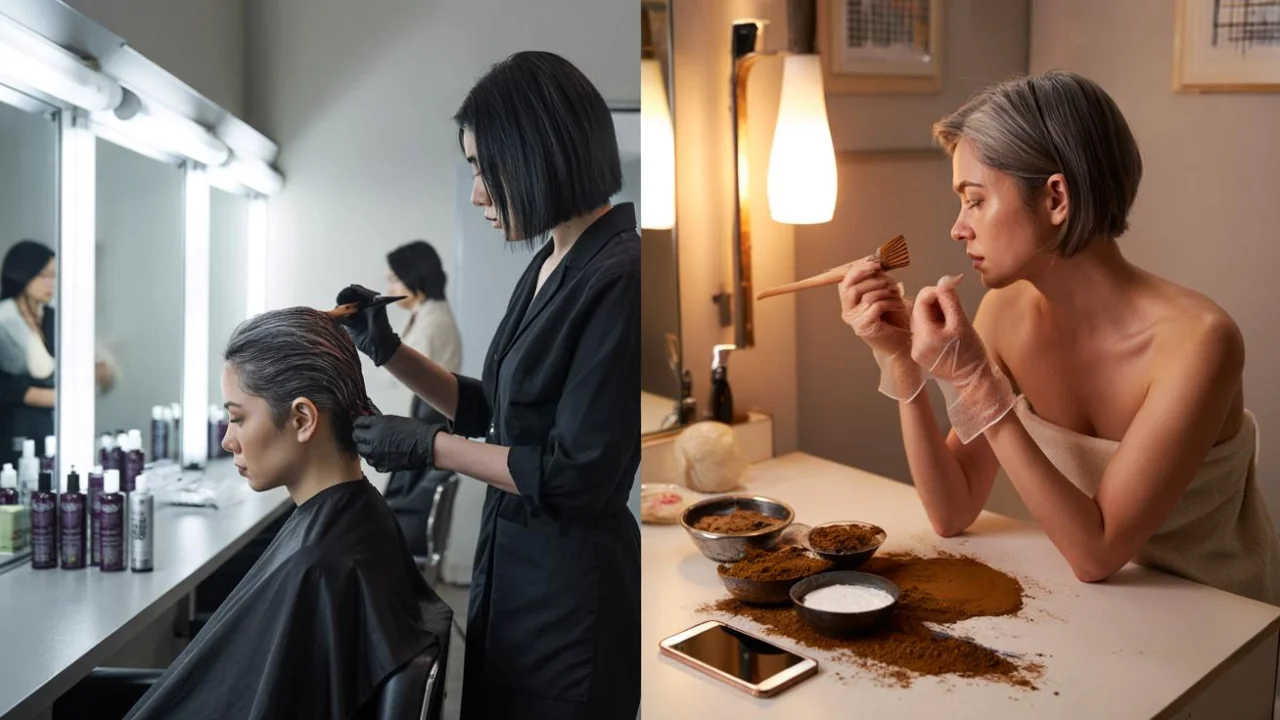
Sarah stares at her reflection, grey roots peeking through like rebellious silver threads. The salon appointment she booked three weeks ago sits forgotten in her calendar. Instead, her kitchen counter holds an odd collection: henna powder, black tea bags, and coconut oil. Her sister swears this homemade hair dye remedy turned her greys into rich auburn streaks without a single chemical burn.

But as Sarah scrolls through conflicting reviews online, the excitement fades. One woman praises her “natural transformation.” The next warns about scalp irritation that lasted weeks. Between the glowing testimonials and horror stories, Sarah realizes she’s caught in the middle of a beauty revolution that has professionals seriously worried.
The question isn’t just about covering grey hair anymore. It’s about whether kitchen-made solutions can really replace decades of salon expertise, and what happens when millions of people decide to find out.

The homemade hair dye phenomenon splitting the beauty world
Walk into any hair salon today and you’ll hear whispered conversations about mysterious kitchen concoctions. Clients casually mention “that viral recipe” they saw on social media, while stylists try to hide their concern behind professional smiles.
The homemade hair dye remedy trend centers around simple ingredients most people already have at home. The most popular versions combine henna powder with strong coffee, black tea, or even turmeric to create thick pastes that promise to cover grey hair naturally.

“I’ve had three clients this month ask me about DIY hair treatments they found online,” says Maria Rodriguez, a colorist with 15 years of experience. “They want to know if mixing coffee grounds with coconut oil will really give them salon-quality results.”
The appeal is obvious. These homemade mixtures cost a fraction of salon treatments and avoid harsh chemicals like ammonia and hydrogen peroxide. For people with sensitive skin, pregnancy concerns, or tight budgets, kitchen remedies seem like perfect solutions.
But behind the social media success stories lies a growing debate about safety, effectiveness, and whether “natural” always means better.
What’s really in these viral grey hair solutions
The most popular homemade hair dye remedy recipes share several common ingredients, each promising different benefits for covering grey hair naturally.

| Ingredient | Purpose | Potential Issues |
|---|---|---|
| Henna Powder | Primary coloring agent, creates reddish-brown tones | Can interact badly with previous chemical dyes |
| Strong Black Coffee | Adds darker tones, enhances depth | Temporary results, can stain skin |
| Black Tea | Natural darkening agent | Very subtle effects, requires multiple applications |
| Coconut Oil | Moisturizes hair, helps mixture spread | Can make hair greasy, difficult to wash out |
| Essential Oils | Scent, claimed conditioning benefits | Common allergens, can cause skin reactions |
Dr. Jennifer Walsh, a dermatologist specializing in scalp conditions, points out a crucial concern: “People assume natural ingredients can’t cause harm, but some of the most potent allergens come from plants. Henna, for example, can cause severe contact dermatitis in sensitive individuals.”
The most concerning trend involves recipes that add ingredients like turmeric, cinnamon, or even lemon juice to enhance color results. While these might work for some people, they can also cause:
- Severe scalp irritation and burning
- Allergic reactions ranging from mild redness to blistering
- Unpredictable color results that fade unevenly
- Hair texture changes that damage the cuticle
- Interactions with previous chemical treatments
Professional colorists worry most about people who don’t patch test these mixtures before applying them to their entire head. Unlike regulated hair dyes, homemade remedies have no standardized formulations or safety testing.
The real-world impact on salons and consumers
The surge in DIY hair coloring is reshaping the beauty industry in unexpected ways. Some salons report a 20-30% drop in grey coverage appointments, while others are adapting by offering “natural” coloring consultations.
“I’ve started keeping henna in the salon because so many clients ask about it,” explains colorist James Chen. “If they’re going to try natural alternatives anyway, I’d rather guide them through it safely than have them show up later with damaged hair.”
But the divide goes deeper than lost revenue. Professional stylists argue that years of training and color theory can’t be replaced by viral videos and kitchen experiments. They point to cases where DIY attempts went wrong, requiring expensive corrective treatments.
Consumer experiences vary dramatically. Lisa Murphy, a 38-year-old mother of two, credits her homemade hair dye remedy with saving both money and her scalp health: “I was spending $150 every six weeks at the salon and still getting irritation from the chemicals. Now I spend $20 every two months on henna and coffee, and my hair feels stronger.”
Conversely, marketing executive Tom Bradley learned about the risks the hard way: “I tried a turmeric and henna mixture I found online. Within hours, my scalp was burning and swollen. It took three weeks and a dermatologist visit to clear up the reaction.”
Dermatologists report seeing more patients with scalp issues related to DIY hair treatments. Dr. Sarah Kim notes: “The concerning part isn’t that people want natural alternatives. It’s that they’re not treating these substances with the same caution they’d use for chemical dyes.”
The trend has also created a new market for “natural” hair coloring products that promise the benefits of homemade remedies with more consistent results. However, these still lack the rigorous testing and regulation of traditional hair dyes.
For the beauty industry, this shift represents more than changing consumer preferences. It challenges fundamental assumptions about expertise, safety standards, and what “professional” really means in an age where information spreads instantly online.
FAQs
Are homemade hair dye remedies actually safer than commercial products?
Not necessarily. While they avoid certain chemicals, natural ingredients can still cause allergic reactions and scalp irritation, especially without proper testing.
How long do results from homemade hair dyes typically last?
Most homemade remedies provide temporary to semi-permanent results, lasting 2-6 weeks depending on hair type and the specific ingredients used.
Can I use homemade hair dye if I’ve previously used chemical hair color?
This can be risky, especially with henna-based mixtures, which may react unpredictably with chemical residue in your hair. Always consult a professional first.
What should I do before trying any homemade hair dye remedy?
Always perform a patch test 24-48 hours before full application, and consider consulting with a dermatologist if you have sensitive skin or scalp conditions.
Do professional stylists ever recommend DIY hair treatments?
Some do, particularly for clients with chemical sensitivities, but they typically prefer to supervise the process or recommend professionally formulated natural alternatives.
Why are dermatologists concerned about this trend?
They’re seeing more patients with scalp reactions from untested DIY treatments, and worry that people assume “natural” automatically means “safe.”
About the Author