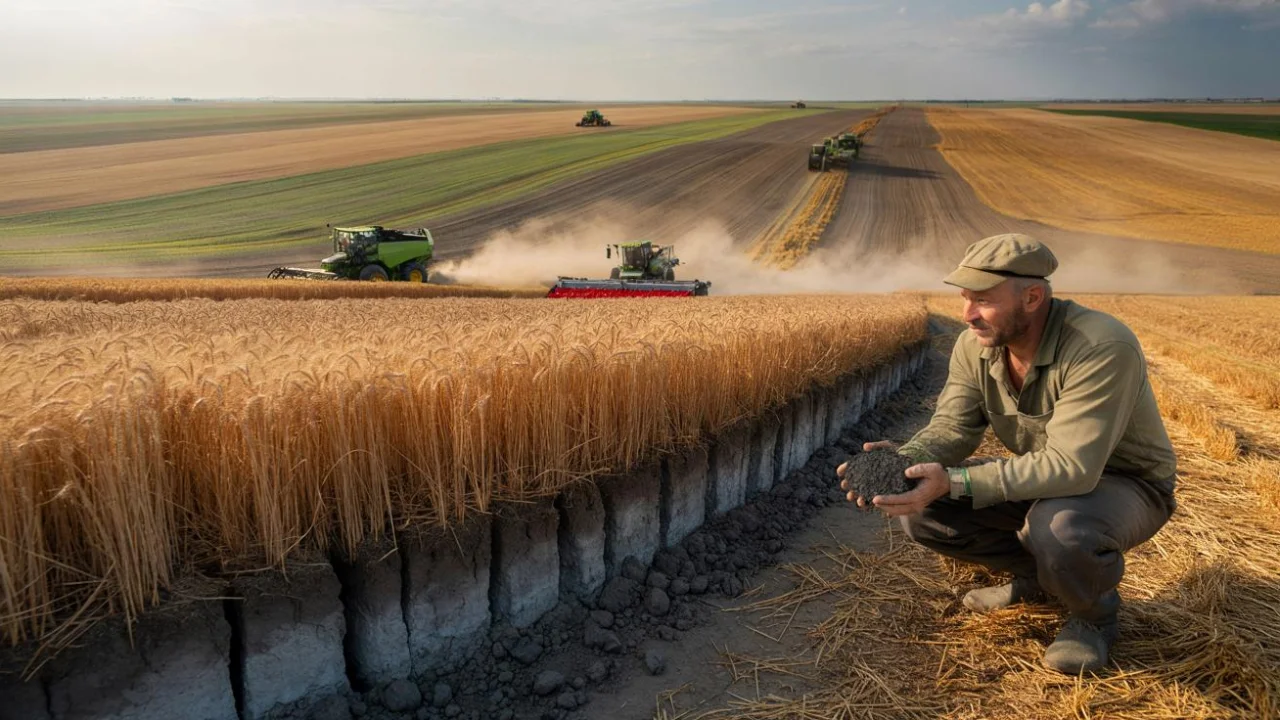
Maria Petrenko remembers the day her grandfather taught her to read the soil. She was eight years old, standing barefoot in their family farm outside Kharkiv, when he scooped up a handful of earth so black it looked like crushed velvet. “This,” he whispered, letting it slip through his weathered fingers, “is why empires have fought over our land.” The soil stained her small palms dark for hours, no matter how hard she scrubbed.

That was thirty years ago. Today, Maria runs the same farm, watching massive combines harvest wheat from fields that stretch to the horizon. But something has changed. The soil that once clung to her boots like thick chocolate now blows away in dust clouds during dry summers.
She’s witnessing the slow disappearance of chernozem soil—the “black gold” that built agricultural empires and still feeds much of the world.

The Black Earth That Changed History
Chernozem soil isn’t just dirt. It’s a geological masterpiece that took thousands of years to create. Stretching across Ukraine, southern Russia, and northern Kazakhstan like a dark ribbon visible from space, this extraordinary soil reaches depths of up to one meter—sometimes more in the most fertile pockets.
The word “chernozem” literally means “black earth” in Russian, but scientists know it by its incredible statistics. With organic matter content reaching 8-12% in prime locations, it makes regular farmland look barren by comparison. Most agricultural soils around the world contain just 2-3% organic matter.

“I’ve tested soils across five continents, and nothing comes close to the richness of Ukrainian chernozem,” says Dr. Viktor Medvedev, a soil scientist who has spent four decades studying these black fields. “It’s like comparing a shallow puddle to a deep lake.”
This natural wonder formed over millennia as deep-rooted prairie grasses grew, died, and decomposed in the region’s unique climate. Each growing season added another microscopic layer of organic matter, building up the thick, dark horizon that makes crops thrive even during droughts.

What Makes Chernozem the World’s Most Valuable Soil
The numbers behind chernozem soil tell an incredible story of natural abundance:
| Characteristic | Chernozem Soil | Average Farmland |
|---|---|---|
| Organic matter content | 8-12% | 2-3% |
| Depth of fertile layer | 80-150 cm | 20-30 cm |
| Water retention capacity | Very high | Moderate |
| Natural fertility | Extremely high | Low to moderate |
| Humus formation time | 5,000+ years | 1,000-2,000 years |
The soil’s superpowers go beyond just feeding plants. Its structure works like a massive sponge, soaking up rainfall during wet periods and slowly releasing moisture during droughts. The deep root channels left by ancient grasses create natural drainage systems that prevent both flooding and water stress.
- Nutrient density: Contains naturally high levels of nitrogen, phosphorus, and potassium
- pH balance: Maintains optimal acidity levels for most crops without chemical amendments
- Soil structure: Crumb-like texture allows excellent air and water movement
- Biological activity: Supports vast communities of beneficial microorganisms
- Carbon storage: Holds enormous amounts of atmospheric carbon in organic matter
“When you plant wheat in chernozem, you’re basically giving your crop a five-star hotel room,” explains Elena Kozlova, an agricultural consultant who works with farms across the region. “Everything the plant needs is already there, perfectly balanced by nature.”
The Crisis Hiding Beneath the Harvest
But this agricultural paradise faces a growing threat. Modern farming practices are slowly destroying what took millennia to build. Intensive agriculture, heavy machinery, and changing weather patterns are causing chernozem soil to disappear at an alarming rate.
Erosion has become the silent killer. Wind strips away topsoil during dry periods, while heavy rains wash precious organic matter into rivers and streams. Some Ukrainian fields have lost 20-30 centimeters of their black layer since the Soviet era—representing centuries of natural soil formation vanishing in just decades.
The statistics paint a sobering picture of what’s at stake. Ukraine alone has lost an estimated 15% of its chernozem depth over the past 50 years. In heavily farmed areas of Russia and Kazakhstan, erosion rates have accelerated dramatically since the introduction of large-scale mechanized farming.
“We’re mining the soil like a mineral resource,” warns Dr. Anatoly Shevchenko, a soil conservation specialist. “Every ton of grain we export contains a piece of our chernozem that took 500 years to form.”
Climate change adds another layer of stress. Longer droughts make the soil more vulnerable to wind erosion, while intense storms create devastating water runoff. Rising temperatures also speed up the decomposition of organic matter, reducing the very substance that makes chernozem so special.
The consequences extend far beyond individual farms. These three countries produce roughly 40% of the world’s sunflower oil, 25% of global wheat exports, and significant portions of corn and barley. Any degradation of their soil directly affects global food security and prices.
Yet hope remains. Progressive farmers are adopting conservation practices that could preserve this black gold for future generations. Cover crops, reduced tillage, and rotation systems help maintain soil structure and organic matter. Some Ukrainian farms have even started using traditional methods alongside modern technology—planting prairie grass strips between fields and allowing natural regeneration periods.
“My grandfather knew something we forgot,” reflects Maria Petrenko, watching the sunset paint her fields golden. “The soil isn’t just a tool for growing crops. It’s a living system that needs care and respect.”
The fate of chernozem soil may determine whether the world’s breadbaskets can continue feeding a growing global population—or whether this black gold will become just another environmental casualty of industrial agriculture.
FAQs
What exactly is chernozem soil?
Chernozem is an extremely fertile, dark-colored soil found mainly in Ukraine, Russia, and Kazakhstan, formed over thousands of years by decomposing grassland vegetation.
Why is chernozem soil so much better than regular farmland?
It contains 8-12% organic matter compared to 2-3% in typical agricultural soils, reaches depths of up to one meter, and naturally provides all the nutrients crops need.
How long does it take for chernozem to form naturally?
Scientists estimate it takes about 500 years to build just one centimeter of chernozem soil through natural processes.
Is chernozem soil really disappearing?
Yes, erosion and intensive farming have caused Ukraine alone to lose approximately 15% of its chernozem depth over the past 50 years.
Can chernozem soil be restored once it’s lost?
While extremely difficult and time-consuming, conservation farming practices like cover cropping and reduced tillage can help maintain and slowly rebuild chernozem soil.
How does chernozem soil loss affect global food prices?
Since Ukraine, Russia, and Kazakhstan produce about 25% of global wheat exports using chernozem soil, any degradation directly impacts world food supplies and prices.
About the Author