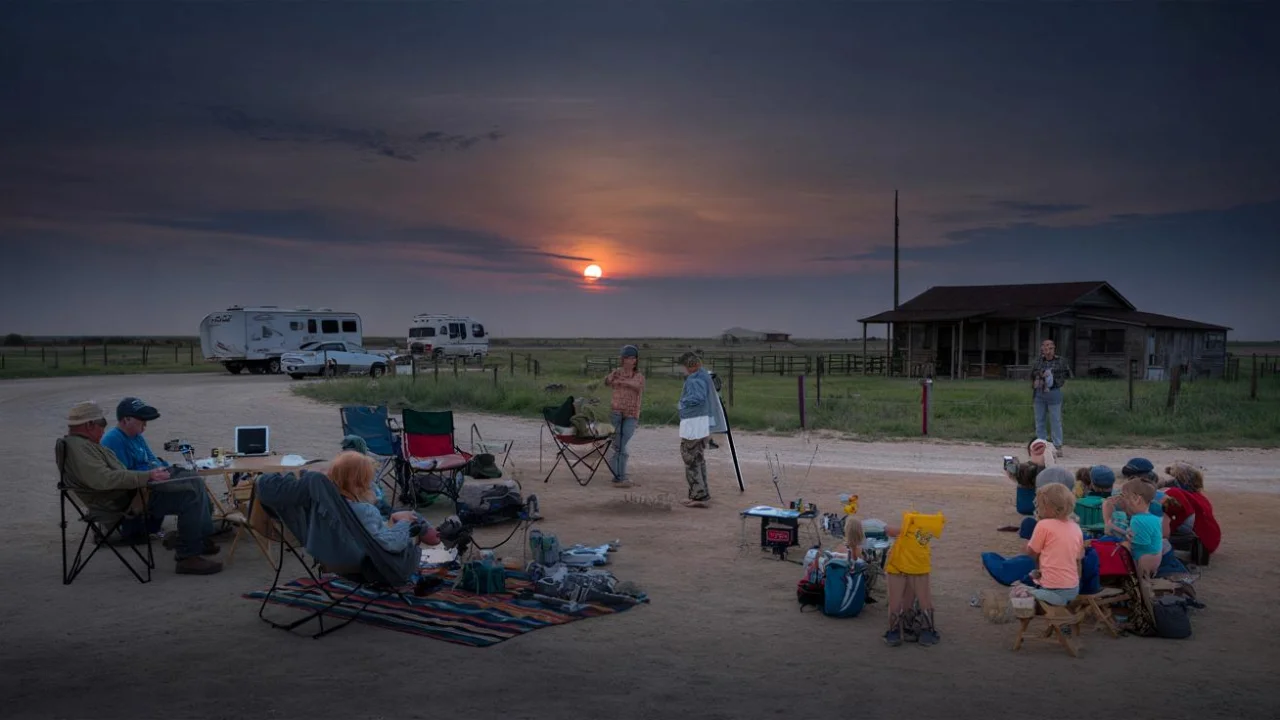
Maria Gonzalez had lived on the same ranch outside of Kerrville, Texas for thirty-seven years. She’d seen droughts, floods, and everything in between. But nothing prepared her for the morning she found three strangers with expensive cameras standing in her pasture, arguing about “optimal solar corona visibility.”

They offered her $15,000 for eight hours of access to her land. One day. Six minutes of darkness. More money than her cattle brought in all of last spring.
That’s when it hit her: the total solar eclipse wasn’t just an astronomical event anymore. It had become the ultimate real estate transaction, where the sky itself was for sale to the highest bidder.

When Science Meets the Gold Rush
A total solar eclipse happens roughly every 18 months somewhere on Earth. But for any specific location, you’re looking at an average wait time of 375 years. This April’s eclipse cut a path across North America that included some of the most populated and accessible regions in decades.
The result? The perfect storm of scientific opportunity, tourism frenzy, and local disruption.

“We’ve never seen anything quite like this,” explains Dr. Sarah Chen, an astronomer who has chased eclipses across five continents. “Usually, totality happens over remote areas or oceans. This time, it’s crossing major cities and tourist-friendly locations. Everyone wants in.”
The path of totality – that narrow band where observers experience complete darkness – became more valuable than beachfront property. Hotels that normally charged $89 a night were asking $800. Airbnb hosts in small Texas towns watched their modest guest rooms turn into goldmines.

But underneath all the excitement, a quieter conflict was brewing. Who really deserves those precious few minutes when day turns to night?
The Battle for Prime Viewing Territory
The competition for eclipse viewing spots revealed three distinct camps, each with compelling arguments for priority access:
- Scientific researchers – Universities and observatories planning experiments that require specific atmospheric conditions
- Tourism industry – Tour operators, cruise lines, and travel companies promising customers the experience of a lifetime
- Local residents – People who live in the path of totality year-round, suddenly dealing with massive crowds in their backyard
The scientific case seemed strongest at first glance. Research teams had spent years preparing specialized equipment to study the sun’s corona, solar wind patterns, and atmospheric changes during totality. Some experiments could only be conducted during these brief windows of darkness.
“This isn’t just sightseeing for us,” says Dr. Michael Torres, who leads a solar physics lab at a major university. “We’re trying to solve mysteries about space weather that could affect satellite communications and power grids. But we need clear skies and stable conditions.”
Tourism advocates pushed back with economic arguments. The eclipse was projected to generate over $1 billion in economic activity across the path of totality. Small communities that rarely saw outside visitors were suddenly booking hotel rooms two years in advance.
| Stakeholder Group | Primary Argument | Economic Impact |
|---|---|---|
| Scientists | Advancing human knowledge | Long-term research benefits |
| Tourism Industry | Economic opportunity | $1+ billion in direct spending |
| Local Residents | Rights to their own community | Property value increases |
| Eclipse Chasers | Personal passion/hobby | Travel and accommodation costs |
When Your Hometown Becomes a Destination
The human cost of eclipse tourism hit hardest in small communities. Towns with populations under 5,000 suddenly faced the prospect of hosting tens of thousands of visitors for a single day.
Infrastructure became the first casualty. Rural roads designed for local farm traffic couldn’t handle the influx of rental cars and RVs. Cellular networks crashed under the load of thousands of people trying to livestream the eclipse simultaneously.
But the social impact cut even deeper.
“My kids couldn’t get to their soccer practice because someone from California had rented our community center’s parking lot,” recalls Jennifer Walsh, a mother of three in rural Texas. “I’m happy for the local economy, but it felt like we were being pushed out of our own town.”
Some communities tried to strike a balance. They designated specific areas for scientific research, created viewing zones for tourists, and reserved spaces for local families. Others simply closed public areas entirely, forcing visitors to pay private landowners for access.
Property owners found themselves in impossible positions. Saying no to thousands of dollars for a day’s use of their land was financially difficult. Saying yes meant dealing with traffic, parking, waste disposal, and potential property damage.
“I had a family offer me $3,000 to set up chairs in my front yard,” explains rancher Tom Martinez. “My mortgage payment is $1,800 a month. How do you turn that down? But then I thought about my neighbors, my community. Where does it end?”
The Lasting Shadow
The eclipse lasted six minutes. The debates about who deserved access will echo much longer.
Some communities emerged stronger, having successfully managed the influx while maintaining their character. Others are still recovering from overwhelmed infrastructure and strained relationships between longtime residents and newcomers.
The scientific community gathered valuable data, though not always from their preferred locations. Tourism operators mostly delivered on their promises, despite logistical challenges. Local residents experienced everything from financial windfalls to complete disruption of their daily lives.
“The next total solar eclipse crossing the U.S. won’t happen until 2045,” notes astronomy educator Lisa Park. “By then, we’ll either have learned how to share these moments better, or we’ll repeat the same conflicts on an even larger scale.”
Perhaps the real lesson isn’t about who deserves front-row seats to a total solar eclipse. It’s about how we balance scientific advancement, economic opportunity, and community well-being when the extraordinary collides with the everyday.
The moon moved on, indifferent to our human squabbles below. But the questions it left in its shadow remain: How do we share wonder? Who gets to profit from nature’s rarest shows? And what happens to small communities when the whole world wants to visit on the same day?
FAQs
How often do total solar eclipses happen?
Total solar eclipses occur somewhere on Earth about every 18 months, but any specific location typically waits 300-400 years between events.
Why was this eclipse such a big deal for tourism?
This eclipse passed over highly populated and accessible areas of North America, making it much easier for people to travel and witness totality compared to eclipses over remote locations.
How much money did eclipse tourism generate?
The eclipse was projected to generate over $1 billion in economic activity across the path of totality, from hotel bookings to restaurant sales.
Did scientists get priority access to viewing areas?
It varied by location – some communities reserved space for research teams, while others operated on a first-come, first-served basis or auction system.
How did small towns handle the massive influx of visitors?
Responses varied widely, from comprehensive planning and designated viewing areas to simply closing public spaces and leaving visitors to negotiate with private landowners.
When will the next total solar eclipse cross the United States?
The next total solar eclipse to cross the United States won’t occur until 2045, making this event particularly significant for American eclipse watchers.
About the Author